
Skip to content
Atlas Anatolia
Dig
NewsIce Age teeth in Sulawesi push betel-nut use back as far as 25,000 yearsRoman mosaic and Eros head uncovered in the basilica at Pompeiopolis, Kastamonu
Megalithic stone facade and trilithon entrance portal of the Ġgantija Temples in Xagħra, Gozo, Malta

Wikimedia Commons (CC BY-SA 3.0)

Country Record

Oldest Sanctuary in Malta

SanctuaryUNESCOFeatured

Ġgantija

Seyfi Cem Baskin

3600 BCE – 2500 BCE

Megalithic temple complex on the island of Gozo constructed between 3600 and 3200 BCE, recognized as one of the world’s oldest free-standing stone religious structures. Its colossal coralline limestone perimeter walls predate both Stonehenge and the Egyptian pyramids by over a millennium.

211
Interest 62

Location

Malta

36.05°N · 14.27°E · Europe

Chronology

Constructed c. 3600–3200 BCE, predating the Great Pyramid of Giza and Stonehenge by over a millennium

Megalith Scale

Outer boundary slabs reach 5.7 meters in length and exceed 50 tonnes in individual weight

Temple Layout

Dual sanctuary: 5-apse South Temple (older) and 4-apse North Temple enclosed in a continuous D-shaped wall

Ritual Finds

Carved libation holes, animal sacrifice hearths (sheep, goats, bovids), and red ochre painted wall plaster

UNESCO

Inscribed 1980 (criterion iv, ref. 132), anchoring the Megalithic Temples of Malta serial property

“Ġgantija represents a revolutionary turning point in prehistoric human architecture: the emergence of monumental, freestanding ceremonial stone buildings with interior chambers centuries before the invention of the wheel or bronze metallurgy.”

Location

Overview

The megalithic sanctuary of Ġgantija stands on the edge of the Xagħra plateau on the island of Gozo in Malta. Constructed during the Neolithic Ġgantija phase (c. 3600–3200 BCE) and utilized continuously through the Tarxien phase until approximately 2500 BCE, the complex consists of two adjacent multi-apsed temples enclosed within a single continuous D-shaped boundary wall. Some of the outer coralline limestone megaliths measure over 5 meters in length and weigh upwards of 50 tonnes, leading later folklore to attribute their construction to a mythical giantess, Sunsuna.

The South Temple is the older, grander structure (c. 3600 BCE), laid out along a five-apse trefoil plan with an elevated central corridor leading through monumental megalithic trilithon gateways. The North Temple, erected alongside it around 3200 BCE, features an intimate four-apse arrangement. Both monuments demonstrate advanced stereotomic planning: dual layers of masonry combine hard, weather-resistant Coralline limestone for the external load-bearing facades with softer, fine-grained Globigerina limestone for interior altars, decorative doorframes, libation basins, and decorative pitted screens.
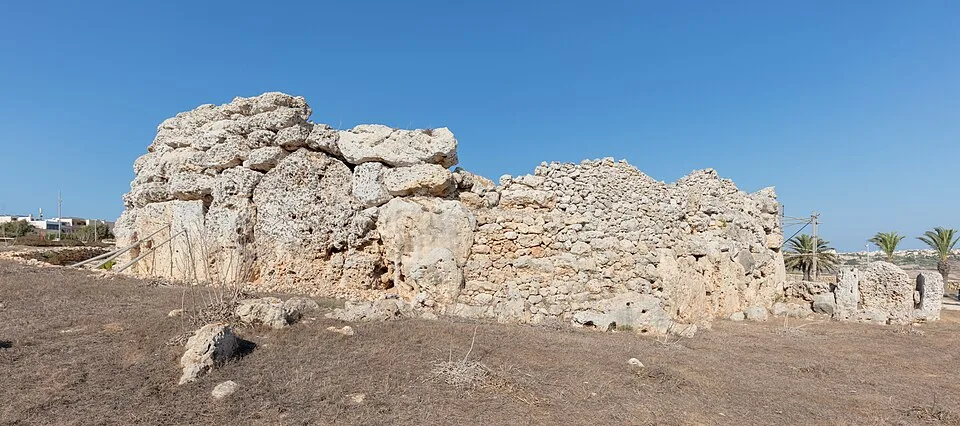
Templo de Ġgantija, isla de Gozo, Malta, 2021-08-23, DD 37
Templo de Ġgantija, isla de Gozo, Malta, 2021-08-23, DD 37 | Diego Delso (CC BY-SA 4.0)
"A giantess named Sansuna ate nothing but broad beans and honey; bearing a child upon her shoulders, she built these towers of enormous stones in a single night."
— Gozo island oral tradition on the building of Ġgantija (recorded by early Maltese antiquarians)

The site was first cleared of debris in 1827 under the direction of John Otto Bayer, the British Lieutenant-Governor of Gozo, and was drawn in detail by artist Charles de Brochtorff before modern weathering accelerated. Scientific excavations were undertaken in the 1930s by Luigi Ugolini and in the 1950s by John Davies Evans and David H. Trump (1954–1955). Between 1987 and 1994, the landmark Cambridge Gozo Project directed by Caroline Malone, Anthony Bonanno, and Colin Renfrew excavated the nearby Xagħra Stone Circle (Brochtorff Circle), discovering a subterranean hypogeum with collective burials, stone statuettes, and mortuary offerings that conclusively linked the temple rituals to an island-wide religious community.
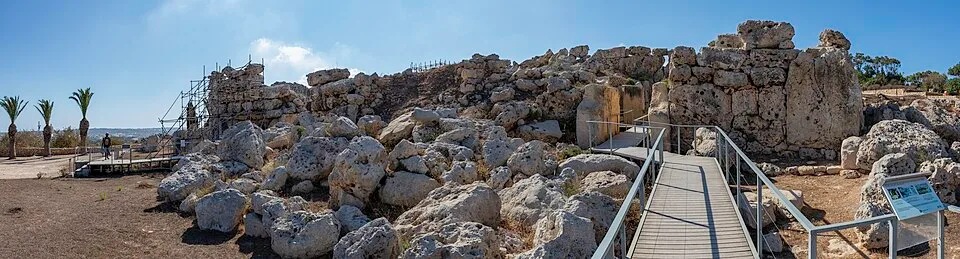
Templo de Ġgantija, isla de Gozo, Malta, 2021-08-23, DD 19-24 PAN
Templo de Ġgantija, isla de Gozo, Malta, 2021-08-23, DD 19-24 PAN | Diego Delso (CC BY-SA 4.0)

Ġgantija was inscribed as a UNESCO World Heritage Site in 1980 (ref. 132), establishing the listing that was later expanded in 1992 to include the five other prehistoric Maltese temples. Placed in dialogue with Ħaġar Qim and the subterranean Ħal Saflieni Hypogeum on Malta, as well as the earlier hunter-gatherer enclosures at Göbekli Tepe and Britain’s later Stonehenge, Ġgantija documents the earliest phase of monumental stone architecture in the Mediterranean.
Why It Matters

Ġgantija represents a revolutionary turning point in prehistoric human architecture: the emergence of monumental, freestanding ceremonial stone buildings with interior chambers centuries before the invention of the wheel or bronze metallurgy. Its exceptional preservation provides direct physical evidence for Neolithic workforce mobilization, corbelled ceiling engineering, sacrificial animal feasting, and sophisticated ritual acoustic design on a small Mediterranean island.

Evidence & Interpretation

Distinguishing what is well-established from what remains debated.

Well-Established Facts

2
  • Radiocarbon dating of sealed charcoal and fauna samples from Trump and Evans’s excavations confirms primary sanctuary erection between 3600 and 3200 BCE.
  • Pitted decorative stone slabs, libation holes, and hearth deposits filled with charred animal bones prove continuous sacrificial rites and communal ritual feasting.

Scholarly Inferences

1
  • Progressive inward corbelling of surviving upper courses indicates the apses originally supported roofing, likely timber beam networks thatched with reeds or corbelled stone vaults.

Debated Interpretations

1
  • Whether the temple complex was primarily consecrated to a supreme Earth Mother fertility goddess or served as an ancestral territorial shrine remains an active archaeological debate.

Community Photos

Share your experience

Have you visited this site? Upload your photos to help others discover it.

Related Stories

How to cite this page

Atlas Anatolia. (3600). Ġgantija. Atlas Anatolia. https://atlasanatolia.com/site/ggantija

Content licensed CC BY-SA 4.0 — attribution required when reusing.

Graph

Connections to related sites and stories.

Sources

  • Mortuary Customs in Prehistoric Malta: Excavations at the Brochtorff Circle at Xagħra — Malone, Caroline; Bonanno, Anthony; Trump, David; Renfrew, Colin (2009)Link
  • The Prehistoric Antiquities of the Maltese Islands: A Survey — Evans, John Davies (1971)
  • UNESCO — Megalithic Temples of Malta (Ref. 132)Link

Frequently Asked Questions

Where is Ġgantija located?

Ġgantija is located in Malta.

How old is Ġgantija?

Ġgantija dates to approximately 3600 BCE – 2500 BCE.

Which civilizations are associated with Ġgantija?

Ġgantija is associated with the Megalithic European.

Why is Ġgantija important?

Ġgantija represents a revolutionary turning point in prehistoric human architecture: the emergence of monumental, freestanding ceremonial stone buildings with interior chambers centuries before the invention of the wheel or bronze metallurgy.

Is Ġgantija a UNESCO World Heritage Site?

Yes — Ġgantija is inscribed as a UNESCO World Heritage Site.