Overview
Göbekli Tepe is a Pre-Pottery Neolithic sanctuary on a barren limestone ridge in the Germuş mountains of southeastern Anatolia, about 15 kilometres northeast of the city of Şanlıurfa in modern Türkiye. Built and used roughly between 9600 and 8000 BCE, it is the oldest known monumental architecture on Earth — its great stone enclosures were raised more than six thousand years before Stonehenge and the Egyptian pyramids, and, astonishingly, before the invention of pottery, metal tools, the wheel, writing, or farming. Its discovery overturned one of the most basic assumptions about how human civilization began.
A discovery that rewrote prehistory
The mound was first noted in a 1963 survey by Istanbul University and the University of Chicago, but the carved stones poking through the surface were dismissed at the time as a medieval or Byzantine cemetery, and the site was left unexcavated for three decades. In 1994 the German archaeologist Klaus Schmidt, working with the German Archaeological Institute (DAI), revisited the hill, recognised that the "gravestones" were in fact the tops of massive prehistoric pillars, and began systematic excavation in 1995. Schmidt would devote the rest of his life to the site until his death in 2014; the work continues today under Necmi Karul of Istanbul University.
The enclosures and their T-shaped pillars
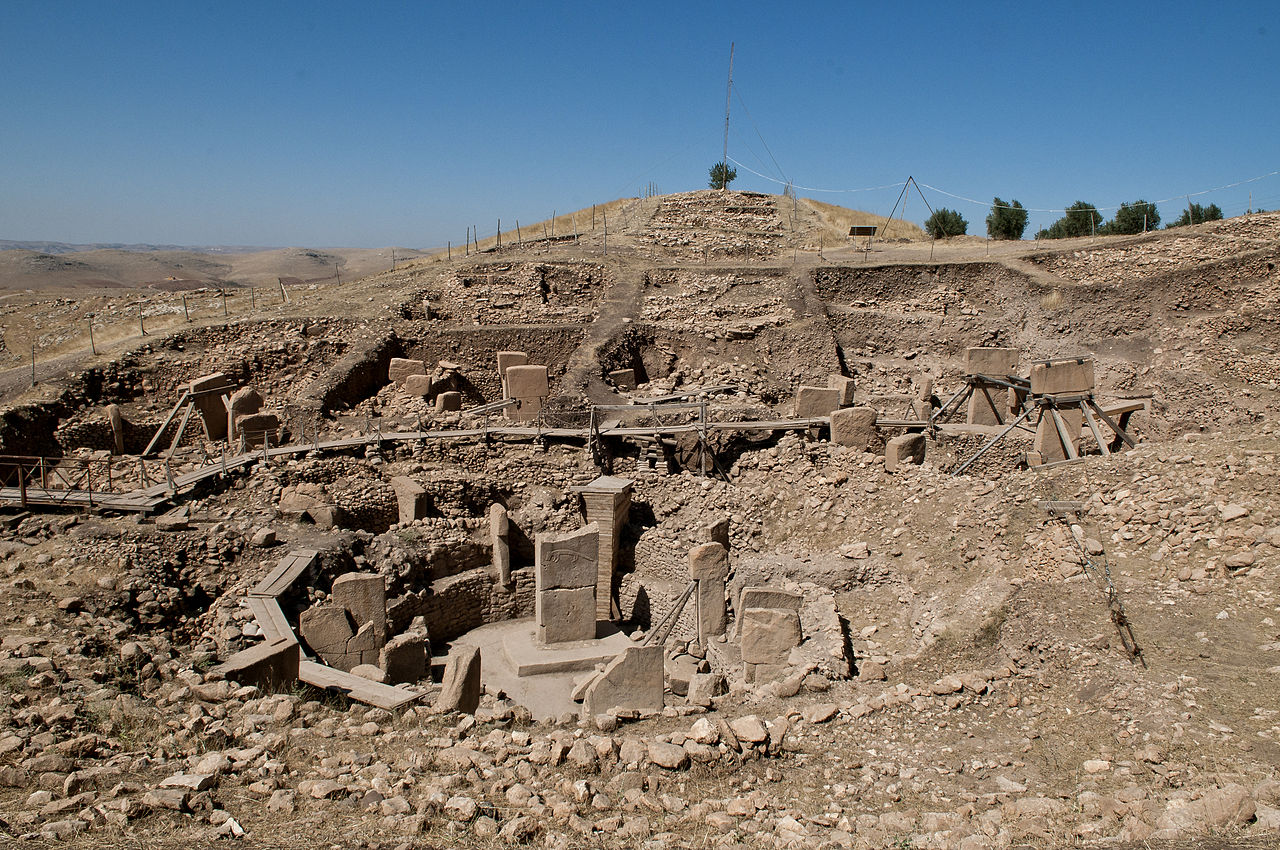
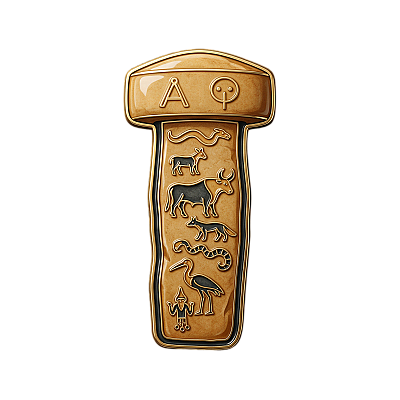
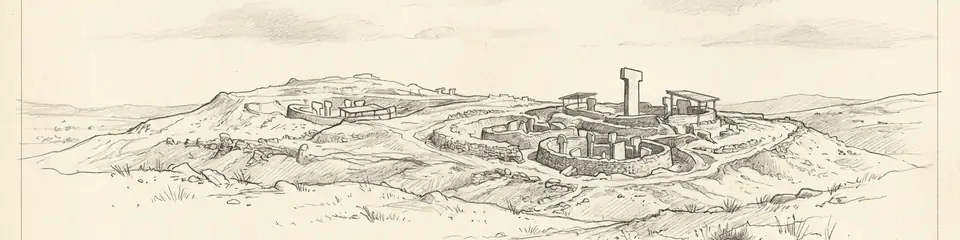
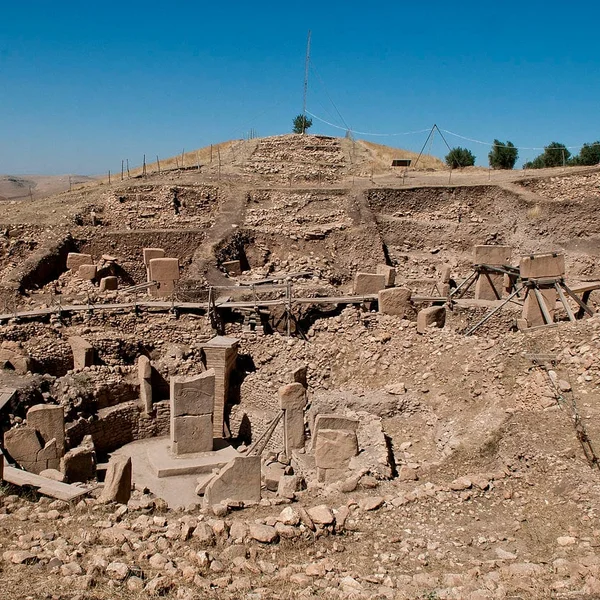
The heart of Göbekli Tepe is a series of large circular and oval enclosures, each defined by a ring of monumental T-shaped limestone pillars set into low stone walls and benches, with two still larger pillars standing free at the centre. The tallest of these central monoliths reach about 5.5 metres and weigh between 10 and 20 tonnes. Four major enclosures — labelled A, B, C and D — have been fully exposed, with Enclosure D the best preserved and most elaborate.
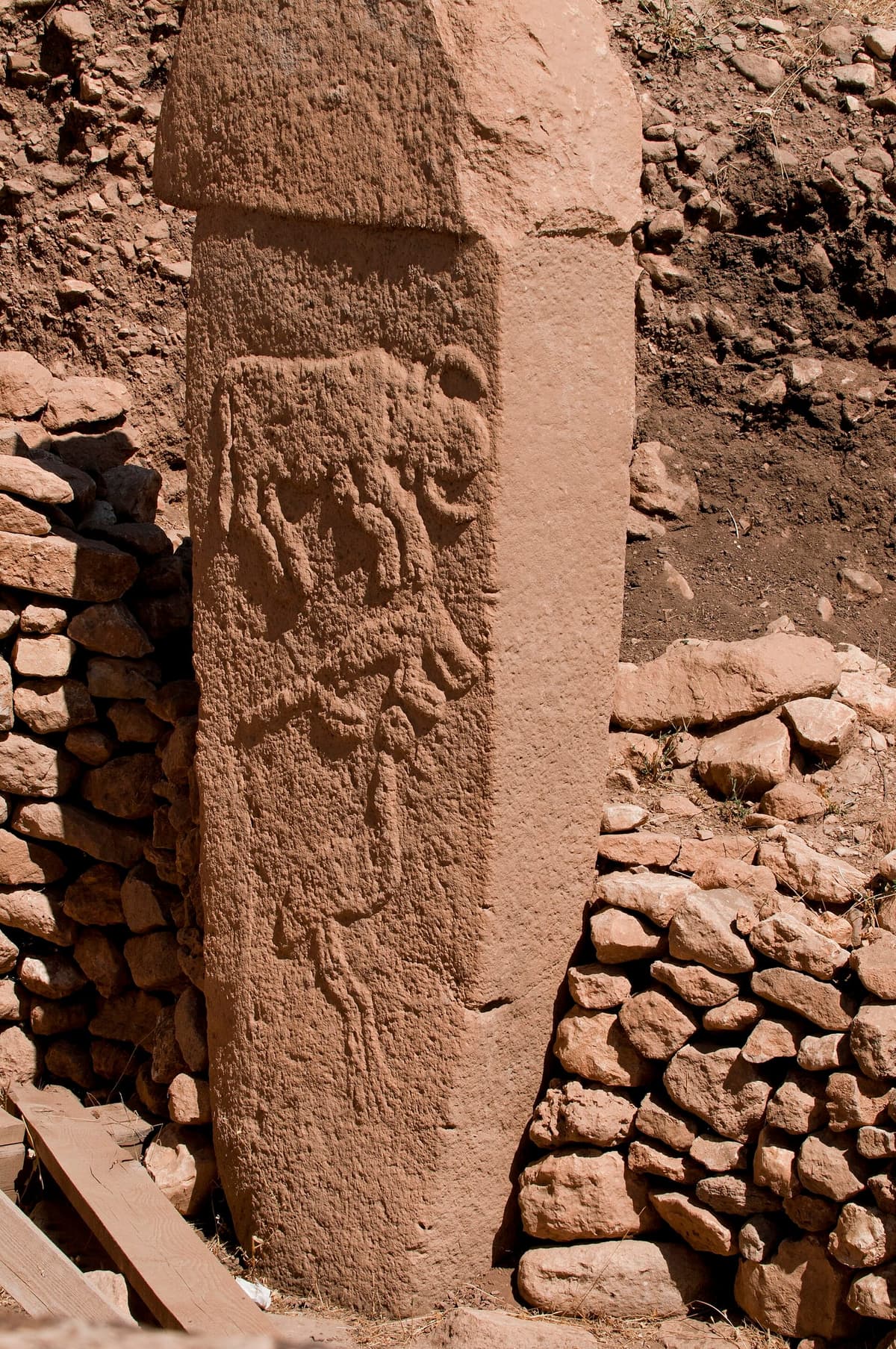
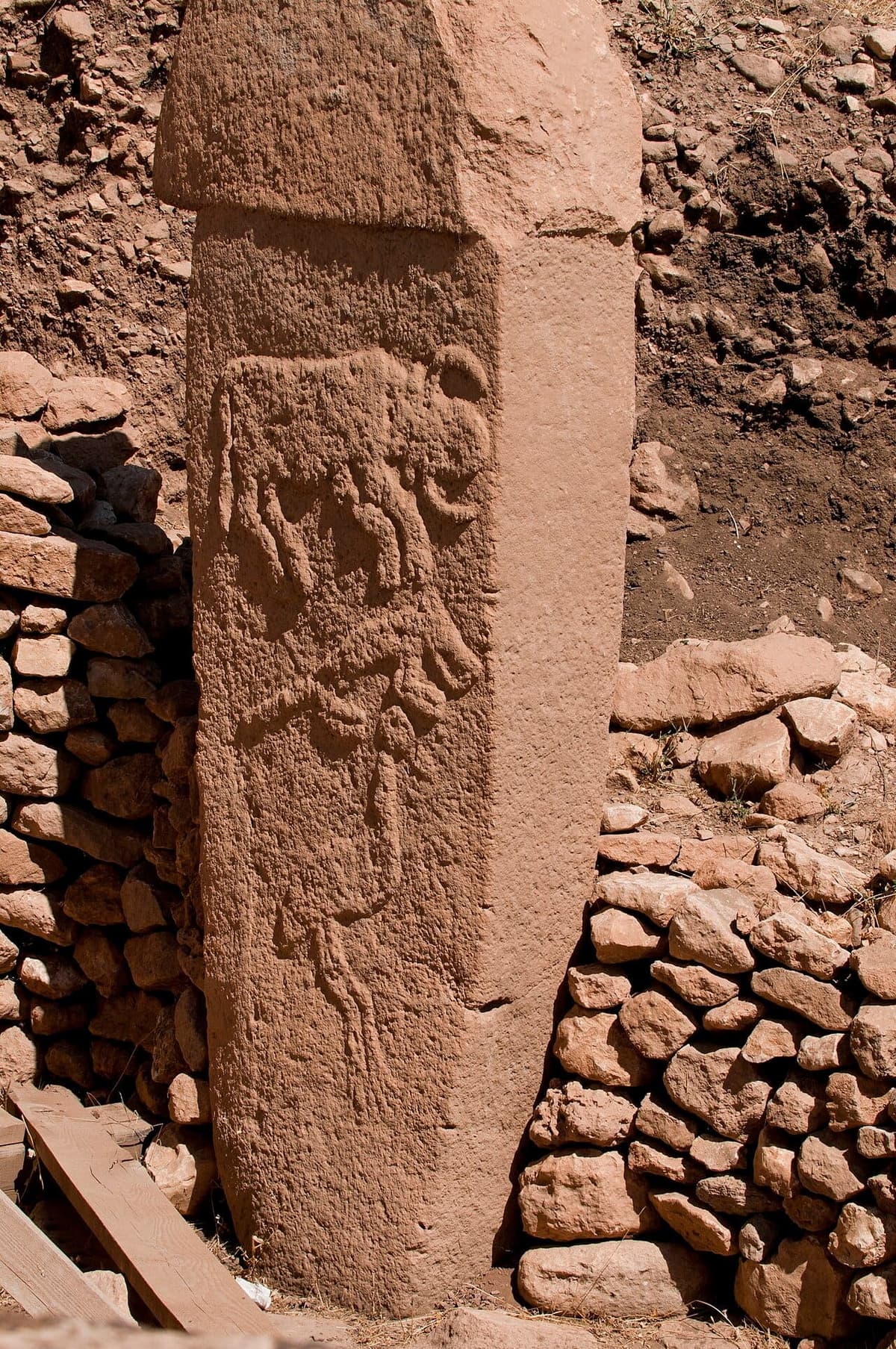
The distinctive T-shape is not arbitrary. Many pillars carry carved arms bent along their sides, hands meeting above a belt, and even loincloths — making clear that the pillars represent stylised human or supernatural beings, their flat tops standing in for heads. The two central pillars of each enclosure are the largest and most richly carved, suggesting they depicted especially important figures, perhaps ancestors or deities, around whom the smaller surrounding pillars were arranged like an assembly.
A bestiary carved in stone
The surfaces of the pillars are covered with some of the earliest monumental relief sculpture in the world. The carvings form a menagerie of dangerous and wild animals: foxes, boars, snakes, scorpions, spiders, wild boar, aurochs, gazelle, and birds including cranes and vultures. The famous Pillar 43 in Enclosure D — the so-called "Vulture Stone" — shows a vulture with outstretched wing above a disc, alongside scorpions and headless figures, a scene widely interpreted as relating to death and the afterlife. Abstract symbols also recur, including H-shaped signs, crescents, and curious "handbag" motifs that reappear at other contemporary sites across the region, hinting at a shared symbolic language whose meaning is now lost.
Built by hunter-gatherers, not farmers
What makes Göbekli Tepe revolutionary is who built it. Every line of evidence — the stone tools, the absence of pottery, and above all the tens of thousands of animal bones recovered from the site — points to a society of hunter-gatherers. The bones are entirely from wild species (gazelle, aurochs, wild boar, red deer, and birds); there are no domesticated animals, and no domesticated grain. These people had not yet taken up farming. Yet they quarried, carved, transported, and erected enclosures of a scale that scholars had long assumed required the surplus, settled life, and social hierarchy of an agricultural civilization.
Inverting the Neolithic Revolution
For most of the twentieth century the standard model held that agriculture came first: farming produced surplus food, surplus fed larger settled populations, and only then could societies afford priests, monuments, and organised religion. Göbekli Tepe stands that sequence on its head. Here, monumental ritual architecture clearly predates farming. Schmidt argued that the impulse to gather, feast, and build came first — and that the need to feed the crowds drawn to such places may itself have encouraged the domestication of wild cereals. Tellingly, genetic studies suggest that one of the world's first domesticated strains of einkorn wheat originated at Karacadağ, a volcanic massif visible from Göbekli Tepe and only about 30 kilometres away. In this reading, the temple helped give birth to the farm, rather than the other way around.
Construction, feasting, and labour
Raising these enclosures was an enormous communal undertaking for people without metal, draft animals, or the wheel. The pillars were quarried from the surrounding limestone bedrock using flint tools — one unfinished pillar, abandoned in its quarry, would have stood around 7 metres tall had it been completed. Moving and erecting blocks of up to 20 tonnes would have required the coordinated labour of hundreds of people, drawn from a wide area. The vast quantity of butchered wild-animal bone, together with very large limestone basins that some researchers believe held liquid (possibly an early fermented beverage), suggests that great communal feasts accompanied the building and use of the enclosures. Göbekli Tepe was, in this sense, a place people travelled to and gathered at — a ritual and social magnet for dispersed bands rather than an ordinary village.
The deliberate burial
One of the site's most striking features is how it ended. Rather than slowly collapsing or being abandoned to erosion, the great enclosures were deliberately and carefully backfilled — packed with rubble, flint debris, and animal bone — around 8000 BCE. This intentional burial sealed and protected the structures, which is precisely why they survive in such extraordinary condition today. Why the builders chose to inter their own monuments remains one of the central mysteries of the site.
Ongoing research and the Taş Tepeler
Despite decades of work, only a small fraction of Göbekli Tepe has been excavated. Ground-penetrating radar and geomagnetic surveys indicate that at least fifteen more large enclosures, and around two hundred pillars, still lie buried beneath the mound. Excavation continues under Necmi Karul, and Göbekli Tepe is now understood not as a lone marvel but as the most famous member of a whole cluster of related Neolithic sites across the Şanlıurfa region — the "Taş Tepeler," or Stone Hills. The most important of these sister sites is Karahan Tepe, whose excavation has revealed comparable T-pillars, carved human heads, and remarkable sculpture. Active debates continue over whether the enclosures were roofed, whether some served domestic as well as ritual functions, and whether their layout encodes any astronomical alignments.
Significance and visiting
Göbekli Tepe was inscribed as a UNESCO World Heritage Site in 2018, recognised as an outstanding testimony to the monumental architecture of the first sedentary or near-sedentary communities. A protective canopy now shelters the main excavation area, with elevated walkways allowing visitors to view the enclosures, and many of the finest carved finds are displayed in the nearby Şanlıurfa Archaeology Museum. For anyone trying to understand the deep origins of religion, social complexity, and civilization itself, Göbekli Tepe is among the most important archaeological sites ever discovered: the place where hunter-gatherers built the world's first temples, and where the story of how humanity settled down has had to be rewritten.