Overview
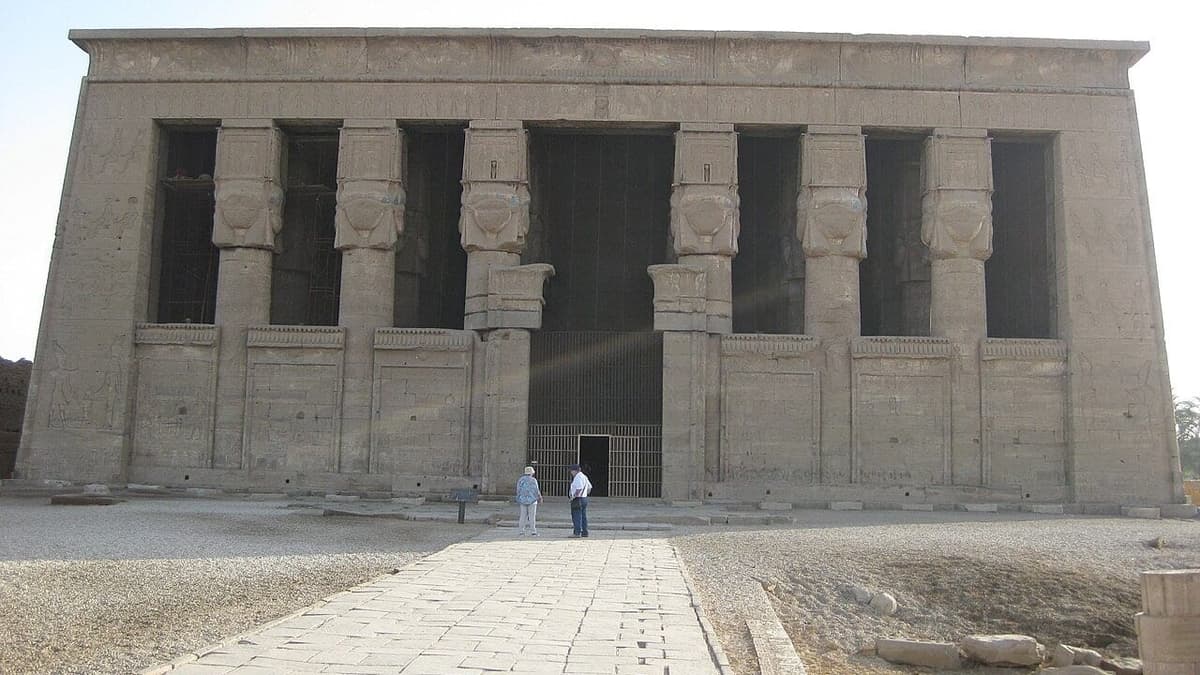
The Dendera Temple complex (ancient Egyptian Iunet or Tantere, Greek Tentyris) covers approximately 40,000 square meters on the west bank of the Nile in Upper Egypt, enclosed by a monumental 10-meter-thick mudbrick temenos wall. While religious activity on the site extends back to the Old Kingdom under Pepi I and saw shrines constructed by Mentuhotep II and Thutmose III, the standing architectural masterpiece visible today is the Great Temple of Hathor, largely constructed during the Ptolemaic and Roman periods between 380 BCE and the reign of Emperor Trajan (early 2nd century CE). Dedicated to Hathor—the goddess of joy, motherhood, fertility, music, and the cosmos—the complex represents the ultimate flowering of late dynastic temple architecture.
The centerpiece of Dendera is the monumental Pronaos (outer hypostyle hall), commissioned under Emperor Tiberius. Its facade features six massive columns linked by stone screen walls, opening into a grand hypostyle chamber supported by 24 colossal sistrum-headed columns adorned with the face of the cow-eared goddess Hathor. Because the hall was buried under protective sand dunes for centuries until excavated by Auguste Mariette in the mid-19th century, its soaring ceiling preserves astonishing original blue and gold polychrome paint. This astronomical ceiling is divided into seven registers illustrating the day and night skies, the decans, constellations, and the passage of the sun and moon barques across the body of the sky goddess Nut.
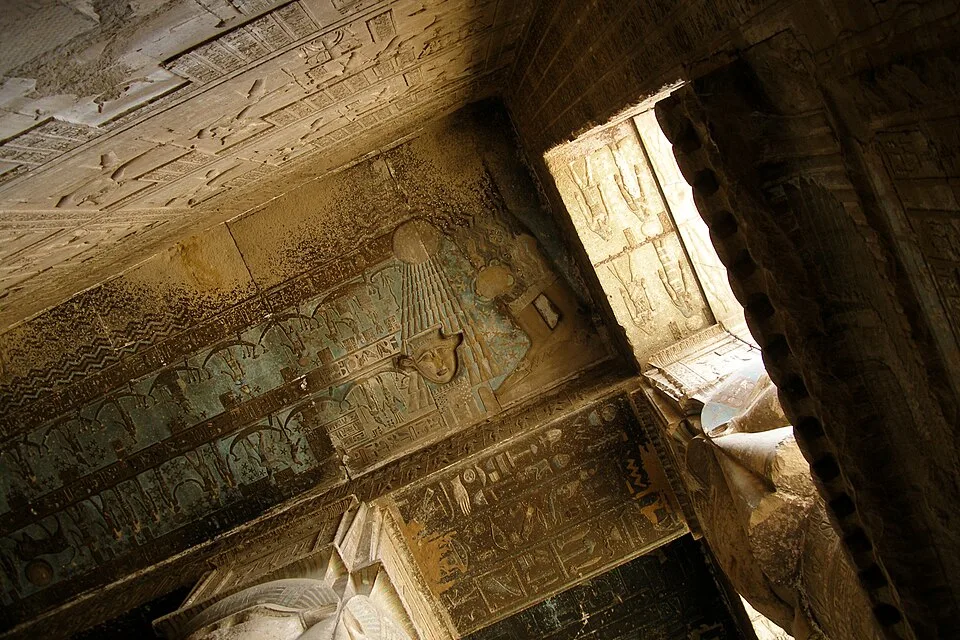
"The sky and its stars make music for thee, and the sun and the moon praise thee, O Golden One, mistress of joy, sovereign of the stars, who shines upon the temple of Iunet."
— Hymn to Hathor, Inscription in the Sanctuary of the Great Temple of Dendera (Ptolemaic period; Mariette, Dendérah)
Ascending the temple's straight and spiral staircases leads to the roof, which housed chapels dedicated to the annual "Union with the Sun Disk" festival and the resurrection of Osiris. In one of these rooftop chapels was carved the celebrated Dendera Zodiac, a bas-relief ceiling measuring 2.5 meters across that combined ancient Egyptian astrological decans with Hellenistic Babylonian zodiac constellations (Taurus, Aries, Scorpio, Leo) and planets. Cut from the ceiling in 1821 by French collector Sébastien Louis Saulnier, the original artifact now resides in the Musée du Louvre, while an accurate plaster cast remains in situ. Beneath the sanctuary floors lie twelve hidden subterranean crypts arranged on three levels; their narrow sandstone walls feature exceptionally crisp bas-reliefs depicting divine emblems, ceremonial boats, and the contentious "Dendera light" motifs (mythological representations of lotus flowers birthing snakes encased in djed-pillar supported stones).
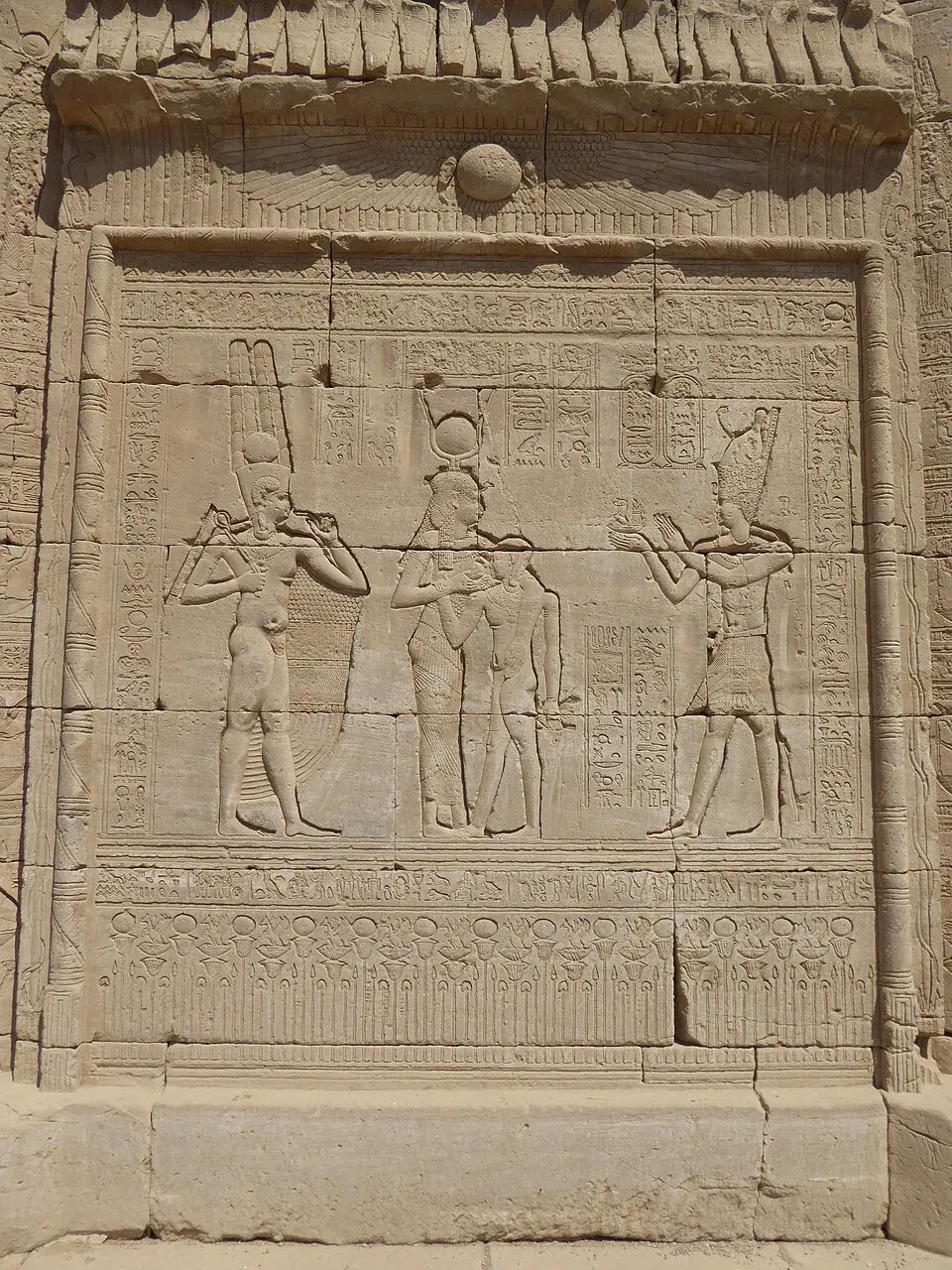
Surrounding the central Hathor Temple within the sacred enclosure are a series of vital secondary monuments: the Roman Mammisi (Birth House) built under Augustus and expanded by Trajan to celebrate the divine birth of Ihy; a 5th-century Christian basilica; a sacred lake bordered by palm trees; a sanatorium where pilgrims bathed in holy water for divine healing; and a domed mudbrick temple of Isis. On the southern exterior facade of the Hathor Temple, colossal bas-reliefs depict Queen Cleopatra VII Philopator dressed as the goddess Isis, standing alongside her teenage son and co-regent Ptolemy XV Caesarion (the son of Julius Caesar), representing the final monumental self-portrait of the Ptolemaic dynasty before Egypt was absorbed into the Roman Empire.