
コンテンツへスキップ
Atlas Anatolia
ニュースIce Age teeth in Sulawesi push betel-nut use back as far as 25,000 yearsRoman mosaic and Eros head uncovered in the basilica at Pompeiopolis, Kastamonu
The Great Pyramid of Cholula with the sanctuary of Nuestra Señora de los Remedios on the summit, Puebla, Mexico

Wikimedia Commons (CC BY-SA 3.0)

Continent Record

Longest Recorded History in North America

神殿注目

Great Pyramid of Cholula

Seyfi Cem Baskin

Tlachihualtepetl300 紀元前 – 1594 西暦

The largest pyramid by volume on Earth — a man-made mountain of adobe stages at Cholula, Puebla, with a 16th-century church on the summit. INAH began rehabilitating the visitor tunnels in 2026, aiming to reopen them before the FIFA World Cup.

31
関心 69

所在地

メキシコ

19.06°N · 98.30°W · 北アメリカ

Volume

~4.45 million m³ — largest pyramid by volume known

Scale

Height ~66 m; base on the order of 400 × 400 m, successive adobe stages

Name

Tlachihualtepetl — “man-made mountain” in Nahuatl

Summit church

Nuestra Señora de los Remedios, 1594

Tunnels

Marquina from 1931; ~8 km opened; visitor circuit closed since 2020

2026

INAH tunnel rehabilitation; reopen targeted before World Cup / end of 2026

“Cholula is the largest pyramid by volume anywhere — a stacked adobe mountain that later piety disguised as a hill with a church, so many visitors never realise they are standing on a temple.”

所在地

概要

The Great Pyramid of Cholula (Nahuatl Tlachihualtepetl, “man-made mountain”) rises from the Puebla–Tlaxcala valley in San Andrés and San Pedro Cholula, about 120 km east of Mexico City. Successive adobe and rubble stages from the late Formative through the Classic period produced a platform about 66 m high with a base on the order of 400 × 400 m. Published volume estimates near 4.45 million cubic metres exceed the Great Pyramid of Giza; the mass is a stacked ritual mountain, not a single-phase tomb. Talud-tablero façades and imported ceramics tie Classic Cholula to the Teotihuacan world; later Olmeca-Xicalanca and Tolteca-Chichimeca occupations, then Triple Alliance pressure, kept the sanctuary alive until the Spanish assault of 1519. In 1594 the sanctuary of Nuestra Señora de los Remedios was built on the summit, so the silhouette most people search for is a yellow church on a green hill.

Ignacio Marquina’s tunnels from 1931 onward cut through construction fills so that visitors walk successive skins of the pyramid rather than a single chamber. Roughly eight kilometres of passages have been opened; tourist copy that claims “ten kilometres” or “24 tunnels” is counting branches and service cuts, not a separate ancient subway. The visitor circuit has been closed since 2020 (COVID, then deferred maintenance). In April–June 2026 INAH and the municipalities of San Pedro and San Andrés Cholula started rehabilitation — consolidation, lighting, security, and a new San Andrés access budgeted at about two million pesos — with INAH Puebla delegate Gustavo Donnadieu Cervantes still declining a firm date but aiming to reopen before the end of 2026, ahead of World Cup traffic through nearby Mexico City.
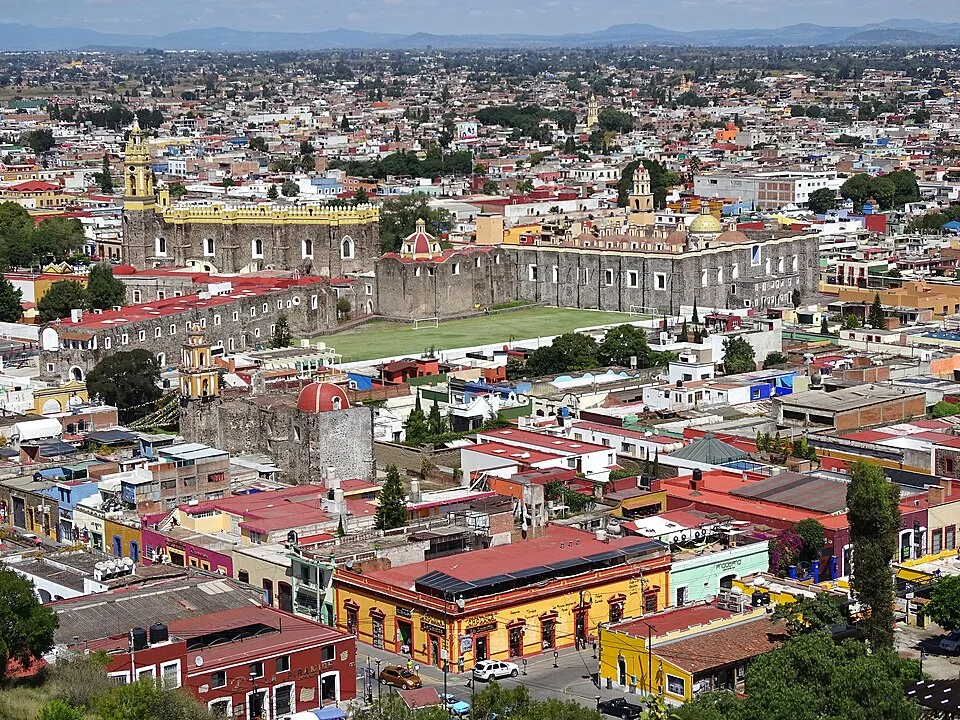
View over Cholula from Summit of Great Pyramid - Cholula - Puebla - Mexico 14924947814
View over Cholula from Summit of Great Pyramid - Cholula - Puebla - Mexico 14924947814 | Adam Jones from Kelowna, BC, Canada (CC BY-SA 2.0)
"Cholula was of great size, and from a distance its temples looked like towers; the greatest cue had one hundred and twenty steps to the summit."
— Bernal Díaz del Castillo, The True History of the Conquest of New Spain, on Cholula (16th century; Maunsell/Maudslay tradition)

Restoration of the Escalinata del Pocito after the 2017 earthquake (reported by INAH as the staircase neared completion in 2023) exposed an adobe core assigned to the fifth construction stage of the Classic period (c. 100–600 CE), dumps of pre-Hispanic brazier fragments, and a 30 cm white-stone preform of Tlaloc with goggles and fangs, interpreted by Sergio Suárez Cruz as a merlon that once crowned a temple. Archaeologist Mariana Toledo Mendieta described the ceramic dump as an unusual concentration beside a terrace rest on the talud. Those finds belong to the Pocito project, not to the 2026 tunnel works. Walk Cholula with Teotihuacan for the Classic highland capital, Templo Mayor for the later Aztec cue, El Tajín for Gulf talud-tablero, and Monte Albán for a highland civic mountain of another kind.
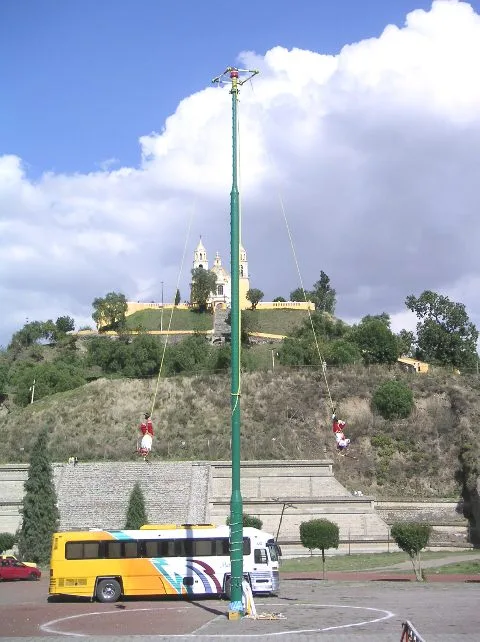
Mexico.Pue.Cholula.Pyramid.02
Mexico.Pue.Cholula.Pyramid.02 | Wikimedia Commons (CC BY-SA 3.0)

Cholula is a Mexican zona arqueológica, not a standalone UNESCO World Heritage property (the nearby monasteries of Popocatépetl are a separate listing). The church remains a living sanctuary; the archaeological story is the adobe mountain underneath it.

重要性

Cholula is the largest pyramid by volume anywhere — a stacked adobe mountain that later piety disguised as a hill with a church, so many visitors never realise they are standing on a temple. The 2026 tunnel rehabilitation is timed to World Cup travel through Mexico City: a rare moment when conservation news and search demand move together.

証拠と解釈

確立された事実と議論が続く事柄を区別する。

確立された事実

3
  • Marquina’s tunnels and later INAH cuts document multiple superimposed construction stages in adobe and rubble, including talud-tablero skins of Classic date.
  • The Pocito staircase restoration after the 2017 earthquake exposed a fifth-stage adobe core (Classic, c. 100–600 CE), brazier fragments, and a 30 cm Tlaloc preform reported by INAH (Toledo Mendieta; Suárez Cruz).
  • INAH Puebla stated in 2026 that visitor-tunnel rehabilitation was underway, with municipal funds for a new San Andrés access and a hoped-for reopening before the end of the year (Donnadieu Cervantes, June 2026).

学術的推論

1
  • Volume figures near 4.45 million m³ depend on reconstructing eroded edges and unexcavated fills; the pyramid is larger than Khufu by that measure, but the comparison is of packed adobe stages to dressed stone.

コミュニティ写真

あなたの体験を共有する

この遺跡を訪れたことがありますか?写真をアップロードして魅力を共有しましょう。

このページの引用方法

Atlas Anatolia. (300). Great Pyramid of Cholula. Atlas Anatolia. https://atlasanatolia.com/ja/site/cholula

コンテンツはCC BY-SA 4.0ライセンスの下で提供されています — 再利用の際は出典表示が必要です。

出典

  • Arquitectura prehispánica — Marquina, Ignacio (1951)
  • Reinterpreting the Great Pyramid of Cholula, Mexico — McCafferty, Geoffrey G. (1996)
  • INAH — restoration at the Great Pyramid of Cholula (Pocito finds)リンク

よくある質問

Great Pyramid of Cholulaはどこにありますか?

Great Pyramid of CholulaはMexicoに位置しています。

Great Pyramid of Cholulaの年代はいつ頃ですか?

Great Pyramid of Cholulaはおよそ300 紀元前 – 1594 西暦のものとされています。

Great Pyramid of Cholulaはどの文明に関連していますか?

Great Pyramid of CholulaはTeotihuacan, Aztec / Mexica, Cholulan文明に関連しています。

Great Pyramid of Cholulaが重要な理由は何ですか?

Cholula is the largest pyramid by volume anywhere — a stacked adobe mountain that later piety disguised as a hill with a church, so many visitors never realise they are standing on a temple.

Great Pyramid of Cholulaはユネスコ世界遺産ですか?

Great Pyramid of Cholulaは現在ユネスコ世界遺産には登録されていません。