Overview
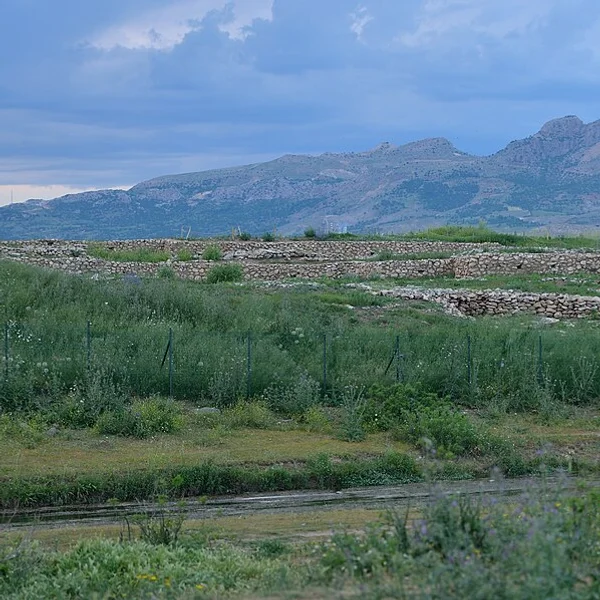
Sayburç lies about 20 km southwest of Şanlıurfa, on the plateau that rings the Harran Plain, in the same Pre-Pottery Neolithic world as Göbekli Tepe and Karahan Tepe. Survey and rescue work began after Roman finds in 2020; Neolithic T-pillars reused in garden walls were recognised in 2021. Istanbul University Prehistory and the Şanlıurfa Museum have excavated since then under the Taş Tepeler project.
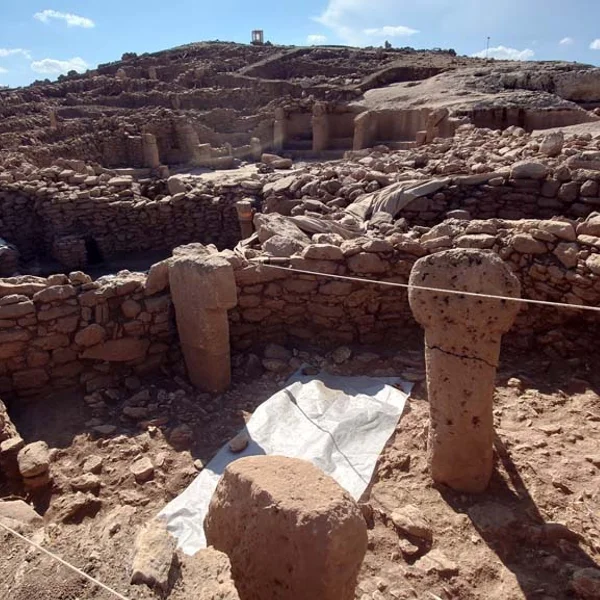
The southern settlement is cut into bedrock. Adjacent stone houses, some with T-shaped pillars and human-faced bases, share a phase. A large circular building, partly hewn from the rock, has a bench whose inner face carries a 3.7 m relief: a man holding his genitals between leopards, and related scenes with a bull and a snake. Eylem Özdoğan published the relief in Antiquity (2022) as a sequential narrative rather than isolated emblems.
By the sixth excavation season, nearly 70 structures had been recorded across about 2,700 m². In 2026 Necmi Karul presented Sayburç with Karahan Tepe as a turning point in early settled life. Minister Ersoy said the settlement would be prepared as an open-air museum, with village buildings in the expropriated area restored as a living-museum counterpart.
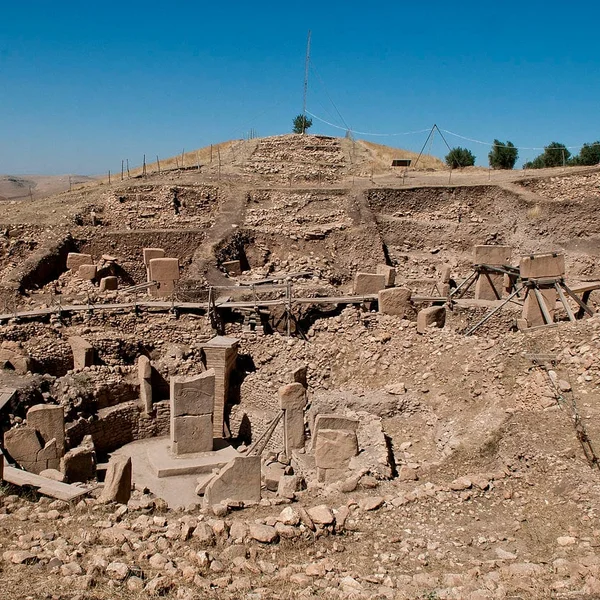
Read Sayburç with Göbekli Tepe for special buildings and with Karahan Tepe for the Taş Tepeler human-and-animal sculpture tradition.