
Skip to content
Atlas Anatolia
Dig
NewsIce Age teeth in Sulawesi push betel-nut use back as far as 25,000 yearsRoman mosaic and Eros head uncovered in the basilica at Pompeiopolis, Kastamonu
Painted rock shelter 8 at Bhimbetka, Madhya Pradesh

Wikimedia Commons (CC BY-SA 4.0)

Continent Record

Longest Recorded History in Asia

ComplexUNESCO

Bhimbetka Rock Shelters

Seyfi Cem Baskin

भीमबेटका शैलाश्रय100000 BCE – 1000 CE

A sandstone hill of painted rock shelters in the Vindhyas of Madhya Pradesh, with occupation from the Lower Palaeolithic through historic centuries, inscribed by UNESCO in 2003.

111
Interest 62

Location

India

22.94°N · 77.61°E · Asia

Identified

V. S. Wakankar, 1957

Sequence

Lower Palaeolithic tools through historic paintings

UNESCO

World Heritage Site (2003), ref. 925

Setting

Vindhya foothills, Raisen district, Madhya Pradesh

Bhimbetka is India’s most visitable Palaeolithic-to-historic rock-shelter sequence, and the place where Wakankar made hunter-gatherer archaeology public.”

Location

Overview

Bhimbetka is a cluster of quartzite and sandstone shelters in Raisen district, Madhya Pradesh, in the foothills of the Vindhya Range. V. S. Wakankar noticed the painted caves from a train in 1957 and began excavation; later ASI and university teams documented more than 700 shelters, of which a core group is open to visitors (notably Auditorium Shelter / Shelter 8).

Paintings in red and white show mesolithic hunters, animals, later riders, and historic scenes. Below the art, excavations recovered Acheulean tools — so the hill is a deep-time sequence, not only a rock-art gallery. Dates for the oldest paintings are inferred from style and associated deposits rather than a single radiocarbon ticket on every panel.
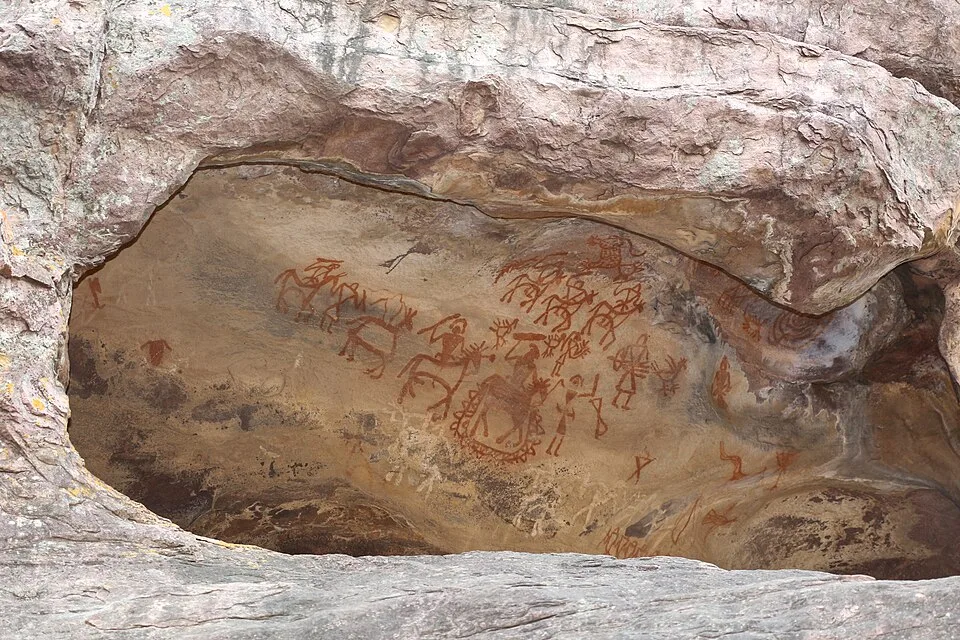
Rock Shelter 8, Bhimbetka 02
Rock Shelter 8, Bhimbetka 02 | Bernard Gagnon (CC BY-SA 3.0)
"The Rock Shelters of Bhimbetka are in the foothills of the Vindhyan Mountains on the southern edge of the central Indian plateau, with five clusters of natural rock shelters displaying paintings that appear to date from the Mesolithic period right through to the historical period."
— UNESCO, Rock Shelters of Bhimbetka (World Heritage List, 2003)

UNESCO listed the Rock Shelters of Bhimbetka in 2003 (ref. 925). Pair the Vindhyan shelters with Sanchi for later Buddhist monumentalisation in the same region, and with Palaeolithic cave art elsewhere on the atlas for method, not for a single “Indian Lascaux” slogan.
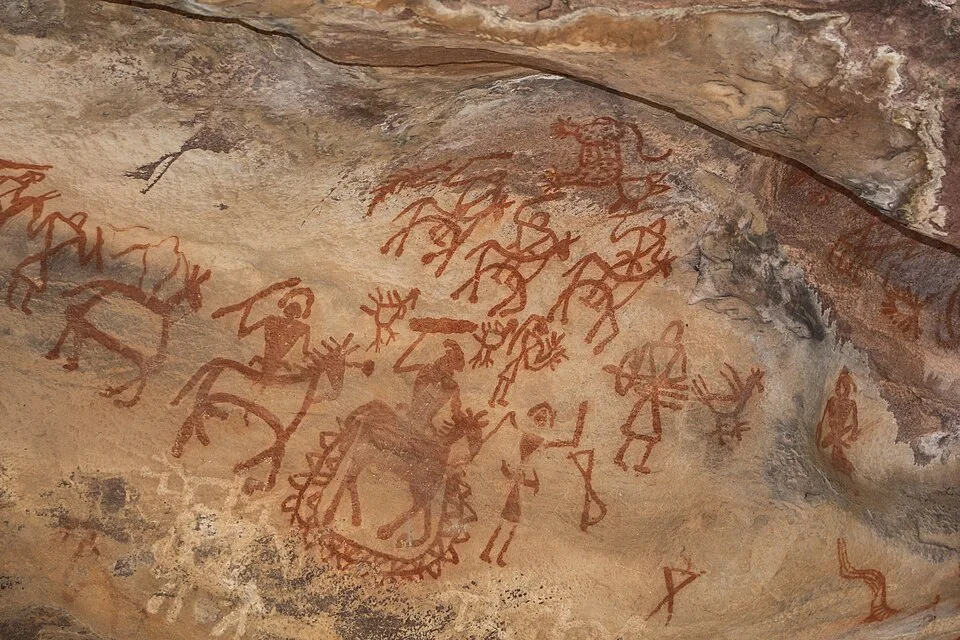
Rock Shelter 8, Bhimbetka 03
Rock Shelter 8, Bhimbetka 03 | Bernard Gagnon (CC BY-SA 3.0)

Boardwalks now a core of shelters; most of the 700 recorded cavities remain closed, so the visitor path is a sample of the archaeological landscape, not the whole hill.

Why It Matters

Bhimbetka is India’s most visitable Palaeolithic-to-historic rock-shelter sequence, and the place where Wakankar made hunter-gatherer archaeology public. It also forces evidence grades: tools in section are Confirmed; many painted “dates” remain stylistic inferences.

Evidence & Interpretation

Distinguishing what is well-established from what remains debated.

Well-Established Facts

1
  • Excavated Acheulean and later lithic assemblages sit in the same hill as the painted shelters documented by Wakankar and the ASI.

Scholarly Inferences

1
  • Stylistic groups of paintings are ordered from Mesolithic hunters to historic riders on analogy with other Indian rock-art sequences.

Debated Interpretations

1
  • Absolute dates for individual painted panels are rarely tied to a published radiocarbon sample on the pigment itself.

Community Photos

Share your experience

Have you visited this site? Upload your photos to help others discover it.

How to cite this page

Atlas Anatolia. (100000). Bhimbetka Rock Shelters. Atlas Anatolia. https://atlasanatolia.com/site/bhimbetka-rock-shelters

Content licensed CC BY-SA 4.0 — attribution required when reusing.

Sources

  • Bhimbetka: Painted Rock-SheltersWakankar, V. S. (1975)
  • UNESCO — Rock Shelters of BhimbetkaLink

Frequently Asked Questions

Where is Bhimbetka Rock Shelters located?

Bhimbetka Rock Shelters is located in India.

How old is Bhimbetka Rock Shelters?

Bhimbetka Rock Shelters dates to approximately 100000 BCE – 1000 CE.

Why is Bhimbetka Rock Shelters important?

Bhimbetka is India’s most visitable Palaeolithic-to-historic rock-shelter sequence, and the place where Wakankar made hunter-gatherer archaeology public.

Is Bhimbetka Rock Shelters a UNESCO World Heritage Site?

Yes — Bhimbetka Rock Shelters is inscribed as a UNESCO World Heritage Site.