
コンテンツへスキップ
Atlas Anatolia
ニュースIce Age teeth in Sulawesi push betel-nut use back as far as 25,000 yearsRoman mosaic and Eros head uncovered in the basilica at Pompeiopolis, Kastamonu
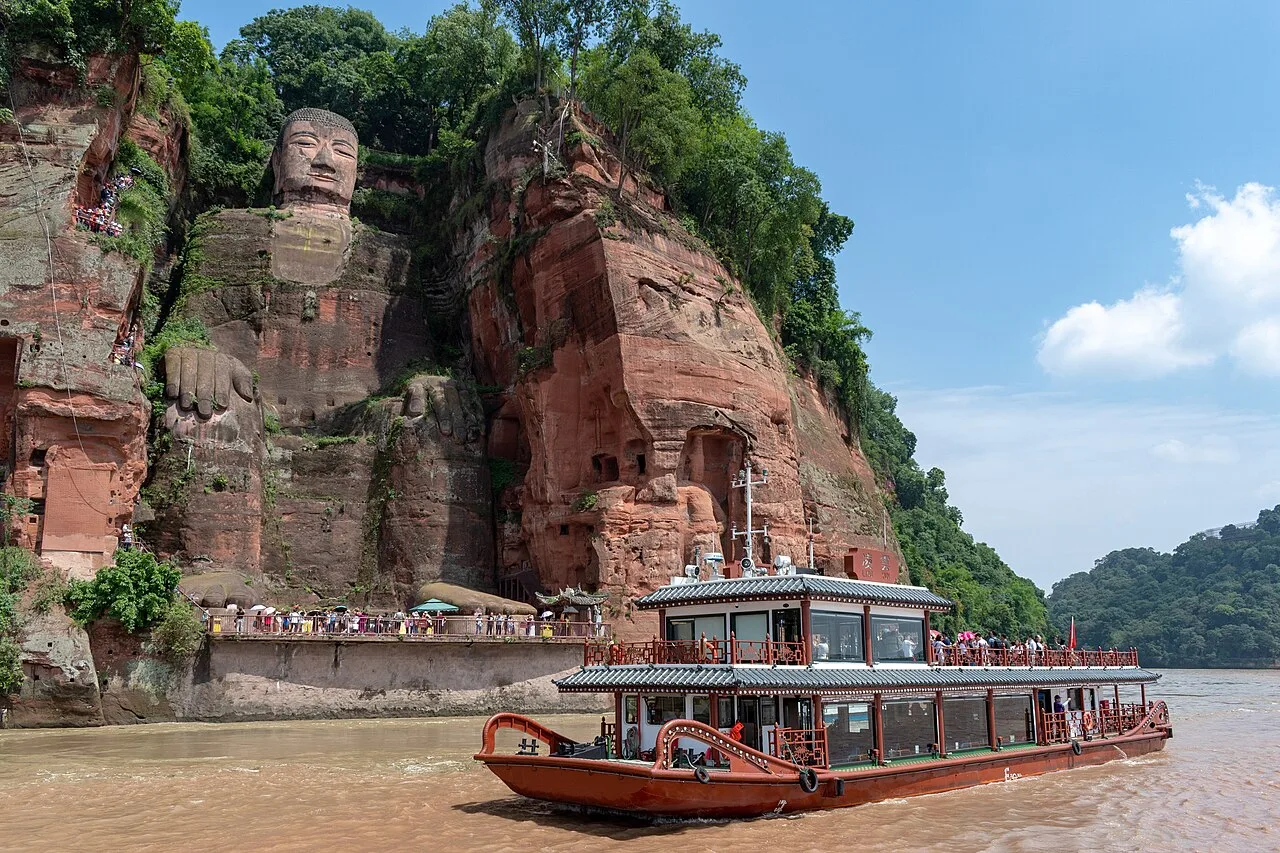
The Leshan Giant Buddha carved into the cliff face in Sichuan, China

Wikimedia Commons

記念碑UNESCO

Leshan Giant Buddha

Seyfi Cem Baskin

乐山大佛713 西暦 – 803 西暦

The largest pre-modern stone Buddha in the world — a 71-metre seated figure carved directly into a red sandstone cliff at the confluence of three rivers in Sichuan, China. Begun in 713 CE and completed ninety years later, it was conceived to calm the deadly currents below, and its hidden internal drainage has helped it survive for over twelve centuries.

311
関心 70

所在地

中国

29.54°N · 103.77°E · アジア

Height

71 m — the largest pre-modern stone Buddha on Earth

Carved

Begun 713 CE (Tang dynasty); completed c. 803 CE

Initiated by

The monk Haitong, to calm the deadly river currents

Depicts

Maitreya, the Buddha of the future, seated

Engineering

Hidden internal drainage channels reduce erosion of the sandstone

UNESCO

Part of "Mount Emei Scenic Area, incl. Leshan Giant Buddha" (1996)

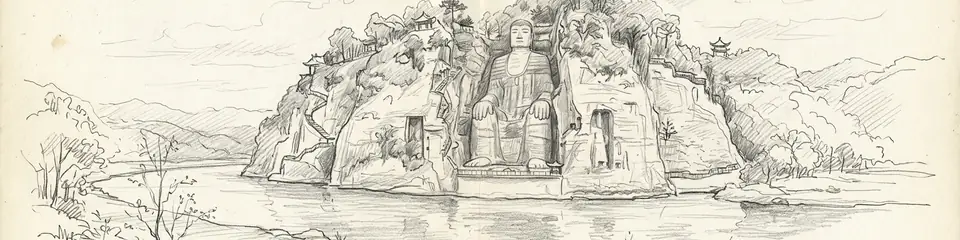
Graphite pencil sketch banner of Leshan Giant Buddha

“The Leshan Giant Buddha is the largest stone Buddha of the pre-modern world and a monumental expression of Tang-dynasty Buddhism, the era when the religion reached its greatest influence in China.”

所在地

概要

The Leshan Giant Buddha is carved into the face of Lingyun Hill, where the Min, Dadu, and Qingyi rivers converge near the city of Leshan in Sichuan province, southwestern China. The figure depicts Maitreya, the Buddha of the future, seated with hands resting on his knees and gazing across the water toward the sacred mountain of Emei. At 71 metres tall it is by a wide margin the largest stone Buddha statue carved before the modern era: its shoulders are about 28 metres wide, each ear is 7 metres long, and its toenails alone are large enough for a person to sit on.

The project was begun in 713 CE during the Tang dynasty, initiated by a Chinese monk named Haitong. The waters at the confluence below were notoriously turbulent and dangerous, wrecking boats and drowning travellers, and Haitong is said to have believed that carving a colossal Buddha overlooking the rivers would calm the spirits responsible and protect those on the water. According to tradition, when local officials threatened to seize the funds he had gathered for the work, Haitong gouged out his own eyes to demonstrate his sincerity and devotion. He did not live to see the statue finished; work stalled after his death and was completed only around 803 CE, some ninety years after it began, under the patronage of a regional military governor.

The Buddha is an extraordinary feat of both sculpture and engineering. Concealed within the figure is a sophisticated drainage system — channels and gutters cut into the head, behind the ears, and in the folds of the robe and chest — that carries rainwater away and reduces erosion of the soft sandstone, a key reason the statue has endured. The vast quantity of stone removed during carving was tipped into the river below, and this material, together with the calming visual presence intended by Haitong, did in practice alter the currents and make the waters safer for navigation.

For centuries the Buddha was sheltered by a multi-storeyed wooden pavilion built against the cliff, but this structure was destroyed, and the figure has stood exposed to the elements ever since. It has required repeated conservation against weathering, pollution, and biological growth. The Leshan Giant Buddha, together with the nearby Mount Emei, was inscribed as a UNESCO World Heritage Site in 1996.

重要性

The Leshan Giant Buddha is the largest stone Buddha of the pre-modern world and a monumental expression of Tang-dynasty Buddhism, the era when the religion reached its greatest influence in China. Its sheer scale, achieved by carving directly into a living cliff over nine decades, makes it one of the most ambitious sculptural undertakings in human history. Beyond its size, the statue is significant as a work of hydraulic and conservation engineering: its concealed internal drainage system, designed twelve centuries ago to protect soft sandstone from erosion, is studied as an early and remarkably effective solution to a problem that still challenges the preservation of stone monuments. Combined with the legend of the monk Haitong, who is said to have sacrificed his eyes for the project, it stands as one of the defining monuments of Chinese cultural and religious heritage and a centrepiece of the Mount Emei UNESCO World Heritage Site (1996).

証拠と解釈

確立された事実と議論が続く事柄を区別する。

確立された事実

3
  • The statue survives in situ as the world's largest pre-modern stone Buddha, its dimensions directly measurable: ~71 m tall, with shoulders ~28 m wide and ears ~7 m long.
  • A concealed drainage system of channels behind the head, ears, and within the robe folds has been documented during conservation work and is shown to carry away rainwater, slowing erosion of the soft red sandstone.
  • Historical records date the start of carving to 713 CE under the monk Haitong and completion around 803 CE under later patronage, giving the project a span of roughly ninety years.

学術的推論

1
  • The dumping of carved-away stone into the confluence, together with the altered flow, is thought to have genuinely reduced the river's turbulence and improved navigation — the practical outcome that the project was partly intended to achieve, inferred from the geography and historical accounts.

議論のある解釈

1
  • The account of Haitong blinding himself to protect the project's funds is recorded in tradition but cannot be independently verified and is treated by historians as a pious legend, however vivid, rather than confirmed fact.

コミュニティ写真

あなたの体験を共有する

この遺跡を訪れたことがありますか?写真をアップロードして魅力を共有しましょう。

このページの引用方法

Atlas Anatolia. (713). Leshan Giant Buddha. Atlas Anatolia. https://atlasanatolia.com/ja/site/leshan-giant-buddha

コンテンツはCC BY-SA 4.0ライセンスの下で提供されています — 再利用の際は出典表示が必要です。

出典

  • Summit of Treasures: Buddhist Cave Art of Dazu, China — Howard, Angela Falco (2001)
  • Tang Dynasty Buddhist Sculpture of Sichuan — Suchan, Tom (2007)

よくある質問

Leshan Giant Buddhaはどこにありますか?

Leshan Giant BuddhaはChinaに位置しています。

Leshan Giant Buddhaの年代はいつ頃ですか?

Leshan Giant Buddhaはおよそ713 西暦 – 803 西暦のものとされています。

Leshan Giant Buddhaはどの文明に関連していますか?

Leshan Giant BuddhaはTang文明に関連しています。

Leshan Giant Buddhaが重要な理由は何ですか?

The Leshan Giant Buddha is the largest stone Buddha of the pre-modern world and a monumental expression of Tang-dynasty Buddhism, the era when the religion reached its greatest influence in China.

Leshan Giant Buddhaはユネスコ世界遺産ですか?

はい — Leshan Giant Buddhaはユネスコ世界遺産に登録されています。