
コンテンツへスキップ
Atlas Anatolia
ニュースIce Age teeth in Sulawesi push betel-nut use back as far as 25,000 yearsRoman mosaic and Eros head uncovered in the basilica at Pompeiopolis, Kastamonu
The Canopus canal and colonnade at Hadrian’s Villa, Tivoli

Wikimedia Commons (CC BY-SA 4.0)

複合体UNESCO注目

Hadrian's Villa

Seyfi Cem Baskin

Villa Adriana118 西暦 – 138 西暦

Emperor Hadrian’s sprawling second-century retreat at Tivoli — Canopus canal, Maritime Theatre, baths, and colonnades quoting Greece and Egypt — is a UNESCO World Heritage site and among the highest pageview Roman archaeological complexes still missing from the atlas.

21
関心 74

所在地

イタリア

41.94°N · 12.80°E · ヨーロッパ

Builder

Emperor Hadrian, mainly 118–138 CE

Area

>120 ha of pavilions and gardens

Landmarks

Canopus, Maritime Theatre, baths, Piazza d’Oro

UNESCO

Inscribed 1999

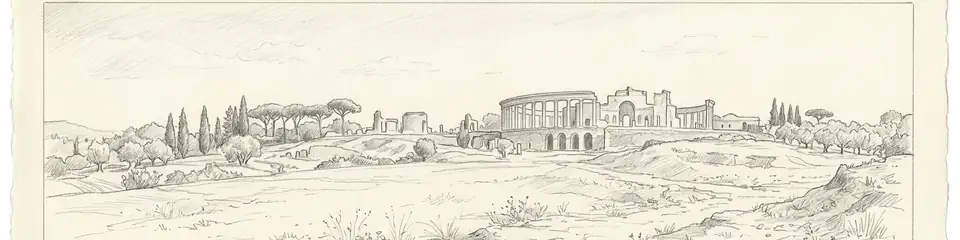
Graphite pencil sketch banner of Hadrian's Villa

“Hadrian’s Villa is the fullest surviving expression of a Roman emperor’s personal landscape architecture — a catalogue of imperial taste after conquest.”

所在地

概要

Hadrian’s Villa occupies the plain below the Tiburtine Hills east of Rome. Built largely between 118 and 138 CE for the emperor who spent much of his reign travelling the provinces, the estate covers over 120 hectares of residential pavilions, gardens, libraries, baths, and service quarters. Designed as a landscape of memories, its named spaces evoke Athens (Poikile), Egypt (Canopus/Serapeum), and Greece (Prytaneum, Stoa Poikile).

Key monuments include the circular Maritime Theatre — a “island villa” within a moat — the long reflecting canal of the Canopus lined with caryatids and statues, the Large and Small Baths, the Piazza d’Oro complex, and imperial apartments. Excavations since the Renaissance (and systematic digs from the 19th century onward) recovered sculpture now dispersed in museums; modern conservation grapples with tourism and seismic risk.

The villa models how imperial identity was staged through architecture after the High Empire’s territorial apex. Pair with the Colosseum, Pantheon, and Roman Forum for metropolitan counterparts, and with Pompeii for Campanian domestic life outside the court.

重要性

Hadrian’s Villa is the fullest surviving expression of a Roman emperor’s personal landscape architecture — a catalogue of imperial taste after conquest. Its Canopus and Maritime Theatre are foundational for studying how Rome appropriated eastern and Greek forms into private palatial space.

証拠と解釈

確立された事実と議論が続く事柄を区別する。

確立された事実

2
  • Brick stamps, literary references (Historia Augusta), and stratified finds date major construction to Hadrian’s reign.
  • Named spaces in Renaissance and modern plans match Egyptian and Greek architectural quotes in sculpture and layout.

学術的推論

1
  • Some pavilions may have functioned as temporary diplomatic stages for provincial elites visiting Italy.

コミュニティ写真

あなたの体験を共有する

この遺跡を訪れたことがありますか?写真をアップロードして魅力を共有しましょう。

このページの引用方法

Atlas Anatolia. (118). Hadrian's Villa. Atlas Anatolia. https://atlasanatolia.com/ja/site/hadrians-villa

コンテンツはCC BY-SA 4.0ライセンスの下で提供されています — 再利用の際は出典表示が必要です。

出典

  • Hadrian's Villa and Its Legacy — MacDonald, William L.; Pinto, John A. (1995)
  • UNESCO — Villa Adriana (Tivoli)リンク

よくある質問

Hadrian's Villaはどこにありますか?

Hadrian's VillaはItalyに位置しています。

Hadrian's Villaの年代はいつ頃ですか?

Hadrian's Villaはおよそ118 西暦 – 138 西暦のものとされています。

Hadrian's Villaはどの文明に関連していますか?

Hadrian's VillaはRoman文明に関連しています。

Hadrian's Villaが重要な理由は何ですか?

Hadrian’s Villa is the fullest surviving expression of a Roman emperor’s personal landscape architecture — a catalogue of imperial taste after conquest.

Hadrian's Villaはユネスコ世界遺産ですか?

はい — Hadrian's Villaはユネスコ世界遺産に登録されています。