
コンテンツへスキップ
Atlas Anatolia
ニュースIce Age teeth in Sulawesi push betel-nut use back as far as 25,000 yearsRoman mosaic and Eros head uncovered in the basilica at Pompeiopolis, Kastamonu
Kailasa Temple (Cave 16) at Ellora, carved from a single basalt outcrop, Maharashtra, India

Wikimedia Commons

Country Record

Longest Recorded History in India

複合体UNESCO

Ellora Caves

Seyfi Cem Baskin

एलोरा गुंफा100 紀元前 – 1100 西暦

The world's largest rock-cut monastic and temple complex — 34 monasteries and shrines carved directly into a 2-kilometre basalt escarpment in Maharashtra, representing Buddhist, Hindu, and Jain traditions side by side. The Hindu Kailasa Temple (Cave 16), hewn from a single enormous rock in the 8th century CE, is the largest monolithic structure ever carved from stone and one of humanity's most audacious feats of rock-cut architecture.

31
関心 79

所在地

Aurangabad · Maharashtra · インド

20.03°N · 75.18°E · アジア

Caves

34 rock-cut caves: 12 Buddhist, 17 Hindu, 5 Jain

Kailasa Temple

Largest monolithic structure ever carved from stone; 84 × 47 m, 30 m tall

Rock removed

c. 400,000 tonnes of basalt excavated to create Kailasa Temple alone

Span

8 centuries of continuous construction, c. 1st century BCE – 11th century CE

UNESCO

World Heritage Site 1983

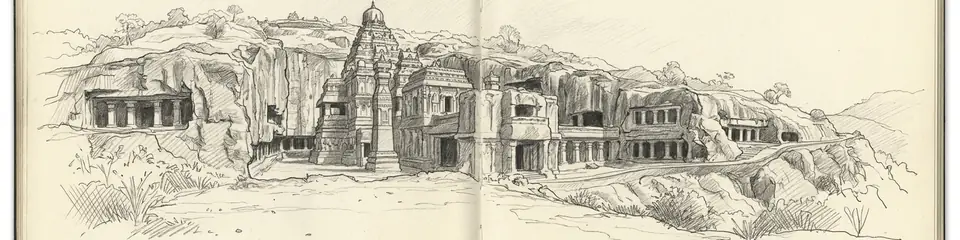
Graphite pencil sketch banner of Ellora Caves

“Ellora is the supreme demonstration of what Deccan rock-cut architecture could achieve.”

所在地

概要

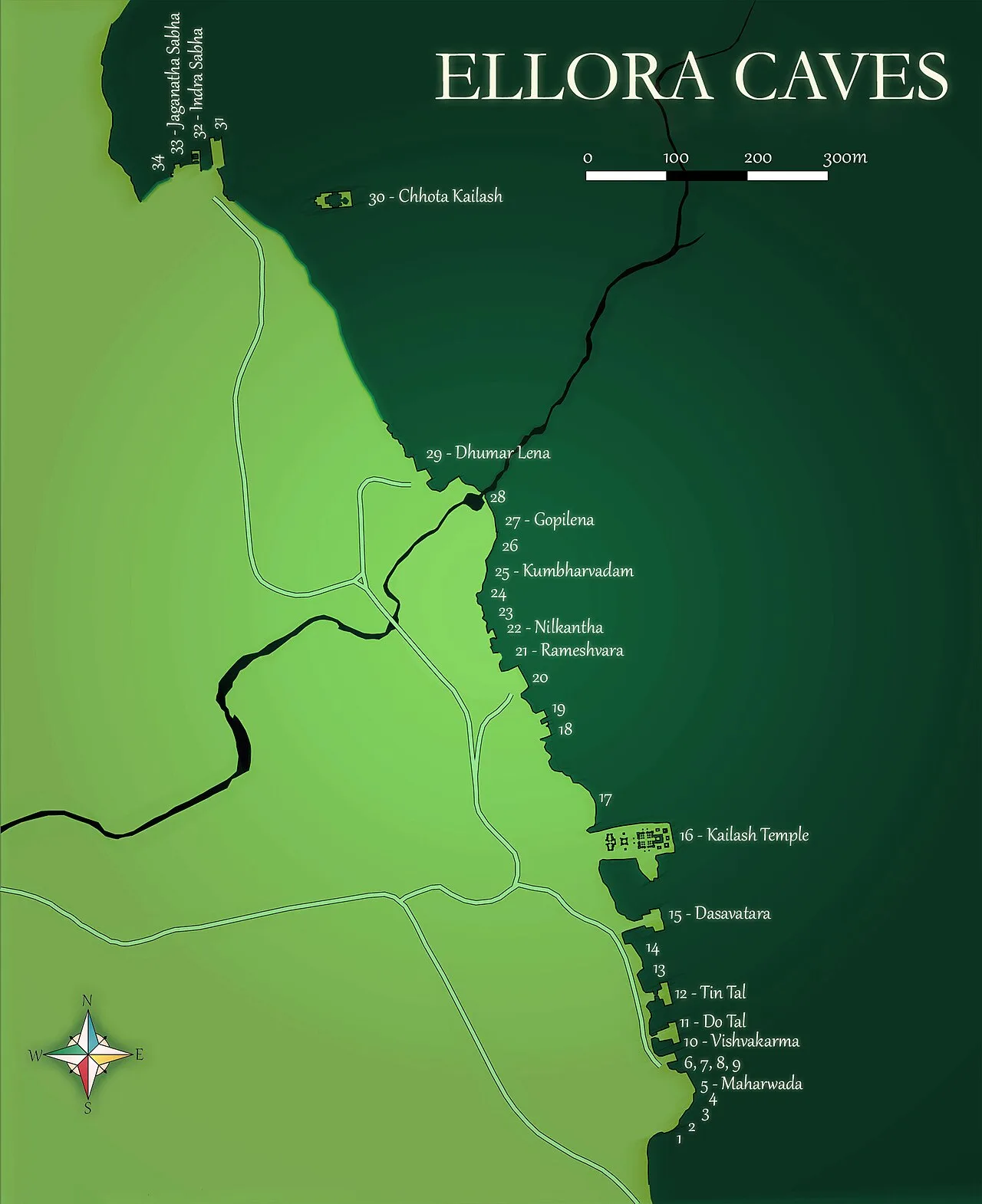
Ellora is located 29 kilometres from Aurangabad in Maharashtra, India. Its 34 rock-cut caves — numbered 1 to 34 — span roughly eight centuries of continuous construction from approximately the 1st century BCE to the 11th century CE, representing three religious traditions: 12 Buddhist caves (1–12, roughly 1st–7th century CE), 17 Hindu caves (13–29, roughly 5th–9th century CE), and 5 Jain caves (30–34, roughly 9th–11th century CE). The coexistence of these traditions at a single site reflects the religious pluralism of the Deccan plateau over this long period.

The Kailasa Temple (Cave 16) is the undisputed centrepiece. Commissioned by the Rashtrakuta king Dantidurga in the 8th century CE and completed under his successor Krishna I, it represents Mount Kailash — the cosmic abode of Shiva — carved directly from the living rock. Quarrymen excavated approximately 400,000 tonnes of rock (working from the top down rather than the inside out) to create a freestanding temple complex 84 metres long, 47 metres wide, and 30 metres tall — larger than the Parthenon and hewn from a single outcrop of basalt without separate building blocks. The temple is adorned with relief sculptures of extraordinary quality, including massive panels showing Ravana shaking Mount Kailash and Shiva and Parvati playing dice.

The Buddhist caves include some of the most refined vihara (monastery) architecture in India. Cave 1 is a simple hall; Cave 12 (Tin Thal) is a three-storey monastery with shrines to the Buddha and Bodhisattvas. The earliest Buddhist caves predate the Kailasa Temple by several centuries and show the evolution of cave temple architecture from austere Hinayana halls to elaborately sculpted Mahayana shrines.

The Jain caves, concentrated at the northern end of the cliff, are noted for their intricate ceiling carvings. Cave 32 (Indra Sabha) contains some of the finest Jain sculptures at the site. Ellora was inscribed as a UNESCO World Heritage Site in 1983.

重要性

Ellora is the supreme demonstration of what Deccan rock-cut architecture could achieve. The Kailasa Temple represents an entirely different approach to monumental architecture — rather than assembling elements, the builders removed everything that was not the temple, sculpting a complete complex from the surrounding rock with the accuracy of jewellers and the ambition of city planners. No scaffolding to erect, no foundations to lay, no joint to mortar: just subtraction on a colossal scale. Beyond the Kailasa, Ellora's greatest significance is its visible record of religious pluralism. Buddhist, Hindu, and Jain craftsmen and patrons commissioned monuments within walking distance of one another over eight centuries — evidence that Deccan India sustained a sophisticated culture of religious coexistence and shared aesthetic traditions that cut across sectarian lines. Ellora also marks the endpoint of India's great rock-cut tradition, which began at Ajanta (2nd century BCE) and reached its apex here. Together, Ajanta and Ellora represent the highest achievement of this uniquely South Asian architectural form.

証拠と解釈

確立された事実と議論が続く事柄を区別する。

確立された事実

3
  • Inscriptions of the Rashtrakuta king Dantidurga and his successor Krishna I confirm royal patronage of the Kailasa Temple (Cave 16) in the 8th century CE.
  • Geological mapping confirms that the entire Kailasa Temple complex was quarried from a single continuous basalt outcrop, excavated from the top downward — an approach fundamentally different from additive construction.
  • Radiocarbon dates and art-historical analysis of Buddhist caves place the earliest constructions (caves 6, 9, 10) in the early centuries CE, broadly consistent with the Satavahana and Vakataka periods.

学術的推論

1
  • The coexistence of Buddhist, Hindu, and Jain caves at Ellora is interpreted as evidence of royal patronage extending across religious traditions, though the extent of deliberate pluralistic policy versus separate patronage sequences is not fully established.

発見と発掘調査

1861

Archaeological Survey of India documentation

James Burgess of the Archaeological Survey of India produced the first comprehensive documentation of the caves.

1950

Ongoing ASI conservation

Continuous conservation and stabilisation work by the Archaeological Survey of India, including structural monitoring of the Kailasa Temple.

コミュニティ写真

あなたの体験を共有する

この遺跡を訪れたことがありますか?写真をアップロードして魅力を共有しましょう。

このページの引用方法

Atlas Anatolia. (100). Ellora Caves. Atlas Anatolia. https://atlasanatolia.com/ja/site/ellora-caves

コンテンツはCC BY-SA 4.0ライセンスの下で提供されています — 再利用の際は出典表示が必要です。

出典

  • The Caves at Ellora and Ajanta — Spink, Walter M. (1975)
  • Carving Devotion in the Jain Caves at Ellora — Owen, Lisa N. (2012)
  • UNESCO — Ajanta and Ellora Cavesリンク

よくある質問

Ellora Cavesはどこにありますか?

Ellora CavesはAurangabad, Maharashtra, Indiaに位置しています。

Ellora Cavesの年代はいつ頃ですか?

Ellora Cavesはおよそ100 紀元前 – 1100 西暦のものとされています。

Ellora Cavesはどの文明に関連していますか?

Ellora CavesはMauryan, Gupta, Vedic Indian文明に関連しています。

Ellora Cavesが重要な理由は何ですか?

Ellora is the supreme demonstration of what Deccan rock-cut architecture could achieve.

Ellora Cavesはユネスコ世界遺産ですか?

はい — Ellora Cavesはユネスコ世界遺産に登録されています。