
コンテンツへスキップ
Atlas Anatolia
ニュースIce Age teeth in Sulawesi push betel-nut use back as far as 25,000 yearsRoman mosaic and Eros head uncovered in the basilica at Pompeiopolis, Kastamonu
Borobudur — Indonesia

Wikimedia Commons (CC BY-SA)

Country Record

Oldest Temple in Indonesia

神殿UNESCO注目

Borobudur

Seyfi Cem Baskin

Barabudhur778 西暦 – 850 西暦

Monumental 9th-century Mahayana Buddhist temple in Java, Indonesia, featuring nine stacked platforms with over 2,600 relief panels and 504 Buddha statues—the world's largest Buddhist temple.

322
関心 82

所在地

Central Java · Magelang · インドネシア

7.61°S · 110.20°E · アジア

Built

c. 778–850 CE

Civilization

Sailendra Dynasty (Mahayana Buddhist)

Discovered

1814 by Thomas Stamford Raffles' expedition (H.C. Cornelius)

Status

UNESCO World Heritage Site (1991)

Dimensions

Base 118 × 118 m, height 35 m (original height estimated 42 m)

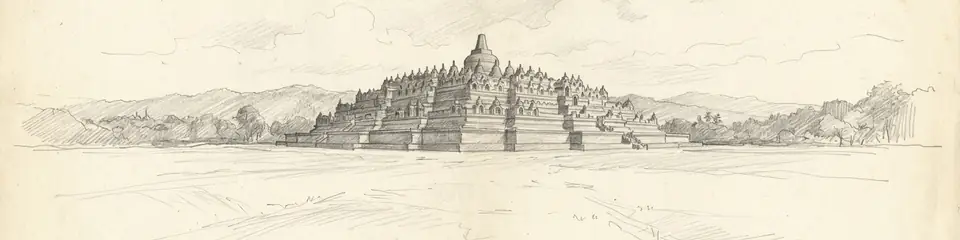
Graphite pencil sketch banner of Borobudur

“Borobudur is the world’s largest Buddhist temple and a culmination of the Sailendra Dynasty’s architectural and religious ambition, demonstrating the extensive maritime trade networks that brought Indian Buddhist concepts to insular Southeast Asia.”

所在地

概要

Overview

Borobudur is a massive Mahayana Buddhist monument constructed on a natural hill near Yogyakarta, Central Java. Its architectural form blends a stepped pyramid, a stupa, and a mandala, ascending through three symbolic realms: Kamadhatu (the sphere of desire), Rupadhatu (the sphere of forms), and Arupadhatu (the formless sphere). The structure comprises six square terraces topped by three circular platforms, culminating in a large central stupa. The walls and balustrades are adorned with 2,672 narrative relief panels covering over 2 km, illustrating the Lalitavistara, Jataka tales, and the Gandavyuha Sutra. There are 504 Buddha statues, with 72 housed in perforated stupas on the circular terraces.

Construction and Patronage

The temple likely dates from the late 8th to mid-9th century CE, during the reign of the Sailendra dynasty, who were active patrons of Mahayana Buddhism. An inscription of 824 CE from the nearby temple of Candi Sewu mentions the end of a period of construction, suggesting Borobudur may have been completed around that time. The name “Borobudur” might derive from the Sanskrit Vihara Buddha Uhr, meaning “Buddhist monastery on a hill.” No foundation inscription has been found, so the exact reign and intended function remain inferred from art and architecture. The labor force and methods, including stone quarrying and transport from the Progo River, have been reconstructed through experimental archaeology.
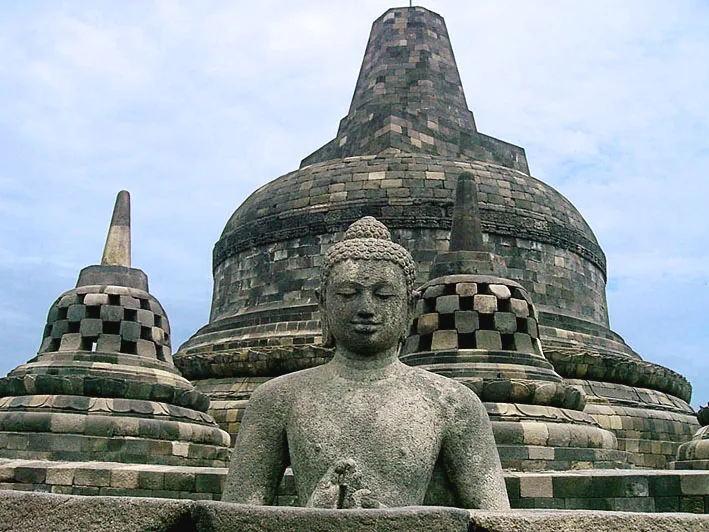
Stupa Borobudur
Stupa Borobudur | Original uploader was Gunawan Kartapranata at en.wikipedia (CC BY-SA 3.0)
"Through this work of merit, may all sentient beings, after crossing the ocean of suffering and obtaining the rank of a Buddha, become illuminators of the world."
— Closing dedication common to Mahayana Buddhist sutras inscribed at Borobudur, c. 825 CE

Abandonment and Rediscovery

Borobudur was abandoned sometime after the 10th century, possibly due to volcanic eruptions or the shift of political power to East Java. It became covered in volcanic ash and jungle, and was forgotten by the local population, though folk memory may have persisted. In 1814, Thomas Stamford Raffles, the British Lieutenant-Governor of Java, heard of a “big monument” and dispatched engineer H.C. Cornelius to investigate. Cornelius cleared vegetation and exposed the upper terraces. By 1835, the entire site was cleared and documented by Dutch colonial authorities, though early clearing efforts inadvertently damaged some carvings.
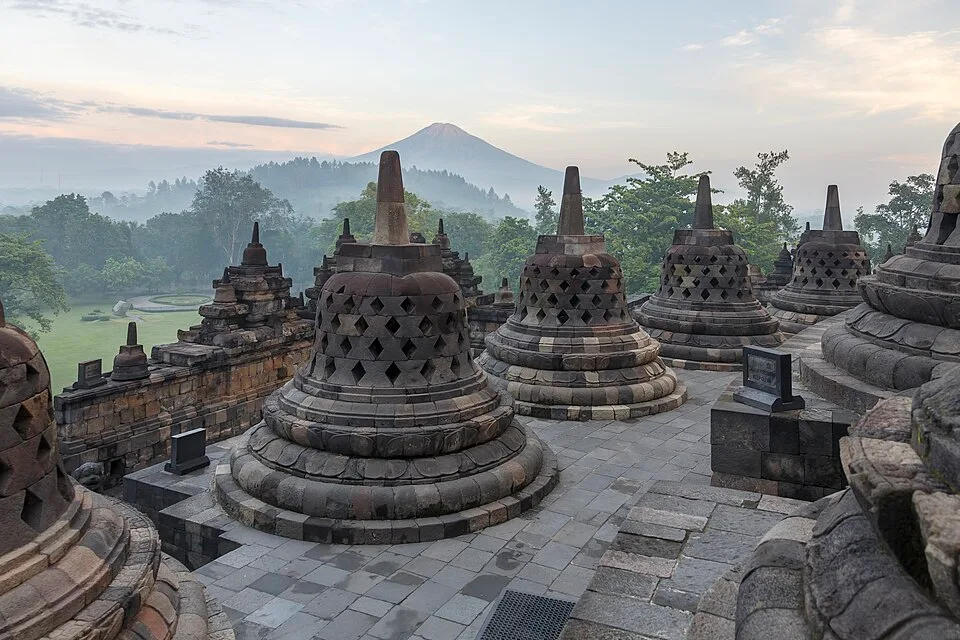
Borobudur-Temple-Park Indonesia Stupas-of-Borobudur-09
Borobudur-Temple-Park Indonesia Stupas-of-Borobudur-09 | CEphoto, Uwe Aranas (CC BY-SA 3.0)

Conservation and Modern Research

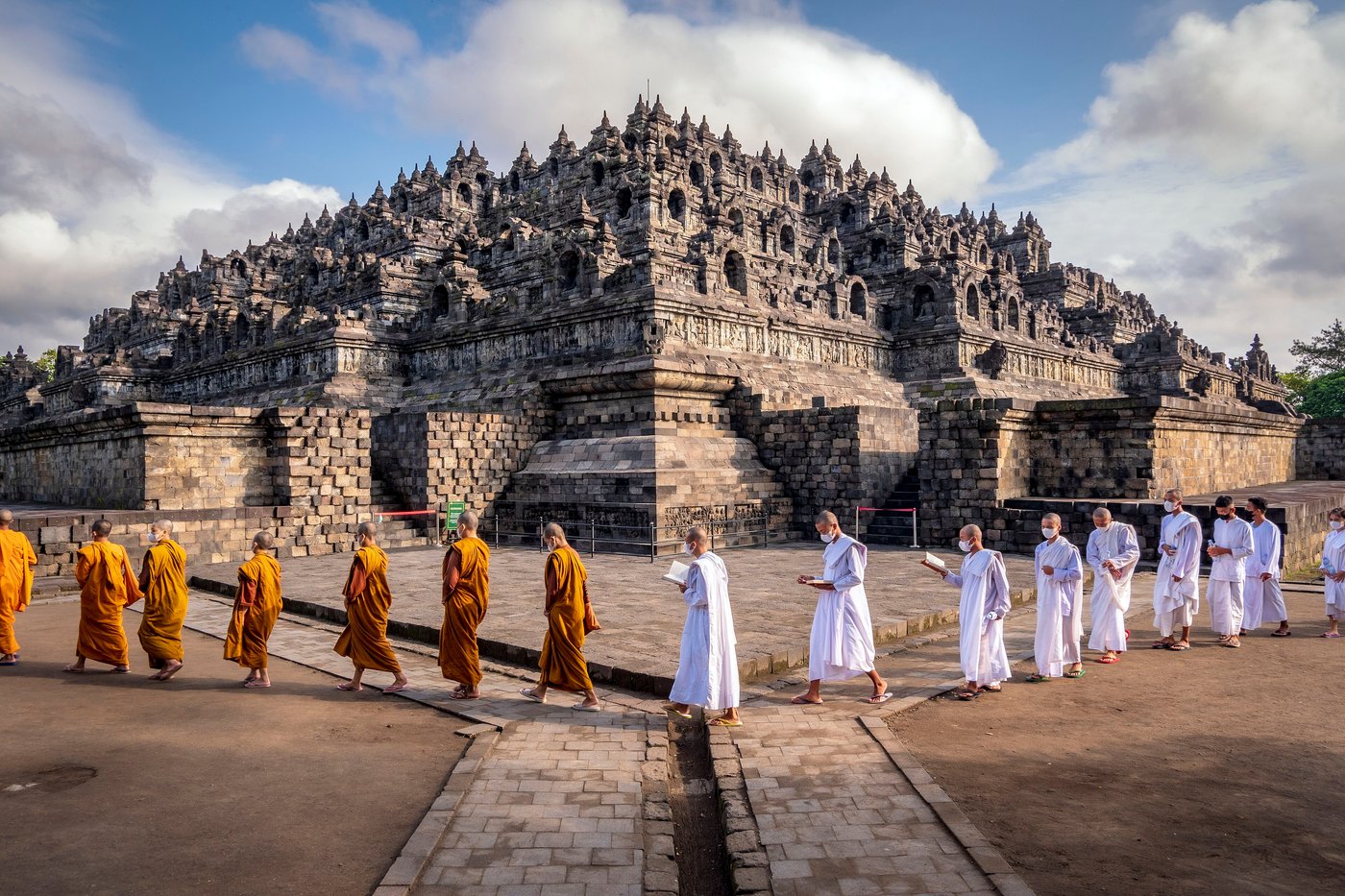
A major restoration was conducted by Theo van Erp from 1907–1911, focusing on stabilizing the structure and cleaning reliefs. From 1973–1983, a comprehensive UNESCO-sponsored project dismantled and rebuilt large sections to install drainage systems and strengthen foundations. Borobudur was inscribed as a UNESCO World Heritage Site in 1991. It remains a place of active Buddhist pilgrimage, notably during Vesak, and is one of Indonesia’s most visited monuments. Scholarly debate continues on its precise chronology, the meaning of its mandala design, and the nature of its original rituals.

重要性

Borobudur is the world’s largest Buddhist temple and a culmination of the Sailendra Dynasty’s architectural and religious ambition, demonstrating the extensive maritime trade networks that brought Indian Buddhist concepts to insular Southeast Asia. Its intricate reliefs provide a visual encyclopedia of 8th–9th century Javanese society, cosmology, and Mahayana Buddhist doctrine, while its sophisticated mandala design influenced later Southeast Asian monuments.

証拠と解釈

確立された事実と議論が続く事柄を区別する。

確立された事実

3
  • Borobudur comprises nine stacked platforms—six square and three circular—with a central stupa at the summit.
  • The monument features over 2,600 narrative relief panels spanning nearly 2 kilometers.
  • It was built during the Sailendra Dynasty, likely between the late 8th and mid-9th centuries CE.

学術的推論

2
  • The original name of the monument may have been 'Bhumisambharabhudhara' or similar, based on a 9th-century inscription from Candi Mendut, suggesting it was considered a mountain of Buddhist merit.
  • The temple was abandoned following a volcanic eruption or political reorientation in the 10th century CE.

議論のある解釈

2
  • Whether Borobudur functioned primarily as a pilgrimage site, a royal mortuary, or a monastic university remains contested among scholars.
  • The precise date of its foundation and the identity of the ruling monarch at the time of its inception are actively debated.

発見と発掘調査

1814–1815

Rediscovery and Initial Clearing

指揮 H.C. Cornelius

H.C. Cornelius, under orders of Stamford Raffles, cut vegetation and exposed the upper terraces.

1885

Discovery of Hidden Foot

指揮 A.W. Nieuwenkamp

A.W. Nieuwenkamp proposed that a buried relief panel on the lowest level depicted the Karmawibhangga text, leading to partial excavations confirming an additional series of 160 hidden panels.

1907–1911

Van Erp Restoration

指揮 Theo van Erp

Theo van Erp led the first major conservation, cleaning reliefs and stabilizing the structure.

1973–1983

UNESCO Master Plan for Borobudur

指揮 Indonesian Ministry of Culture and UNESCO

A massive project dismantled and rebuilt large portions of the monument to install drainage and reinforce foundations, co-financed by UNESCO and the Indonesian government.

コミュニティ写真

あなたの体験を共有する

この遺跡を訪れたことがありますか?写真をアップロードして魅力を共有しましょう。

このページの引用方法

Atlas Anatolia. (778). Borobudur. Atlas Anatolia. https://atlasanatolia.com/ja/site/borobudur

コンテンツはCC BY-SA 4.0ライセンスの下で提供されています — 再利用の際は出典表示が必要です。

出典

  • Soekmono (1976), Chandi Borobudur: A Monument of Mankind — Soekmono (1976)
  • Miksic, John (1990), Borobudur: Golden Tales of the Buddhas — John Miksic (1990)
  • Degroot, Véronique (2009). 'The Archaeological Remains of the Sailendra Dynasty: A Preliminary Survey.' Bulletin de l'École française d'Extrême-Orient 95-96: 281-306. — Véronique Degroot (2009)
  • Woodward, Hiram (2004). 'Esoteric Buddhism in Southeast Asia in the Light of Recent Scholarship.' Journal of Southeast Asian Studies 35(2): 329-354. — Hiram Woodward (2004)
  • UNESCO World Heritage entry for Borobudur Temple Compoundsリンク

よくある質問

Borobudurはどこにありますか?

BorobudurはCentral Java, Magelang, Indonesiaに位置しています。

Borobudurの年代はいつ頃ですか?

Borobudurはおよそ778 西暦 – 850 西暦のものとされています。

Borobudurはどの文明に関連していますか?

BorobudurはSrivijaya / Sailendra文明に関連しています。

Borobudurが重要な理由は何ですか?

Borobudur is the world’s largest Buddhist temple and a culmination of the Sailendra Dynasty’s architectural and religious ambition, demonstrating the extensive maritime trade networks that brought Indian Buddhist concepts to insular Southeast Asia.

Borobudurはユネスコ世界遺産ですか?

はい — Borobudurはユネスコ世界遺産に登録されています。