Skip to content
Atlas Anatolia
Dig
NewsNeolithic malachite and copper workshop exposed at Çayönü Tepesi, ErganiNature lidar survey estimates tens of thousands of earthworks in southwest Amazonia
Jebel Barkal sandstone butte and temple ruins beside the Nile, Sudan

Wikimedia Commons (public domain / CC)

Continent Record

Oldest Complex in Africa

ComplexUNESCOFeatured

Jebel Barkal

جبل بركل1450 BCE – 400 CE

A sandstone butte and temple complex at the Fourth Cataract bend of the Nile in Sudan, sacred to Amun and the religious heart of Napata, capital of the Kushite 25th Dynasty kings who ruled Egypt. UNESCO-listed with Napatan–Meroitic cemeteries.

111
Interest 49

Location

Sudan

18.54°N · 31.83°E · Africa

UNESCO

Gebel Barkal and the Sites of the Napatan Region (2003)

Role

Religious capital of Napata / Kushite 25th Dynasty

Cult

Amun of Napata at Temple B 500

Cemeteries

El-Kurru and Nuri royal pyramids nearby

Jebel Barkal is where Nubian kingship and Egyptian Amun theology fused into an African imperial capital that conquered Thebes.”

Location

Overview

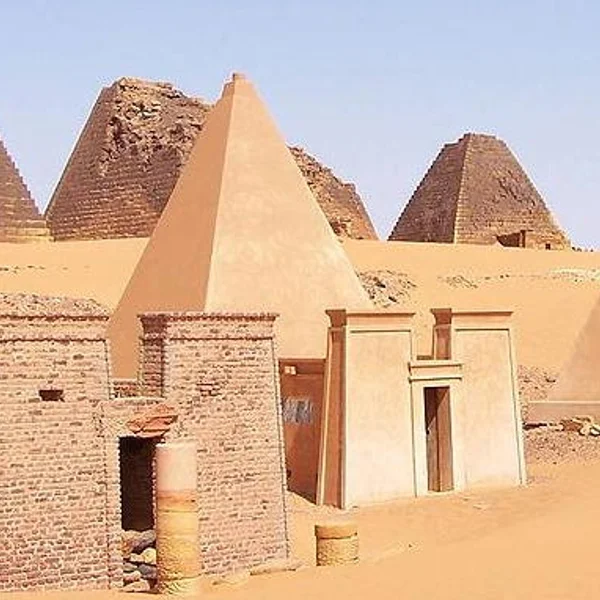
Jebel Barkal rises abruptly beside the Nile near Karima. Egyptians of the New Kingdom already treated the mountain as a southern home of Amun; Nubian Kushite kings of the 25th Dynasty (Piye, Taharqo, and others) made Napata their coronation landscape. Temples (B 500 and others), palaces, and the nearby royal cemeteries of El-Kurru and Nuri form one archaeological zone. Taharqo’s inscriptions and the ram-headed sphinxes proclaim Amun of Napata as kingmaker.

After the Assyrian expulsion from Egypt, Napata remained Kush’s holy city even as political gravity shifted south to Meroë. Harvard–Museum of Fine Arts and later Sudanese–international missions mapped the Amun temple, the pinnacle’s “uraeus” silhouette, and the relationship to pyramid fields downstream. The mountain’s profile—read as a natural cobra—explains its theology as much as any built shrine.

Pair with Meroe and Kerma for the full Kushite arc, and with Karnak for Amun’s northern twin.
Why It Matters

Jebel Barkal is where Nubian kingship and Egyptian Amun theology fused into an African imperial capital that conquered Thebes. Atlases that skip Napata leave the 25th Dynasty looking like an Egyptian footnote instead of a Kushite project.

Evidence & Interpretation

Distinguishing what is well-established from what remains debated.

Well-Established Facts

1
  • Temples, stelae, and royal cemeteries document Napata as the sacred centre of Kushite kingship including the 25th Dynasty.

Scholarly Inferences

1
  • The butte’s cobra-like pinnacle was intentionally read as a uraeus, anchoring Amun’s southern theology in landscape.

Debated Interpretations

1
  • How early a full Amun temple stood at Barkal in the New Kingdom versus a later Kushite monumentalisation is still refined by excavation.

More Photos

Community Photos

Share your experience

Have you visited this site? Upload your photos to help others discover it.

How to cite this page

Atlas Anatolia. (1450). Jebel Barkal. Atlas Anatolia. https://atlasanatolia.com/site/jebel-barkal

Content licensed CC BY-SA 4.0 — attribution required when reusing.

Sources

  • Gebel Barkal and the Kingdom of KushKendall, Timothy (1997)
  • Gebel Barkal and the Sites of the Napatan RegionUNESCO (2003)Link

Frequently Asked Questions

Where is Jebel Barkal located?

Jebel Barkal is located in Sudan.

How old is Jebel Barkal?

Jebel Barkal dates to approximately 1450 BCE – 400 CE.

Which civilizations are associated with Jebel Barkal?

Jebel Barkal is associated with the Ancient Egyptian, Nubian / Kushite.

Why is Jebel Barkal important?

Jebel Barkal is where Nubian kingship and Egyptian Amun theology fused into an African imperial capital that conquered Thebes.

Is Jebel Barkal a UNESCO World Heritage Site?

Yes — Jebel Barkal is inscribed as a UNESCO World Heritage Site.