
콘텐츠로 건너뛰기
Atlas Anatolia
디그
뉴스술라웨시 빙하기 치아에서 빈랑 사용 25,000년 전까지 소급카스타모누 폼페이오폴리스 바실리카에서 로마 모자이크와 에로스 두상 발견
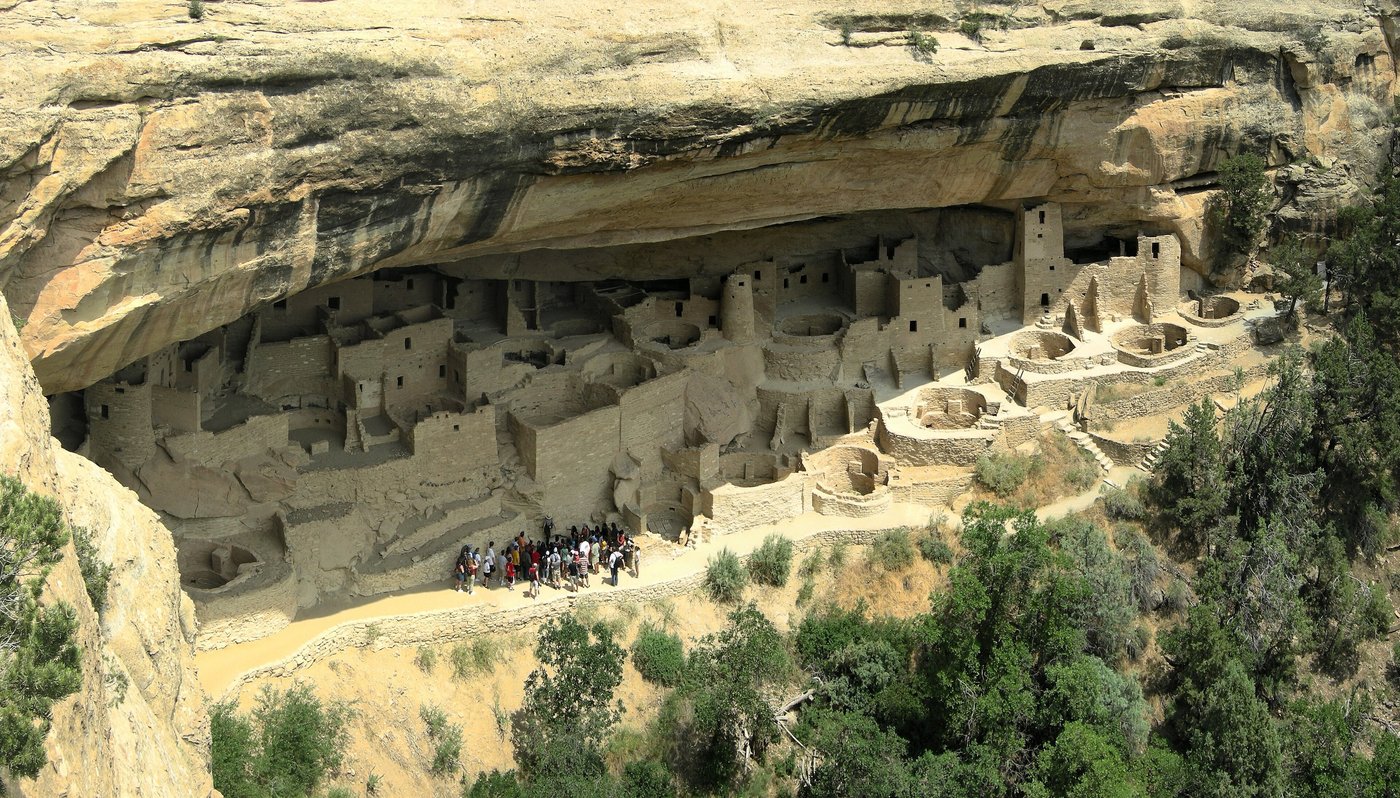
Mesa Verde — United States

Wikimedia Commons (CC BY-SA)

Continent Record

Oldest Complex in North America

복합 단지유네스코주요

Mesa Verde

Seyfi Cem Baskin

600 서기 – 1300 서기

Mesa Verde, in Colorado, USA, preserves elaborate cliff dwellings built by the Ancestral Pueblo people between 1190 and 1280 CE, reflecting a sophisticated pre-Columbian society.

421
관심 78

위치

Colorado · Four Corners · 미국

37.19°N · 108.49°W · 북아메리카

Built

1190–1280 CE (major cliff dwellings)

Civilization

Ancestral Puebloans

Discovered

1888 by Richard Wetherill and Charlie Mason

Status

UNESCO World Heritage Site (1978)

Abandoned

By 1300 CE

Structures

Over 4,500 sites, including 600 cliff dwellings

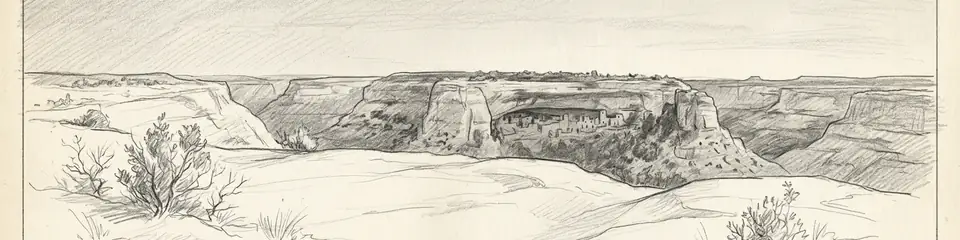
Graphite pencil sketch banner of Mesa Verde

“Mesa Verde represents the apex of Ancestral Puebloan cliff-dwelling culture, showcasing sophisticated communal planning and environmental adaptation.”

위치

개요

Mesa Verde, meaning 'green table' in Spanish, is a sandstone-capped plateau in southwestern Colorado cut by steep canyons. For over 700 years, it was home to the Ancestral Pueblo people, who progressed from pit houses on mesa tops to the iconic multi-story cliff dwellings that cling to canyon walls. The archaeological landscape comprises over 4,500 sites, including 600 cliff dwellings, spanning from approximately 600 to 1300 CE, with the most intensive occupation and construction occurring in the 13th century. Mesa Verde National Park, established in 1906, protects this concentration of dwellings and religious structures, offering an unparalleled window into the lives, ingenuity, and eventual departure of one of North America's most advanced pre-Columbian cultures.

Discovery and Documentation

Mesa Verde's cliff dwellings were known to local Ute and Navajo peoples, but they entered Euro-American awareness after rancher Richard Wetherill and his brother-in-law Charlie Mason spotted Cliff Palace in 1888 during a winter expedition. Wetherill enthusiastically collected artifacts and guided visitors, while Swedish archaeologist Gustaf Nordenskiöld conducted the first systematic excavations in 1891, meticulously documenting finds and publishing 'The Cliff Dwellers of the Mesa Verde' (1893)—a work that sparked international scholarly interest. Following the creation of the national park, professional archaeologists such as Jesse Nusbaum (1908–1922) and later the Wetherill Mesa Archaeological Project (1958–1963) undertook extensive survey, excavation, and stabilization. These efforts established the chronological framework and cultural context, revealing a long arc of Basketmaker and Puebloan settlement.
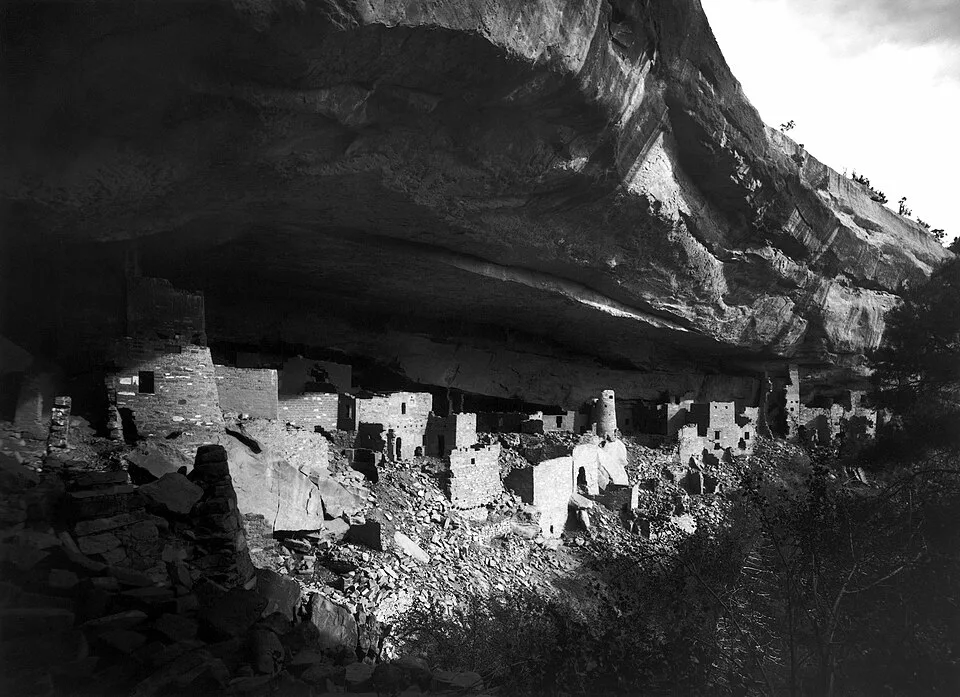
Mesa-Verde---Cliff-Palace-in 1891 - edit1
Mesa-Verde---Cliff-Palace-in 1891 - edit1 | Gustaf Nordenskiöld, edit of en:Image:Mesa Verde - Cliff Palace in 1891.jpg by Andrew c to reduce du (Public domain)
"There it was — a little city of stone, asleep. It was as still as sculpture, and something like that. Far above me, a thousand feet or so, was an over-hanging cliff. From the floor of this cavern to the highest tower stood the Cliff Palace."
— Willa Cather, The Professor's House, on Mesa Verde (1925), drawing on Richard Wetherill's 1888 first sighting

Architecture and Settlement

The Ancestral Puebloans initially built semi-subterranean pit houses on the mesa tops during the Basketmaker period (600–750 CE). During Pueblo I and II (750–1150 CE), they constructed above-ground room blocks of adobe and stone, along with increasingly elaborate kivas. The most iconic phase—Pueblo III (1150–1280 CE)—witnessed a dramatic relocation into natural sandstone alcoves, where multi-story villages were erected using shaped sandstone blocks and adobe mortar, supported by wooden beams carried up from valleys. Cliff Palace, the largest dwelling, contains 150 rooms and 23 kivas; other notable examples include Balcony House, Spruce Tree House, and Long House. These structures exhibit sophisticated masonry styles, T-shaped doorways, and tower-like structures suggestive of both defense and ritual. Great kivas, integrated into many communities, underscore the role of communal ceremony.
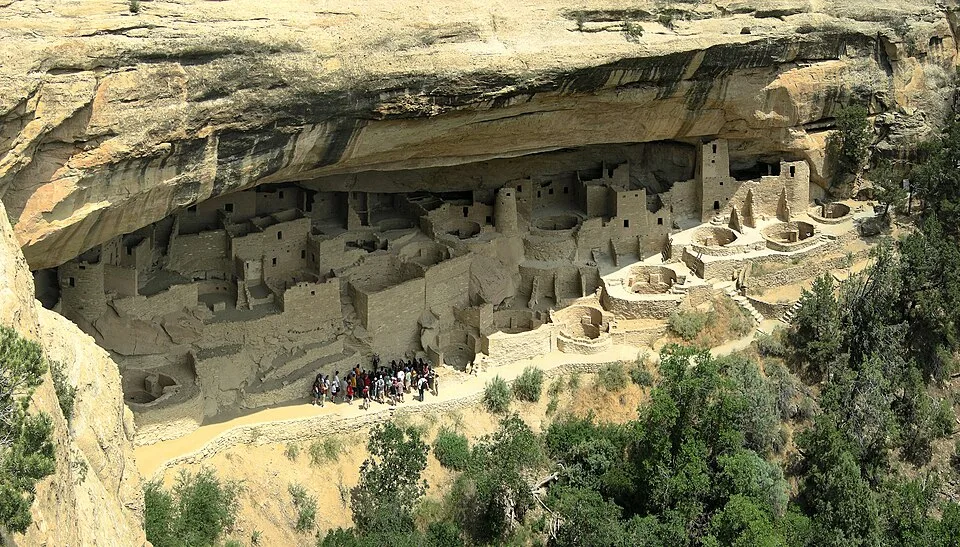
Cliff Palace-Colorado-Mesa Verde NP
Cliff Palace-Colorado-Mesa Verde NP | Tobi 87 (CC BY-SA 4.0)

Cultural Context and Abandonment

Mesa Verde supported a complex society that practiced dry farming of maize, beans, and squash, supplemented by hunting of deer and rabbits and gathering of wild plants. Trade networks extended to the Pacific coast (shells) and Mesoamerica (copper bells and macaws). Tree-ring dates indicate that the final construction surge occurred between 1240 and 1280, but by 1300, the entire region was depopulated. Scholars generally agree that a combination of severe drought, overexploitation of resources, and perhaps social stress prompted migration south to the Rio Grande valley and other Pueblo areas. Evidence of violence is sparse but concentrated toward the end, including a few unburied bodies and burned structures, yet interpretations of cannibalism or warfare remain contested. The precise triggers and pace of the exodus continue to animate archaeological debate.

Significance

Designated a UNESCO World Heritage Site in 1978, Mesa Verde stands as the largest and most intact archaeological preserve of Ancestral Puebloan culture in the United States. Its cliff dwellings represent an extraordinary marriage of architecture and landscape, demonstrating advanced engineering, community planning, and adaptation to a challenging environment. The site holds deep cultural meaning for modern Pueblo peoples, including the Hopi, Zuni, and others, who regard it as an ancestral place. Ongoing conservation and interpretation balance scientific inquiry with respect for indigenous heritage, making Mesa Verde a cornerstone of North American archaeology.

중요성

Mesa Verde represents the apex of Ancestral Puebloan cliff-dwelling culture, showcasing sophisticated communal planning and environmental adaptation. Its well-preserved architecture and abandonment record provide critical insights into pre-Columbian societal resilience and reorganization. As a living ancestral landscape for modern Pueblo peoples, it bridges a thousand-year continuum of cultural tradition.

증거와 해석

확립된 사실과 논쟁 중인 사항을 구분합니다.

잘 확립된 사실

4
  • Tree-ring dating confirms that the major cliff dwellings were constructed between 1190 and 1280 CE.
  • The Ancestral Puebloans cultivated maize, beans, and squash using dry farming and runoff irrigation.
  • Mesa Verde was designated a UNESCO World Heritage Site in 1978.
  • The site contains over 4,500 archaeological sites, including 600 cliff dwellings.

학술적 추론

2
  • The construction of cliff dwellings likely functioned partly for defensive purposes given their difficult access.
  • Prolonged drought and resource depletion were primary factors in the migration from Mesa Verde around 1300 CE.

논쟁 중인 해석

1
  • Whether social conflict, cannibalism, or religious upheaval were main drivers of abandonment is still debated among archaeologists.

발견과 발굴

Ongoing conservation

지휘 National Park Service

National Park Service conservators continuously monitor, stabilize, and research the cliff dwellings to address erosion and structural fatigue.

1888–1890

Richard Wetherill's early explorations

지휘 Richard Wetherill

Richard Wetherill and family discovered and extensively collected artifacts from Cliff Palace and other sites, popularizing Mesa Verde.

1891–1891

First scientific excavations

지휘 Gustaf Nordenskiöld

Gustaf Nordenskiöld conducted systematic excavations at Cliff Palace and other dwellings, publishing influential findings and advocating for site preservation.

1908–1922

Early NPS investigations

지휘 Jesse Nusbaum

Jesse Nusbaum, as park custodian and archaeologist, carried out stabilization and excavation, establishing baseline documentation.

1958–1963

Wetherill Mesa Archaeological Project

지휘 National Park Service and multiple universities

A large-scale National Park Service and university collaboration that surveyed, excavated, and analyzed sites on Wetherill Mesa, greatly expanding knowledge of Pueblo III life.

커뮤니티 사진

당신의 경험을 공유하세요

이 유적지를 방문하셨나요? 다른 탐험가들을 위해 사진을 업로드해 보세요.

이 페이지 인용 방법

Atlas Anatolia. (600). Mesa Verde. Atlas Anatolia. https://atlasanatolia.com/ko/site/mesa-verde

콘텐츠는 CC BY-SA 4.0 라이선스에 따라 제공됩니다 — 재사용 시 출처 표시가 필요합니다.

출처

  • Nordenskiöld (1893), The Cliff Dwellers of the Mesa Verde — Gustaf Nordenskiöld (1893)
  • Noble (2006), Ancient Ruins of the Southwest: An Archaeological Guide — David Grant Noble (2006)
  • Lipe (1995), The Depopulation of the Northern San Juan: Conditions in the Turbulent 1200s, Journal of Anthropological Archaeology 14(2): 143-169 — William D. Lipe (1995)
  • Cordell (1997), Archaeology of the Southwest, 2nd ed., Academic Press — Linda S. Cordell (1997)
  • UNESCO World Heritage Centre - Mesa Verde National Park링크

자주 묻는 질문

Mesa Verde은(는) 어디에 위치해 있나요?

Mesa Verde은(는) Colorado, Four Corners, United States에 위치해 있습니다.

Mesa Verde의 연대는 언제인가요?

Mesa Verde의 연대는 대략 600 서기 – 1300 서기로 거슬러 올라갑니다.

Mesa Verde과(와) 관련된 고대 문명은 무엇인가요?

Mesa Verde은(는) Ancestral Puebloan 문명과 관련이 있습니다.

Mesa Verde이(가) 중요한 이유는 무엇인가요?

Mesa Verde represents the apex of Ancestral Puebloan cliff-dwelling culture, showcasing sophisticated communal planning and environmental adaptation.

Mesa Verde은(는) 유네스코 세계유산인가요?

예 — Mesa Verde은(는) 유네스코 세계유산으로 등재되어 있습니다.