
콘텐츠로 건너뛰기
Atlas Anatolia
디그
뉴스술라웨시 빙하기 치아에서 빈랑 사용 25,000년 전까지 소급카스타모누 폼페이오폴리스 바실리카에서 로마 모자이크와 에로스 두상 발견
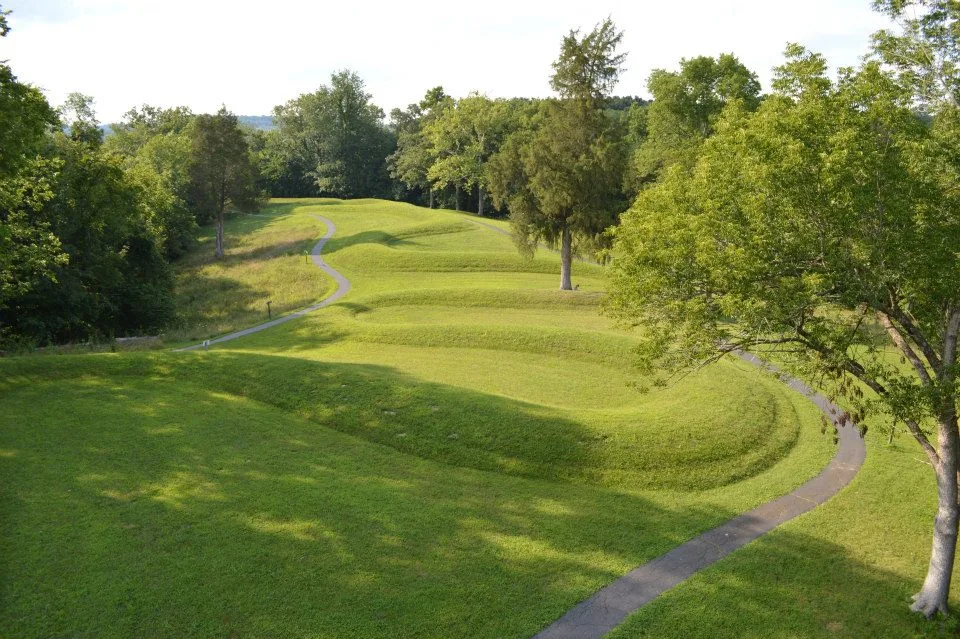
Aerial view of the Great Serpent Mound, a 411-metre serpentine effigy earthwork in Adams County, Ohio

Wikimedia Commons

Country Record

Oldest Monument in United States

기념물

Serpent Mound

Seyfi Cem Baskin

Great Serpent Mound300 기원전 – 1070 서기

The largest serpent-effigy earthwork on Earth — a sinuous, 411-metre-long mound shaped like an uncoiling snake, built atop a ridge overlooking a Ohio Brush Creek in southern Ohio. Who built it and when remains one of North American archaeology's more contested questions: early 20th-century excavation attributed it to the Adena culture around 300 BCE, while 1990s radiocarbon dating pointed instead to the later Fort Ancient culture around 1070 CE — a debate that has never been fully resolved.

211
관심 67

위치

Adams County · Ohio · 미국

39.02°N · 83.43°W · 북아메리카

Length

411 m (1,348 ft) — the largest serpent effigy earthwork known

Dating dispute

Adena (c. 300 BCE) per 1880s excavation vs. Fort Ancient (c. 1070 CE) per 1996 radiocarbon dating

No burials

Unlike typical regional mounds, no artefacts or remains found within the effigy

Astronomy

Coils align with solstice and equinox sun positions

Status

National Historic Landmark (1966); UNESCO Tentative List

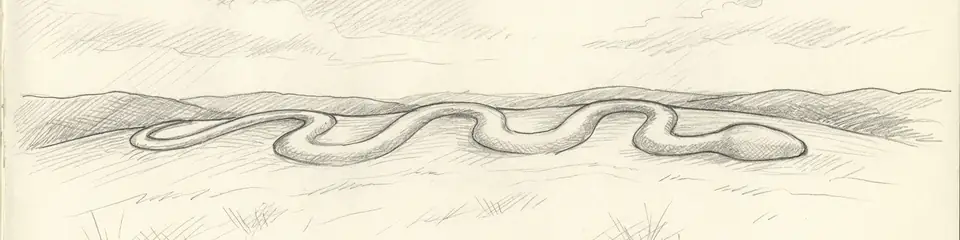
Graphite pencil sketch banner of Serpent Mound

“Serpent Mound is a textbook case study in how a single dating technique can overturn a century of settled scholarly consensus — and how even a definitive-seeming radiocarbon date does not always resolve a debate cleanly, since the 1996 findings themselves have been contested on methodological grounds by researchers favouring the older Adena attribution.”

위치

개요

Serpent Mound sits atop a plateau overlooking a horseshoe bend of Ohio Brush Creek in Adams County, southern Ohio. The earthwork forms an undulating serpentine shape 411 metres (1,348 feet) long and up to 1.5 metres high, with seven distinct coils culminating in a triangular head aligned toward the summer solstice sunset, and a tightly coiled tail at the opposite end. An oval earthwork at the head, often interpreted as an egg being swallowed or an eye, adds to the figure's enigmatic composition. No burials or artefacts were found within the effigy itself, distinguishing it from the burial mounds commonly built by contemporary Ohio Valley cultures.

The mound's cultural attribution has shifted more than once. Frederic Ward Putnam's pioneering excavations in the 1880s, which preserved the site by purchasing it for Harvard University's Peabody Museum (later transferred to the Ohio Historical Society), associated the earthwork with the Adena culture (roughly 800 BCE – 100 CE) based on nearby burial mounds and the broader regional pattern of Adena effigy and geometric earthworks. This Adena attribution held as the standard scholarly view for over a century.

In 1996, however, radiocarbon dating of charcoal recovered from within the mound's fill produced dates clustering around 1070 CE, squarely within the later Fort Ancient culture period (circa 1000–1650 CE) — a Mississippian-influenced society quite distinct from the Adena. This finding prompted a significant reassessment, with some researchers proposing the effigy was built or substantially rebuilt by Fort Ancient people, possibly incorporating and reshaping an earlier Adena-era structure. Subsequent research has not settled the question definitively; some archaeologists continue to favour Adena origins with later Fort Ancient repair or reuse, while others accept a primarily Fort Ancient construction date.

Astronomical alignment studies have found that the serpent's coils correspond with notable precision to solstice and equinox sunrise/sunset positions as observed from the effigy, suggesting its builders — whichever culture is ultimately credited — incorporated careful astronomical observation into the design. Serpent Mound was designated a National Historic Landmark in 1966 and is one of the entries on the U.S. National Park Service's Tentative List for UNESCO World Heritage status, as part of a broader nomination of Ohio Hopewell-culture ceremonial earthworks.

중요성

Serpent Mound is a textbook case study in how a single dating technique can overturn a century of settled scholarly consensus — and how even a definitive-seeming radiocarbon date does not always resolve a debate cleanly, since the 1996 findings themselves have been contested on methodological grounds by researchers favouring the older Adena attribution. It is a valuable teaching example of archaeology as an ongoing, revisable process rather than a fixed set of answers. As the largest and most sophisticated serpent effigy known anywhere in the world, the mound demonstrates the scale of collective earthmoving labour and long-range planning that non-state, small-scale societies in the pre-Columbian Ohio Valley were capable of organising — comparable in ambition, if not in method, to the monumental earthworks of Poverty Point centuries earlier. The apparent solstice and equinox alignments built into the serpent's coils place it within a wider North American tradition of earthworks encoding astronomical observation into monumental form, offering insight into how the site's builders understood and marked the passage of the year without a written calendar.

증거와 해석

확립된 사실과 논쟁 중인 사항을 구분합니다.

잘 확립된 사실

2
  • Radiocarbon dating of charcoal from within the mound's fill, conducted in 1996, produced dates clustering around 1070 CE, within the Fort Ancient cultural period.
  • Archaeoastronomical survey confirms that the serpent's head aligns with the summer solstice sunset, and other coils correspond with reasonable precision to additional solstice and equinox positions.

학술적 추론

1
  • The absence of burials or artefacts within the mound suggests a primarily ceremonial or symbolic function distinct from the burial mounds common elsewhere in the region, though the specific meaning of the serpent form itself is not independently confirmed.

논쟁 중인 해석

1
  • Whether the effigy was originally built by the Adena culture (c. 300 BCE, based on 1880s excavation and regional context) or primarily by the Fort Ancient culture (c. 1070 CE, based on radiocarbon dating) remains an unresolved scholarly dispute; some researchers propose an Adena origin with later Fort Ancient rebuilding.

발견과 발굴

1886–1889

Frederic Ward Putnam excavation and preservation

Pioneering excavation and site purchase for Harvard's Peabody Museum, establishing the Adena attribution that stood as consensus for a century.

1991–1996

Radiocarbon dating study

New excavation and radiocarbon dating of mound fill charcoal, producing dates supporting a Fort Ancient construction period and reopening the attribution debate.

커뮤니티 사진

당신의 경험을 공유하세요

이 유적지를 방문하셨나요? 다른 탐험가들을 위해 사진을 업로드해 보세요.

이 페이지 인용 방법

Atlas Anatolia. (300). Serpent Mound. Atlas Anatolia. https://atlasanatolia.com/ko/site/serpent-mound

콘텐츠는 CC BY-SA 4.0 라이선스에 따라 제공됩니다 — 재사용 시 출처 표시가 필요합니다.

출처

  • Serpent Mound: A Fort Ancient Icon? — Fletcher, Robert V. et al. (1996)
  • Ancient Monuments of the Mississippi Valley — Squier, Ephraim G. and Davis, Edwin H. (1848)
  • Ohio History Connection — Serpent Mound링크

자주 묻는 질문

Serpent Mound은(는) 어디에 위치해 있나요?

Serpent Mound은(는) Adams County, Ohio, United States에 위치해 있습니다.

Serpent Mound의 연대는 언제인가요?

Serpent Mound의 연대는 대략 300 기원전 – 1070 서기로 거슬러 올라갑니다.

Serpent Mound과(와) 관련된 고대 문명은 무엇인가요?

Serpent Mound은(는) Adena, Fort Ancient 문명과 관련이 있습니다.

Serpent Mound이(가) 중요한 이유는 무엇인가요?

Serpent Mound is a textbook case study in how a single dating technique can overturn a century of settled scholarly consensus — and how even a definitive-seeming radiocarbon date does not always resolve a debate cleanly, since the 1996 findings themselves have been contested on methodological grounds by researchers favouring the older Adena attribution.

Serpent Mound은(는) 유네스코 세계유산인가요?

Serpent Mound은(는) 현재 유네스코 세계유산 목록에 등재되어 있지 않습니다.