
コンテンツへスキップ
Atlas Anatolia
ニュースIce Age teeth in Sulawesi push betel-nut use back as far as 25,000 yearsRoman mosaic and Eros head uncovered in the basilica at Pompeiopolis, Kastamonu
Courtyard and domes of the Blue Mosque (Sultan Ahmed Mosque), Istanbul

Wikimedia Commons (CC BY-SA 4.0)

Country Record

Known by the Most Names in Turkey

遺産神殿注目

Blue Mosque

Seyfi Cem Baskin

Sultanahmet Camii1609 西暦 – 1617 西暦

The early 17th-century imperial mosque facing Hagia Sophia in Istanbul — six minarets, cascading domes, and Iznik tiles that earned it the nickname "Blue Mosque" — is among the most searched Ottoman monuments in Turkish, German, and English Wikipedia.

21
関心 81

所在地

トルコ

41.01°N · 28.98°E · ヨーロッパ

Built

1609–1617 CE under Sultan Ahmed I

Architect

Sedefkar Mehmed Aga (student of Sinan)

Minarets

Six — controversial at completion

Tiles

20,000+ Iznik ceramic tiles in prayer hall

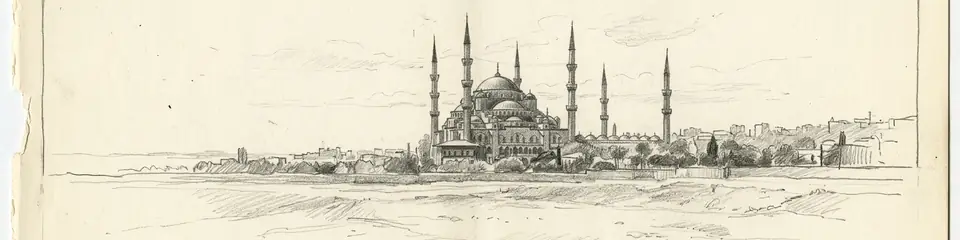
Graphite pencil sketch banner of Blue Mosque

“The Blue Mosque closes the arc from Byzantine dome architecture to Ottoman imperial mosque design — Mehmed Aga's answer to Hagia Sophia across the square.”

所在地

概要

The Sultan Ahmed Mosque stands on the historical peninsula of Istanbul, directly opposite Hagia Sophia and beside the Byzantine hippodrome. Sultan Ahmed I commissioned the building between 1609 and 1617 during a pause in Ottoman military expansion — a bold statement of piety when the empire could not match Selim II or Suleiman's conquests with new campaigns. Architect Sedefkar Mehmed Aga, a pupil of Sinan, synthesised his master's vocabulary with a cascade of domes and semi-domes around a central dome about 23 metres in diameter.

The interior owes its popular name to more than 20,000 Iznik tiles in turquoise and cobalt floral patterns on the lower walls and galleries. Stained glass (much restored) once flooded the prayer hall with coloured light. Six minarets caused controversy at completion — only the Mecca sanctuary had six at the time — resolved by adding a seventh minaret in Mecca. The mosque remains an active place of worship; visitors enter outside prayer times through the courtyard gate.

The complex (külliye) originally included a hospital, school, market, and the sultan's tomb. Ahmed I is buried in the türbe on the north side. Together with Hagia Sophia and the Basilica Cistern, Sultanahmet Square forms Istanbul's densest cluster of Byzantine and Ottoman superstars.

重要性

The Blue Mosque closes the arc from Byzantine dome architecture to Ottoman imperial mosque design — Mehmed Aga's answer to Hagia Sophia across the square. Its Iznik tile programme is a high-water mark of 17th-century ceramic production and a primary reason Istanbul dominates Turkish-language heritage search.

証拠と解釈

確立された事実と議論が続く事柄を区別する。

確立された事実

2
  • Ottoman foundation charters (vakfiye) and inscriptions date construction and name Ahmed I and Mehmed Aga.
  • Iznik tile batches match early 17th-century workshop styles documented in ceramic studies.

学術的推論

1
  • Six minarets were intended to rival or echo Mecca's sanctuary — inferred from contemporary court accounts.

コミュニティ写真

あなたの体験を共有する

この遺跡を訪れたことがありますか?写真をアップロードして魅力を共有しましょう。

このページの引用方法

Atlas Anatolia. (1609). Blue Mosque. Atlas Anatolia. https://atlasanatolia.com/ja/site/blue-mosque

コンテンツはCC BY-SA 4.0ライセンスの下で提供されています — 再利用の際は出典表示が必要です。

出典

  • A History of Ottoman Architecture — Goodwin, Godfrey (1971)
  • Turkish Ministry of Culture — Sultanahmet Mosqueリンク

よくある質問

Blue Mosqueはどこにありますか?

Blue MosqueはTurkeyに位置しています。

Blue Mosqueの年代はいつ頃ですか?

Blue Mosqueはおよそ1609 西暦 – 1617 西暦のものとされています。

Blue Mosqueはどの文明に関連していますか?

Blue MosqueはIslamic / Medieval, Ottoman文明に関連しています。

Blue Mosqueが重要な理由は何ですか?

The Blue Mosque closes the arc from Byzantine dome architecture to Ottoman imperial mosque design — Mehmed Aga's answer to Hagia Sophia across the square.

Blue Mosqueはユネスコ世界遺産ですか?

Blue Mosqueは現在ユネスコ世界遺産には登録されていません。