
콘텐츠로 건너뛰기
Atlas Anatolia
디그
뉴스술라웨시 빙하기 치아에서 빈랑 사용 25,000년 전까지 소급카스타모누 폼페이오폴리스 바실리카에서 로마 모자이크와 에로스 두상 발견
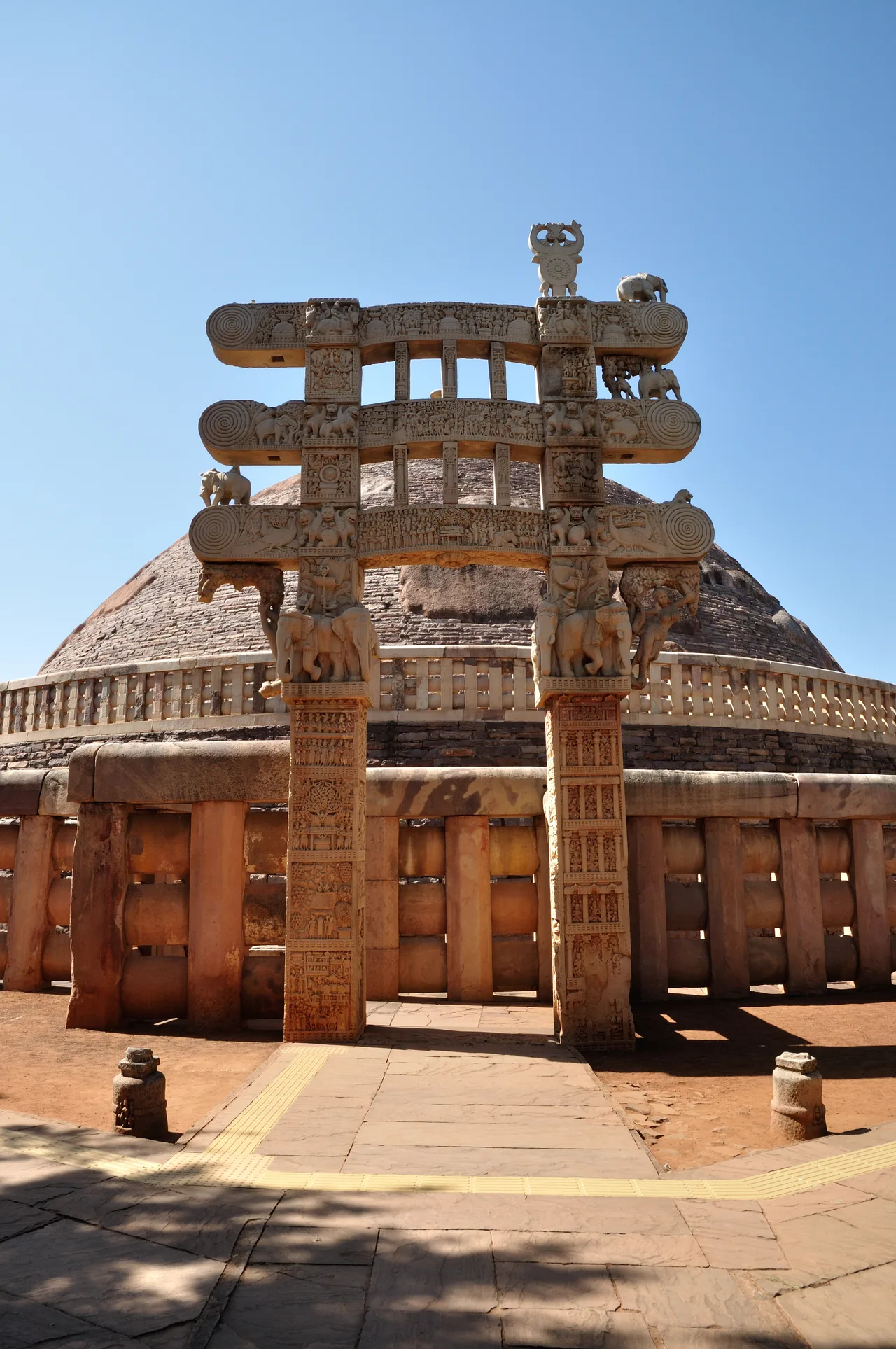
The Great Stupa of Sanchi, the oldest stone structure in Buddhist architecture

Wikimedia Commons

Country Record

Oldest Complex in India

복합 단지유네스코

Sanchi

Seyfi Cem Baskin

साँची269 기원전 – 1200 서기

A hilltop complex in Madhya Pradesh containing the oldest stone structure in Buddhist architecture — the Great Stupa commissioned by Emperor Ashoka in the 3rd century BCE — whose four carved gateways (toranas) rank among the greatest achievements of ancient Indian sculpture.

31
관심 68

위치

인도

23.48°N · 77.74°E · 아시아

Great Stupa founded

c. 269–232 BCE by Emperor Ashoka

Stupa dimensions

36.6 m diameter, 16.5 m height

Toranas added

1st century BCE – 1st century CE (four gateways)

Buddha representation

Aniconic — Buddha shown only by symbols, never in human form

UNESCO

World Heritage Site since 1989

Significance

Oldest stone Buddhist monument; prototype of all Asian stupas

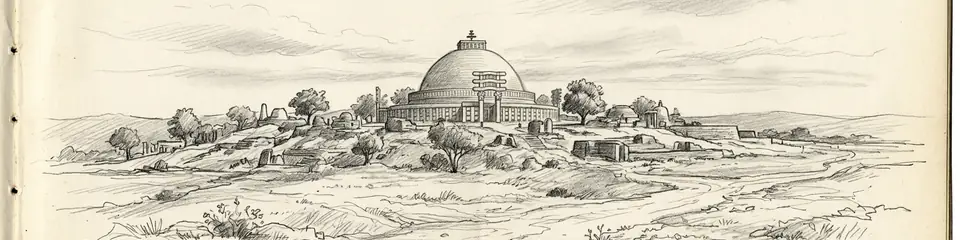
Graphite pencil sketch banner of Sanchi

“Sanchi is the physical origin point of Buddhist monumental architecture.”

위치

개요

Sanchi sits on a sandstone hilltop in the Raisen district of Madhya Pradesh, 46 km northeast of Bhopal. The site was chosen for Buddhist monasticism in the 3rd century BCE — possibly because of its proximity to Vidisha, a major city of the Mauryan empire and birthplace of Devi, the wife of Emperor Ashoka. According to Buddhist tradition, Ashoka's son Mahinda, who carried Buddhism to Sri Lanka, was raised and ordained at Sanchi.

The Great Stupa (Stupa No. 1) is the earliest stone structure in Buddhist architecture. It began as a simple hemispherical mound of brick and earth commissioned by Ashoka (c. 269–232 BCE), enclosing relics of the Buddha. In the 2nd century BCE, during the Shunga dynasty, it was enlarged to roughly twice its original size, encased in stone, and given a circumambulatory path (pradakshina path) on a raised drum. The stupa now stands 16.5 m high with a diameter of 36.6 m, topped by a three-tiered honorific umbrella (chattravali) and surrounded by a massive stone railing.

The four toranas (gateways) added in the 1st century BCE–1st century CE are the masterwork of early Indian narrative sculpture. Each gateway consists of two square pillars supporting three curved architraves, every surface densely carved with scenes from the Jataka tales (the past lives of the Buddha), the life of the historical Buddha, and scenes of worship. The Buddha himself is never depicted in human form in the early gateways — his presence is indicated by symbols (the Bodhi tree, footprints, a parasol, an empty throne) in a convention of aniconic representation that predates the Gandharan introduction of Buddha portraiture. The gateway carvings preserve the most complete visual narrative of early Buddhism that survives: the Maya Dream, the Temptation by Mara, the First Sermon at Sarnath, the Mahaparinirvana, and dozens of Jataka stories are represented.

The site fell out of use after the 13th century, was rediscovered by a British officer in 1818, and was partly excavated and restored in the late 19th and early 20th centuries by John Marshall.

중요성

Sanchi is the physical origin point of Buddhist monumental architecture. The stupa form that spread from India across Asia — to Tibet, China, Japan, Southeast Asia, and Sri Lanka as the dagoba, chedi, pagoda, and stupa — begins here. The toranas are the first great flowering of Indian stone sculpture: carved in an era before Buddha-images existed, they encode the entire early Buddhist visual vocabulary in relief panels that are simultaneously encyclopaedic and artistically commanding. The aniconic convention — representing the Buddha by his absence — raises a philosophical question about representation and presence that resonates across Buddhist thought. Sanchi is also a rare case of a site that preserves stratified Buddhist monumentality across nearly 1,500 years (3rd century BCE to 12th century CE) on a single hilltop.

증거와 해석

확립된 사실과 논쟁 중인 사항을 구분합니다.

잘 확립된 사실

3
  • An Ashokan pillar inscription at Sanchi confirms Ashoka's personal connection to the site; the polished sandstone pillar capital depicts four lions (similar to the Sarnath capital that became India's national emblem).
  • Reliquary boxes found inside Stupas 2 and 3 at Sanchi bear inscriptions naming their contents as relics of the Buddha's direct disciples Sariputra and Maudgalyayana, confirming the site's function as a relic shrine from the earliest period.
  • The four torana gateways were carved by ivory workers, as evidenced by a Brahmi inscription on the south gateway reading: "gift of the artisans of Vidisha" — identifying both the patronage community and the craft tradition.

학술적 추론

1
  • The aniconic Buddha convention in the Sanchi carvings — consistently representing the Buddha by the Bodhi tree, the wheel, the footprint, or the empty throne — reflects an early doctrinal position that the enlightened Buddha had passed beyond form and could not be depicted in human likeness.

커뮤니티 사진

당신의 경험을 공유하세요

이 유적지를 방문하셨나요? 다른 탐험가들을 위해 사진을 업로드해 보세요.

이 페이지 인용 방법

Atlas Anatolia. (269). Sanchi. Atlas Anatolia. https://atlasanatolia.com/ko/site/sanchi

콘텐츠는 CC BY-SA 4.0 라이선스에 따라 제공됩니다 — 재사용 시 출처 표시가 필요합니다.

출처

  • A Guide to Sanchi — John Marshall (1918)
  • The Stupa: Its Religious, Historical and Architectural Significance — Anna Libera Dallapiccola (ed.) (1980)
  • Archaeological Survey of India — Sanchi링크

자주 묻는 질문

Sanchi은(는) 어디에 위치해 있나요?

Sanchi은(는) India에 위치해 있습니다.

Sanchi의 연대는 언제인가요?

Sanchi의 연대는 대략 269 기원전 – 1200 서기로 거슬러 올라갑니다.

Sanchi과(와) 관련된 고대 문명은 무엇인가요?

Sanchi은(는) Vedic Indian, Mauryan 문명과 관련이 있습니다.

Sanchi이(가) 중요한 이유는 무엇인가요?

Sanchi is the physical origin point of Buddhist monumental architecture.

Sanchi은(는) 유네스코 세계유산인가요?

예 — Sanchi은(는) 유네스코 세계유산으로 등재되어 있습니다.