
콘텐츠로 건너뛰기
Atlas Anatolia
디그
뉴스술라웨시 빙하기 치아에서 빈랑 사용 25,000년 전까지 소급카스타모누 폼페이오폴리스 바실리카에서 로마 모자이크와 에로스 두상 발견
Kailasa Temple (Cave 16) at Ellora, carved from a single basalt outcrop, Maharashtra, India

Wikimedia Commons

Country Record

Longest Recorded History in India

복합 단지유네스코

Ellora Caves

Seyfi Cem Baskin

एलोरा गुंफा100 기원전 – 1100 서기

The world's largest rock-cut monastic and temple complex — 34 monasteries and shrines carved directly into a 2-kilometre basalt escarpment in Maharashtra, representing Buddhist, Hindu, and Jain traditions side by side. The Hindu Kailasa Temple (Cave 16), hewn from a single enormous rock in the 8th century CE, is the largest monolithic structure ever carved from stone and one of humanity's most audacious feats of rock-cut architecture.

31
관심 79

위치

Aurangabad · Maharashtra · 인도

20.03°N · 75.18°E · 아시아

Caves

34 rock-cut caves: 12 Buddhist, 17 Hindu, 5 Jain

Kailasa Temple

Largest monolithic structure ever carved from stone; 84 × 47 m, 30 m tall

Rock removed

c. 400,000 tonnes of basalt excavated to create Kailasa Temple alone

Span

8 centuries of continuous construction, c. 1st century BCE – 11th century CE

UNESCO

World Heritage Site 1983

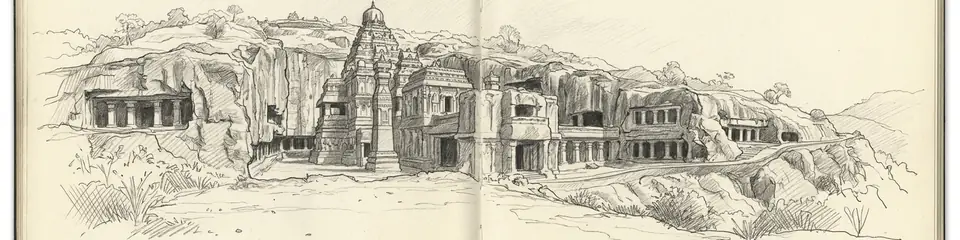
Graphite pencil sketch banner of Ellora Caves

“Ellora is the supreme demonstration of what Deccan rock-cut architecture could achieve.”

위치

개요

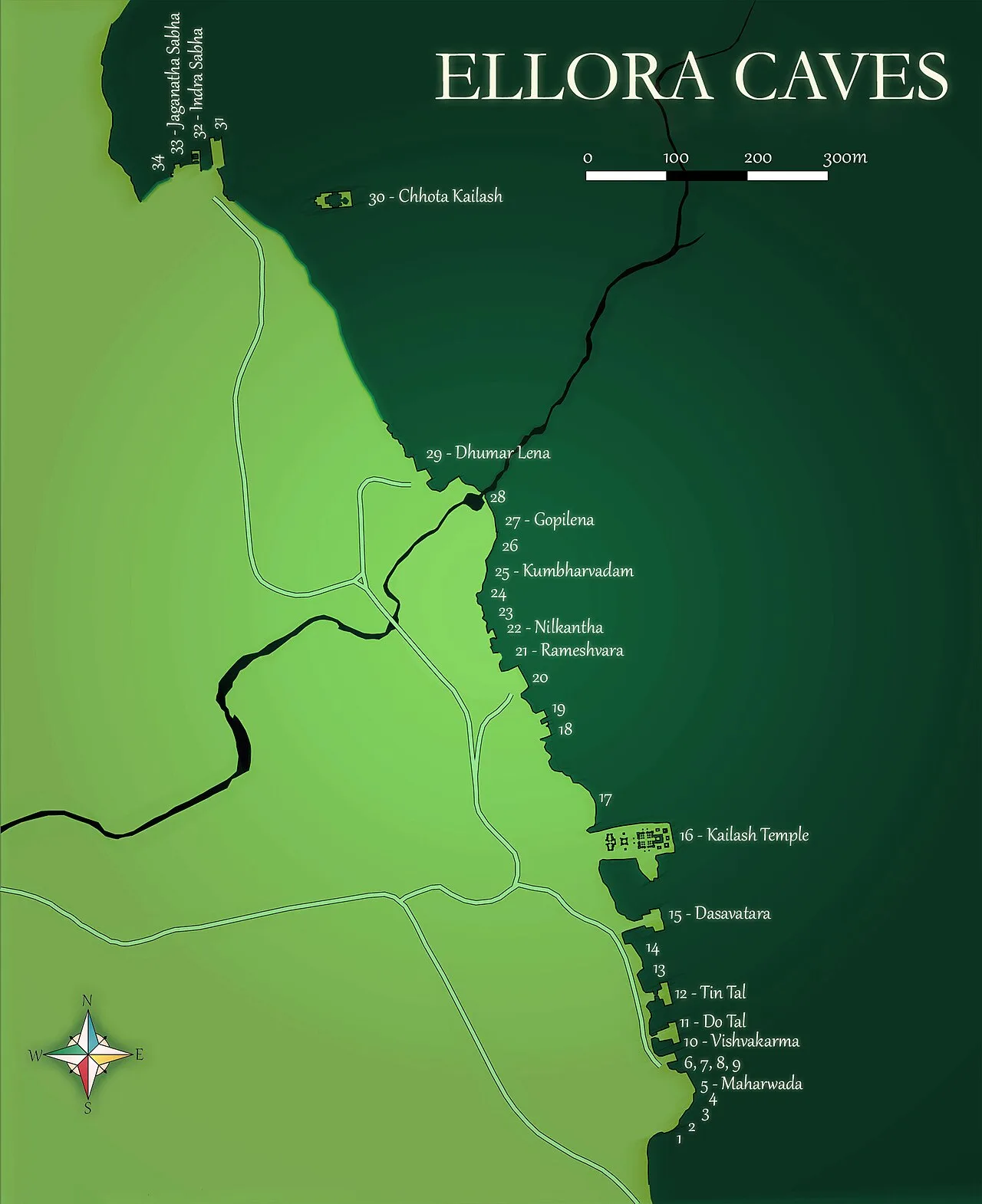
Ellora is located 29 kilometres from Aurangabad in Maharashtra, India. Its 34 rock-cut caves — numbered 1 to 34 — span roughly eight centuries of continuous construction from approximately the 1st century BCE to the 11th century CE, representing three religious traditions: 12 Buddhist caves (1–12, roughly 1st–7th century CE), 17 Hindu caves (13–29, roughly 5th–9th century CE), and 5 Jain caves (30–34, roughly 9th–11th century CE). The coexistence of these traditions at a single site reflects the religious pluralism of the Deccan plateau over this long period.

The Kailasa Temple (Cave 16) is the undisputed centrepiece. Commissioned by the Rashtrakuta king Dantidurga in the 8th century CE and completed under his successor Krishna I, it represents Mount Kailash — the cosmic abode of Shiva — carved directly from the living rock. Quarrymen excavated approximately 400,000 tonnes of rock (working from the top down rather than the inside out) to create a freestanding temple complex 84 metres long, 47 metres wide, and 30 metres tall — larger than the Parthenon and hewn from a single outcrop of basalt without separate building blocks. The temple is adorned with relief sculptures of extraordinary quality, including massive panels showing Ravana shaking Mount Kailash and Shiva and Parvati playing dice.

The Buddhist caves include some of the most refined vihara (monastery) architecture in India. Cave 1 is a simple hall; Cave 12 (Tin Thal) is a three-storey monastery with shrines to the Buddha and Bodhisattvas. The earliest Buddhist caves predate the Kailasa Temple by several centuries and show the evolution of cave temple architecture from austere Hinayana halls to elaborately sculpted Mahayana shrines.

The Jain caves, concentrated at the northern end of the cliff, are noted for their intricate ceiling carvings. Cave 32 (Indra Sabha) contains some of the finest Jain sculptures at the site. Ellora was inscribed as a UNESCO World Heritage Site in 1983.

중요성

Ellora is the supreme demonstration of what Deccan rock-cut architecture could achieve. The Kailasa Temple represents an entirely different approach to monumental architecture — rather than assembling elements, the builders removed everything that was not the temple, sculpting a complete complex from the surrounding rock with the accuracy of jewellers and the ambition of city planners. No scaffolding to erect, no foundations to lay, no joint to mortar: just subtraction on a colossal scale. Beyond the Kailasa, Ellora's greatest significance is its visible record of religious pluralism. Buddhist, Hindu, and Jain craftsmen and patrons commissioned monuments within walking distance of one another over eight centuries — evidence that Deccan India sustained a sophisticated culture of religious coexistence and shared aesthetic traditions that cut across sectarian lines. Ellora also marks the endpoint of India's great rock-cut tradition, which began at Ajanta (2nd century BCE) and reached its apex here. Together, Ajanta and Ellora represent the highest achievement of this uniquely South Asian architectural form.

증거와 해석

확립된 사실과 논쟁 중인 사항을 구분합니다.

잘 확립된 사실

3
  • Inscriptions of the Rashtrakuta king Dantidurga and his successor Krishna I confirm royal patronage of the Kailasa Temple (Cave 16) in the 8th century CE.
  • Geological mapping confirms that the entire Kailasa Temple complex was quarried from a single continuous basalt outcrop, excavated from the top downward — an approach fundamentally different from additive construction.
  • Radiocarbon dates and art-historical analysis of Buddhist caves place the earliest constructions (caves 6, 9, 10) in the early centuries CE, broadly consistent with the Satavahana and Vakataka periods.

학술적 추론

1
  • The coexistence of Buddhist, Hindu, and Jain caves at Ellora is interpreted as evidence of royal patronage extending across religious traditions, though the extent of deliberate pluralistic policy versus separate patronage sequences is not fully established.

발견과 발굴

1861

Archaeological Survey of India documentation

James Burgess of the Archaeological Survey of India produced the first comprehensive documentation of the caves.

1950

Ongoing ASI conservation

Continuous conservation and stabilisation work by the Archaeological Survey of India, including structural monitoring of the Kailasa Temple.

커뮤니티 사진

당신의 경험을 공유하세요

이 유적지를 방문하셨나요? 다른 탐험가들을 위해 사진을 업로드해 보세요.

이 페이지 인용 방법

Atlas Anatolia. (100). Ellora Caves. Atlas Anatolia. https://atlasanatolia.com/ko/site/ellora-caves

콘텐츠는 CC BY-SA 4.0 라이선스에 따라 제공됩니다 — 재사용 시 출처 표시가 필요합니다.

출처

  • The Caves at Ellora and Ajanta — Spink, Walter M. (1975)
  • Carving Devotion in the Jain Caves at Ellora — Owen, Lisa N. (2012)
  • UNESCO — Ajanta and Ellora Caves링크

자주 묻는 질문

Ellora Caves은(는) 어디에 위치해 있나요?

Ellora Caves은(는) Aurangabad, Maharashtra, India에 위치해 있습니다.

Ellora Caves의 연대는 언제인가요?

Ellora Caves의 연대는 대략 100 기원전 – 1100 서기로 거슬러 올라갑니다.

Ellora Caves과(와) 관련된 고대 문명은 무엇인가요?

Ellora Caves은(는) Mauryan, Gupta, Vedic Indian 문명과 관련이 있습니다.

Ellora Caves이(가) 중요한 이유는 무엇인가요?

Ellora is the supreme demonstration of what Deccan rock-cut architecture could achieve.

Ellora Caves은(는) 유네스코 세계유산인가요?

예 — Ellora Caves은(는) 유네스코 세계유산으로 등재되어 있습니다.