
콘텐츠로 건너뛰기
Atlas Anatolia
디그
뉴스술라웨시 빙하기 치아에서 빈랑 사용 25,000년 전까지 소급카스타모누 폼페이오폴리스 바실리카에서 로마 모자이크와 에로스 두상 발견
Courtyard and domes of the Blue Mosque (Sultan Ahmed Mosque), Istanbul

Wikimedia Commons (CC BY-SA 4.0)

Country Record

Known by the Most Names in Turkey

유산신전주요

Blue Mosque

Seyfi Cem Baskin

Sultanahmet Camii1609 서기 – 1617 서기

The early 17th-century imperial mosque facing Hagia Sophia in Istanbul — six minarets, cascading domes, and Iznik tiles that earned it the nickname "Blue Mosque" — is among the most searched Ottoman monuments in Turkish, German, and English Wikipedia.

21
관심 81

위치

튀르키예

41.01°N · 28.98°E · 유럽

Built

1609–1617 CE under Sultan Ahmed I

Architect

Sedefkar Mehmed Aga (student of Sinan)

Minarets

Six — controversial at completion

Tiles

20,000+ Iznik ceramic tiles in prayer hall

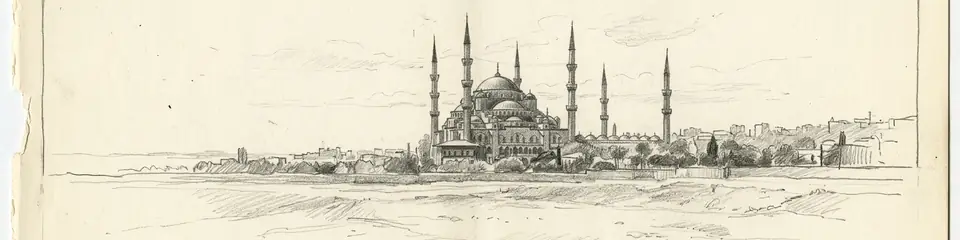
Graphite pencil sketch banner of Blue Mosque

“The Blue Mosque closes the arc from Byzantine dome architecture to Ottoman imperial mosque design — Mehmed Aga's answer to Hagia Sophia across the square.”

위치

개요

The Sultan Ahmed Mosque stands on the historical peninsula of Istanbul, directly opposite Hagia Sophia and beside the Byzantine hippodrome. Sultan Ahmed I commissioned the building between 1609 and 1617 during a pause in Ottoman military expansion — a bold statement of piety when the empire could not match Selim II or Suleiman's conquests with new campaigns. Architect Sedefkar Mehmed Aga, a pupil of Sinan, synthesised his master's vocabulary with a cascade of domes and semi-domes around a central dome about 23 metres in diameter.

The interior owes its popular name to more than 20,000 Iznik tiles in turquoise and cobalt floral patterns on the lower walls and galleries. Stained glass (much restored) once flooded the prayer hall with coloured light. Six minarets caused controversy at completion — only the Mecca sanctuary had six at the time — resolved by adding a seventh minaret in Mecca. The mosque remains an active place of worship; visitors enter outside prayer times through the courtyard gate.

The complex (külliye) originally included a hospital, school, market, and the sultan's tomb. Ahmed I is buried in the türbe on the north side. Together with Hagia Sophia and the Basilica Cistern, Sultanahmet Square forms Istanbul's densest cluster of Byzantine and Ottoman superstars.

중요성

The Blue Mosque closes the arc from Byzantine dome architecture to Ottoman imperial mosque design — Mehmed Aga's answer to Hagia Sophia across the square. Its Iznik tile programme is a high-water mark of 17th-century ceramic production and a primary reason Istanbul dominates Turkish-language heritage search.

증거와 해석

확립된 사실과 논쟁 중인 사항을 구분합니다.

잘 확립된 사실

2
  • Ottoman foundation charters (vakfiye) and inscriptions date construction and name Ahmed I and Mehmed Aga.
  • Iznik tile batches match early 17th-century workshop styles documented in ceramic studies.

학술적 추론

1
  • Six minarets were intended to rival or echo Mecca's sanctuary — inferred from contemporary court accounts.

커뮤니티 사진

당신의 경험을 공유하세요

이 유적지를 방문하셨나요? 다른 탐험가들을 위해 사진을 업로드해 보세요.

이 페이지 인용 방법

Atlas Anatolia. (1609). Blue Mosque. Atlas Anatolia. https://atlasanatolia.com/ko/site/blue-mosque

콘텐츠는 CC BY-SA 4.0 라이선스에 따라 제공됩니다 — 재사용 시 출처 표시가 필요합니다.

출처

  • A History of Ottoman Architecture — Goodwin, Godfrey (1971)
  • Turkish Ministry of Culture — Sultanahmet Mosque링크

자주 묻는 질문

Blue Mosque은(는) 어디에 위치해 있나요?

Blue Mosque은(는) Turkey에 위치해 있습니다.

Blue Mosque의 연대는 언제인가요?

Blue Mosque의 연대는 대략 1609 서기 – 1617 서기로 거슬러 올라갑니다.

Blue Mosque과(와) 관련된 고대 문명은 무엇인가요?

Blue Mosque은(는) Islamic / Medieval, Ottoman 문명과 관련이 있습니다.

Blue Mosque이(가) 중요한 이유는 무엇인가요?

The Blue Mosque closes the arc from Byzantine dome architecture to Ottoman imperial mosque design — Mehmed Aga's answer to Hagia Sophia across the square.

Blue Mosque은(는) 유네스코 세계유산인가요?

Blue Mosque은(는) 현재 유네스코 세계유산 목록에 등재되어 있지 않습니다.