
콘텐츠로 건너뛰기
Atlas Anatolia
디그
뉴스술라웨시 빙하기 치아에서 빈랑 사용 25,000년 전까지 소급카스타모누 폼페이오폴리스 바실리카에서 로마 모자이크와 에로스 두상 발견
Aerial view of the Mosque–Cathedral of Córdoba and the Guadalquivir

Wikimedia Commons (CC BY-SA 4.0)

유산신전유네스코주요

Mosque–Cathedral of Córdoba

Seyfi Cem Baskin

Mezquita-Catedral de Córdoba785 서기 – 1600 서기

The hypostyle forest of Umayyad Córdoba — striped arches over Roman and Visigothic spolia — later pierced by a Renaissance cathedral nave, is among the most important surviving monuments of medieval Islamic Spain.

21
관심 79

위치

스페인

37.88°N · 4.78°W · 유럽

Founded

785–786, Abd al-Rahman I

Mihrab

Al-Hakam II, 961–976

Cathedral conversion

1236; Renaissance nave 16th c.

UNESCO

Historic Centre of Córdoba

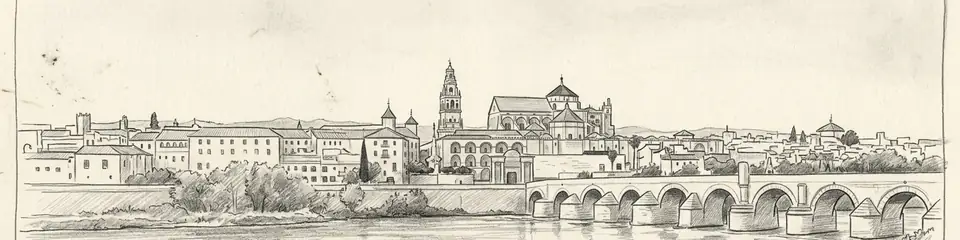
Graphite pencil sketch banner of Mosque–Cathedral of Córdoba

“Córdoba’s mosque is the architectural manifesto of Umayyad al-Andalus and a rare case where a major Islamic ritual space survives largely intact beneath later Christian insertions.”

위치

개요

The Great Mosque of Córdoba was founded in 785–786 under Abd al-Rahman I on the site of a Visigothic church tradition. Successive Umayyad enlargements under Abd al-Rahman II, Al-Hakam II, and Almanzor created a vast hypostyle hall of superimposed horseshoe arches on recycled columns, culminating in Al-Hakam’s luminous maqsura and mihrab (961–976). After the Christian conquest of 1236 the building became a cathedral; in the 16th century a towering cruciform nave and transept were inserted into the prayer hall, producing the hybrid Mosque–Cathedral visible today.

The Patio de los Naranjos, bell tower rising from the former minaret, and the Cordoban marble and jasper of the mihrab remain key experiences. UNESCO protects the Mosque–Cathedral within the Historic Centre of Córdoba. Pair with the Alhambra and Topkapi Palace for contrasting Islamic court architectures of the western and eastern Mediterranean.

중요성

Córdoba’s mosque is the architectural manifesto of Umayyad al-Andalus and a rare case where a major Islamic ritual space survives largely intact beneath later Christian insertions. It anchors debates about reuse, conquest, and heritage identity in medieval Iberia.

증거와 해석

확립된 사실과 논쟁 중인 사항을 구분합니다.

잘 확립된 사실

2
  • Dated Arabic inscriptions, endowment texts, and stratified fabric record the successive Umayyad expansions and the post-1236 cathedral conversion.
  • Column shafts and capitals include identifiable Roman and Visigothic spolia reused in the hypostyle grid.

논쟁 중인 해석

1
  • The exact footprint of any pre-Islamic church beneath the first mosque remains incompletely resolved archaeologically.

커뮤니티 사진

당신의 경험을 공유하세요

이 유적지를 방문하셨나요? 다른 탐험가들을 위해 사진을 업로드해 보세요.

이 페이지 인용 방법

Atlas Anatolia. (785). Mosque–Cathedral of Córdoba. Atlas Anatolia. https://atlasanatolia.com/ko/site/mosque-cathedral-cordoba

콘텐츠는 CC BY-SA 4.0 라이선스에 따라 제공됩니다 — 재사용 시 출처 표시가 필요합니다.

출처

  • Architecture and Ideology in Early Medieval Spain — Dodds, Jerrilynn D. (1990)
  • UNESCO — Historic Centre of Córdoba링크

자주 묻는 질문

Mosque–Cathedral of Córdoba은(는) 어디에 위치해 있나요?

Mosque–Cathedral of Córdoba은(는) Spain에 위치해 있습니다.

Mosque–Cathedral of Córdoba의 연대는 언제인가요?

Mosque–Cathedral of Córdoba의 연대는 대략 785 서기 – 1600 서기로 거슬러 올라갑니다.

Mosque–Cathedral of Córdoba과(와) 관련된 고대 문명은 무엇인가요?

Mosque–Cathedral of Córdoba은(는) Islamic / Medieval, Umayyad 문명과 관련이 있습니다.

Mosque–Cathedral of Córdoba이(가) 중요한 이유는 무엇인가요?

Córdoba’s mosque is the architectural manifesto of Umayyad al-Andalus and a rare case where a major Islamic ritual space survives largely intact beneath later Christian insertions.

Mosque–Cathedral of Córdoba은(는) 유네스코 세계유산인가요?

예 — Mosque–Cathedral of Córdoba은(는) 유네스코 세계유산으로 등재되어 있습니다.