
콘텐츠로 건너뛰기
Atlas Anatolia
디그
뉴스술라웨시 빙하기 치아에서 빈랑 사용 25,000년 전까지 소급카스타모누 폼페이오폴리스 바실리카에서 로마 모자이크와 에로스 두상 발견
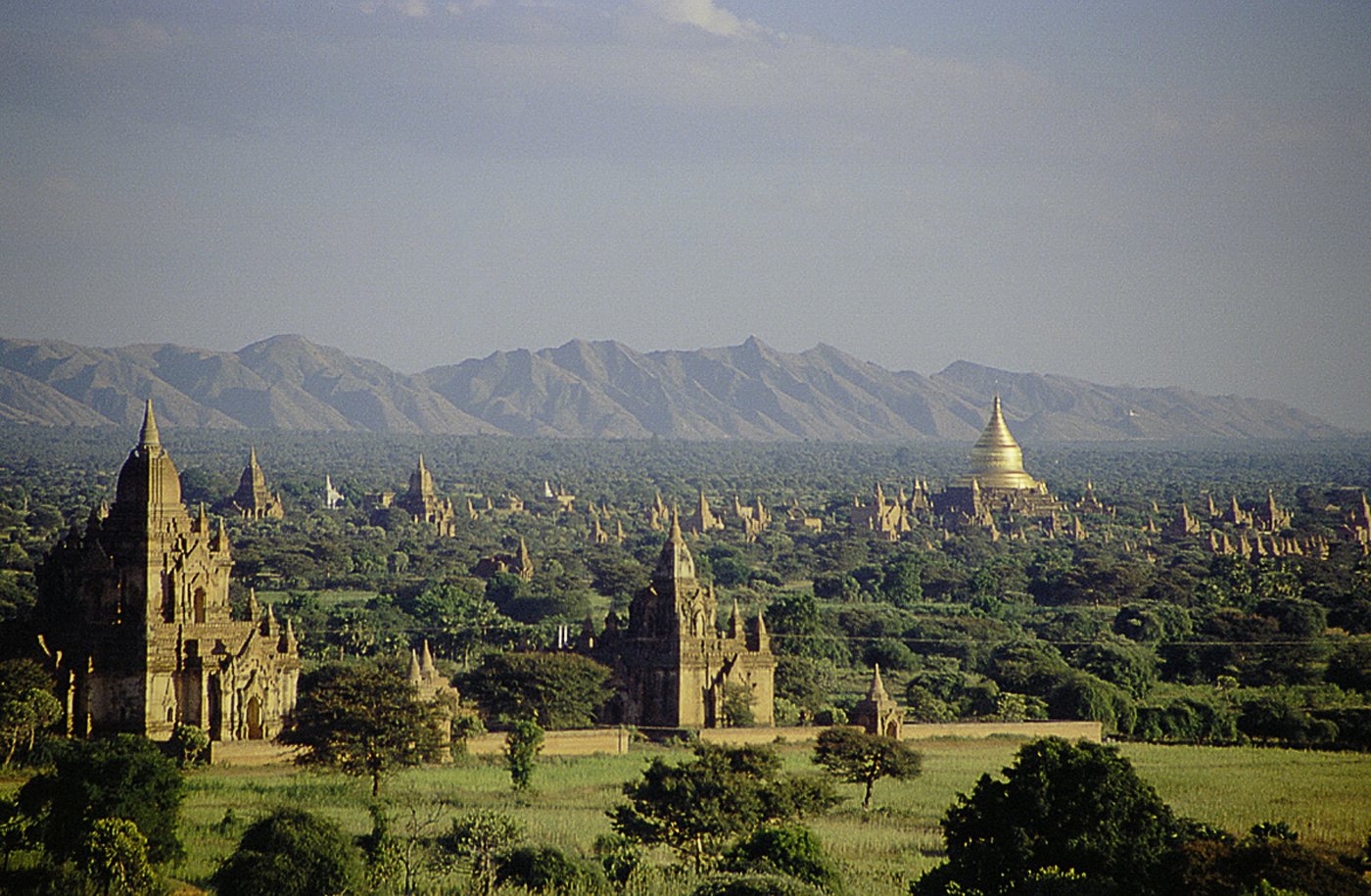
Bagan — Myanmar

Wikimedia Commons (CC BY-SA)

복합 단지유네스코주요

Bagan

Seyfi Cem Baskin

ပုဂံ849 서기 – 1297 서기

The ancient capital of the Pagan Kingdom (849–1297 CE), Bagan is a vast sacred landscape in central Myanmar, famous for over 2,000 surviving Buddhist monuments from a period of intense religious construction.

323
관심 71

위치

Mandalay Region · Central Myanmar · 미얀마

21.17°N · 94.86°E · 아시아

Built

c. 849–1297 CE (peak 11th–13th centuries)

Civilization

Pagan Kingdom (Burmese)

Discovered

Known locally; first Western survey 1855

Status

UNESCO World Heritage Site (2019)

Monuments

Over 2,200 surviving temples and pagodas

Religion

Theravada Buddhism (state religion from 1056)

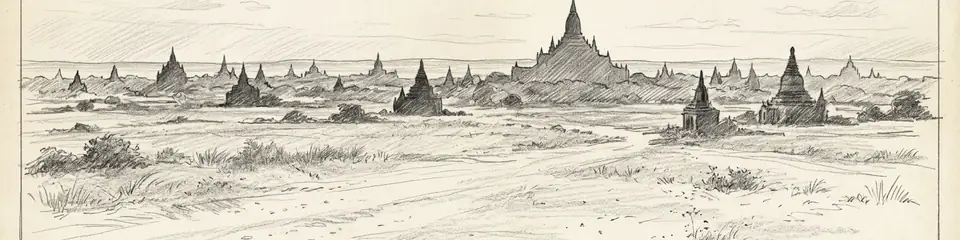
Graphite pencil sketch banner of Bagan

“Bagan represents one of the greatest concentrations of Buddhist architecture in the world, marking the emergence of a unified Burmese state and Theravada Buddhist culture that shaped mainland Southeast Asia.”

위치

개요

Historical Context

Bagan served as the capital of the Pagan Kingdom from approximately 849 to 1297 CE, a period in which the first unified Burmese state emerged. Founded near the confluence of the Irrawaddy and Chindwin rivers, the city became a powerful center under King Anawrahta (reigned 1044–77), who adopted Theravada Buddhism as the state religion after his conquest of the Mon kingdom of Thaton in 1057. This event catalyzed an extraordinary building campaign that, over two centuries, covered the arid plain with thousands of religious monuments. Inscriptions and chronicles document the donations of land, labor, and materials by royalty, nobility, and commoners, reflecting a deeply embedded merit-making ethos. The kingdom’s decline followed a series of Mongol invasions from the north; the sack of Bagan in 1287 effectively ended its political supremacy, though the site continued as a religious and economic hub into the subsequent Pinya and Ava periods.

Architectural Splendor

The architecture of Bagan is dominated by two primary forms: the solid, bell-shaped pagoda (stupa or zedi) and the hollow, square temple (gu). The Shwezigon Pagoda, begun by Anawrahta, established a prototype for later Burmese stupas with its tapering profile and gold-gilt umbrella. The Ananda Temple, completed in 1105, represents the pinnacle of the gu style, with a cruciform plan, soaring terraces, and interior corridors lined with murals depicting Jataka tales and scenes of the Buddha’s life. Stucco ornamentation, glazed ceramic plaques, and stone sculptures exhibit a syncretic artistic language blending Mon, Pyu, Pala Indian, and localized innovations. The use of brick with lime mortar allowed rapid construction, although subsequent renovation and restoration have sometimes obscured original surfaces.
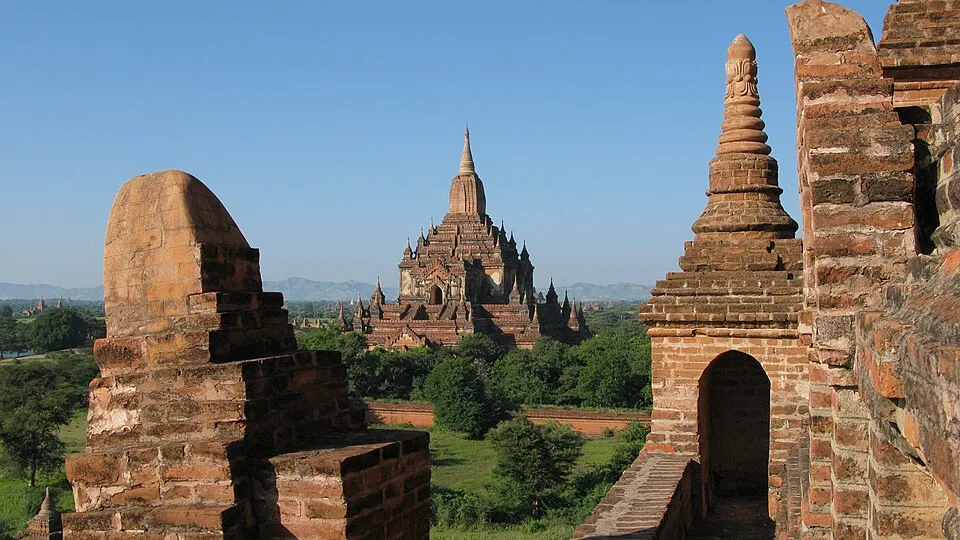
Bagan, Myanmar, Htilominlo Temple and other Buddhist stupas in Bagan plain
Bagan, Myanmar, Htilominlo Temple and other Buddhist stupas in Bagan plain | Vyacheslav Argenberg (CC BY 4.0)
"Whoever passes through this kingdom will see, scattered on the plain of Pagan, more pagodas than there are houses — temples without number, of every shape and size, raised by kings whose names alone are written on the bricks."
— Marco Polo, The Travels III.42, describing the city of Pagan (Bagan), c. 1298 CE

Discovery and Early Scholarship

Although Bagan was never truly lost, its documentation by European scholarship began in 1855 when British envoy Henry Yule visited and published detailed sketches and notes. Systematic study commenced under the Archaeological Survey of India in 1901, led by Taw Sein Ko, who conducted the first extensive inventory and clearance of vegetation. These early efforts stabilized major structures but also introduced anachronistic reconstruction methods, such as metal roof supports and modern brickwork. The site gained wider recognition following the publication of the Glass Palace Chronicle translation in 1923 and the foundational works of G. H. Luce, whose multi-volume Old Burma—Early Pagán (1969) remains a cornerstone of Bagan epigraphy and art history.
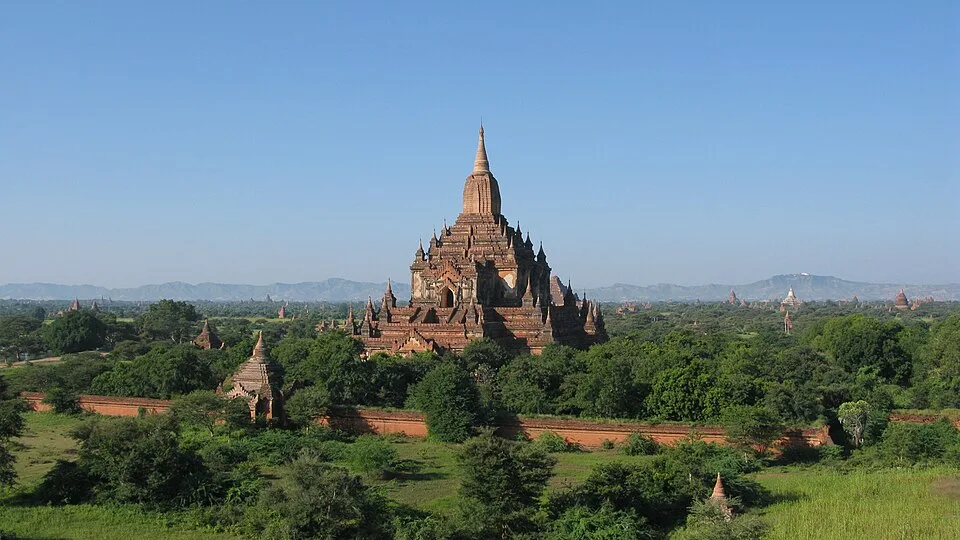
Bagan, Myanmar, Sulamani Temple 2
Bagan, Myanmar, Sulamani Temple 2 | Vyacheslav Argenberg (CC BY 4.0)

Controversies and Debates

Scholarly disputes persist over key aspects of Bagan’s history. The chronology of early temples is contested, particularly the dating of structures like the Nathaung Kyaung, which may be later than their traditional attributions. The extent to which Mon artisans shaped Bagan’s visual culture versus a primarily indigenous Burmese tradition is another area of debate. The ecological and economic sustainability of such massive construction is questioned: some historians argue that temple building drained state resources and contributed to dynastic decline, while others point to continued construction into the 13th century as evidence of enduring wealth. Restoration practices, especially those after the 1975 earthquake and in the lead-up to UNESCO nomination, have been criticized for lacking authenticity, employing modern materials and conjectural additions. The 2019 inscription was delayed for decades partly due to these concerns.

Significance

Bagan’s sacred landscape is a testament to the power of Buddhist belief to shape physical and social environments. Its concentration of monuments—over 2,200 surviving from perhaps 10,000—represents one of the largest archaeological sites in terms of structure density. The site continues to function as an active pilgrimage destination, with regular festivals and rituals integrating heritage with living religion. Inscribed as a UNESCO World Heritage Site in 2019, Bagan now faces challenges of sustainable tourism, earthquake resilience, and balancing conservation with spiritual practice.

중요성

Bagan represents one of the greatest concentrations of Buddhist architecture in the world, marking the emergence of a unified Burmese state and Theravada Buddhist culture that shaped mainland Southeast Asia. Its artistry and scale bear witness to a distinctive synthesis of local and external influences over four centuries.

증거와 해석

확립된 사실과 논쟁 중인 사항을 구분합니다.

잘 확립된 사실

3
  • Over 10,000 religious structures were originally built, with more than 2,200 remaining today, based on archaeological surveys and satellite imagery.
  • The Ananda Temple, completed in 1105, features a cruciform plan and Jataka-themed murals, as confirmed by dedicatory inscriptions.
  • Bagan's decline followed a series of Mongol invasions, notably the sack of 1287, recorded in Mongol and Burmese chronicles.

학술적 추론

2
  • The Bagan empire likely relied on intensive irrigation-based agriculture and trade along the Irrawaddy River to sustain its monumental building program.
  • Artistic styles suggest significant syncretism, incorporating Mon, Pyu, and Indian Gupta and Pala elements into a distinctive Bagan aesthetic.

논쟁 중인 해석

3
  • The extent to which the 'temple-building frenzy' depleted economic resources and contributed to the kingdom's collapse remains contested among scholars.
  • The dating of early temples such as the Nathaung Kyaung (claimed 11th century) is disputed, with some arguing for a later 12th-century origin based on architectural features.
  • The degree of continuity following the Mongol invasions is debated, with some scholars arguing for a gradual transition rather than abrupt abandonment.

발견과 발굴

Modern conservation

지휘 Various international teams and the Department of Archaeology and National Museum

Extensive conservation projects, site mapping using remote sensing, and eventual inscription as UNESCO World Heritage Site in 2019.

1855–1855

First Western Survey by Henry Yule

지휘 Henry Yule

Mission to the court of Ava included the first recorded European description and sketches of Bagan, noting hundreds of temples.

1901–1930

Early Clearance and Survey

지휘 Taw Sein Ko (for ASI)

The Archaeological Survey of India began systematic conservation and inventory, clearing jungle and stabilizing major temples. Led by Taw Sein Ko and others.

1975–1980

Post-Earthquake Restoration

지휘 UNESCO and Burmese Department of Archaeology

After a severe earthquake in 1975 damaged many temples, a major international restoration effort began, sometimes controversial for heavy-handed reconstruction.

커뮤니티 사진

당신의 경험을 공유하세요

이 유적지를 방문하셨나요? 다른 탐험가들을 위해 사진을 업로드해 보세요.

이 페이지 인용 방법

Atlas Anatolia. (849). Bagan. Atlas Anatolia. https://atlasanatolia.com/ko/site/bagan

콘텐츠는 CC BY-SA 4.0 라이선스에 따라 제공됩니다 — 재사용 시 출처 표시가 필요합니다.

출처

  • Luce (1969), Old Burma – Early Pagán — G. H. Luce (1969)
  • Aung-Thwin (1985), Pagan: The Origins of Modern Burma — Michael Aung-Thwin (1985)
  • Stadtner (2011), 'The Enigma of the Nathaung Kyaung' in Journal of Burma Studies — Donald M. Stadtner (2011)
  • UNESCO World Heritage List: Bagan링크
  • Pe Maung Tin & G.H. Luce (1923), The Glass Palace Chronicle of the Kings of Burma — Pe Maung Tin & G.H. Luce (1923)
  • Hudson (2008), 'The Nyaungyan Period: Archaeological Evidence for a Second Urbanization in Myanmar' — Bob Hudson (2008)

자주 묻는 질문

Bagan은(는) 어디에 위치해 있나요?

Bagan은(는) Mandalay Region, Central Myanmar, Myanmar에 위치해 있습니다.

Bagan의 연대는 언제인가요?

Bagan의 연대는 대략 849 서기 – 1297 서기로 거슬러 올라갑니다.

Bagan과(와) 관련된 고대 문명은 무엇인가요?

Bagan은(는) Pagan / Bagan 문명과 관련이 있습니다.

Bagan이(가) 중요한 이유는 무엇인가요?

Bagan represents one of the greatest concentrations of Buddhist architecture in the world, marking the emergence of a unified Burmese state and Theravada Buddhist culture that shaped mainland Southeast Asia.

Bagan은(는) 유네스코 세계유산인가요?

예 — Bagan은(는) 유네스코 세계유산으로 등재되어 있습니다.