
コンテンツへスキップ
Atlas Anatolia
ニュースIce Age teeth in Sulawesi push betel-nut use back as far as 25,000 yearsRoman mosaic and Eros head uncovered in the basilica at Pompeiopolis, Kastamonu
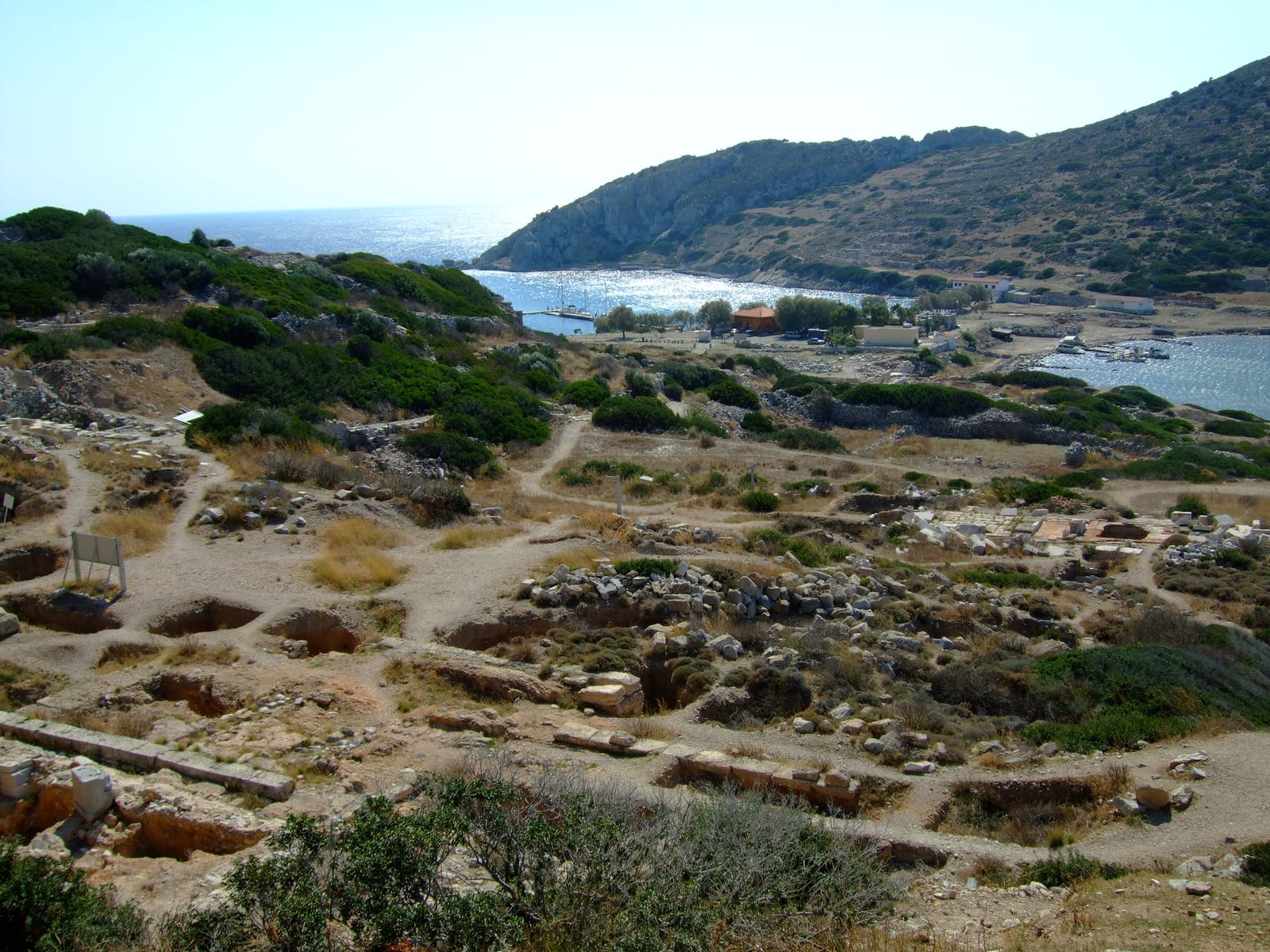
Twin harbors of Knidos at the tip of the Datça Peninsula

Wikimedia Commons

都市

Knidos

Seyfi Cem Baskin

700 紀元前 – 600 西暦

A famous ancient Greek city at the tip of the Datca Peninsula, renowned for the Aphrodite of Knidos — the first life-size nude female statue — its twin harbors, sundial, and contributions to mathematics and astronomy.

312
関心 50

所在地

Mugla · Aegean · トルコ

36.69°N · 27.38°E · アジア

Famous Statue

Aphrodite of Knidos by Praxiteles (c. 350 BCE)

Twin Harbors

Military and commercial harbors flanking an isthmus

Famous Citizens

Eudoxus (mathematician), Sostratus (architect)

Position

Tip of Datca Peninsula, where Aegean meets Mediterranean

Notable Monument

The Knidos Sundial, a monumental marble sundial from the 2nd century BCE, is one of the largest and best-preserved ancient sundials in the world.

Major Public Structure

A large, well-preserved theater built into the hillside, with a capacity for approximately 5,000 spectators, dating primarily to the Hellenistic period.

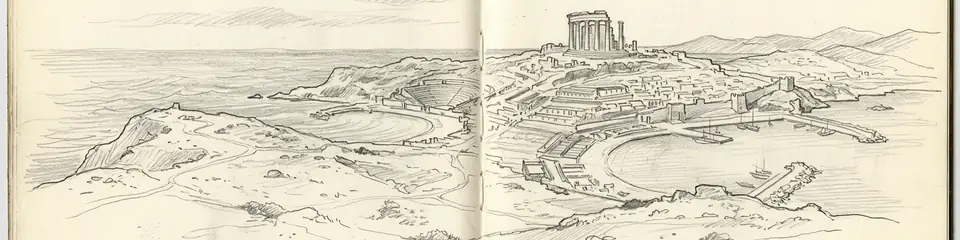
Graphite pencil sketch banner of Knidos

“The Aphrodite of Knidos was a watershed moment in the history of art — the first time the female nude was presented as a monumental subject, establishing a tradition that would dominate Western art for millennia.”

Wikipediaより

Knidos was a famous ancient Greek city at the tip of the Datca Peninsula, renowned for the Aphrodite of Knidos by Praxiteles and its twin harbors.

Wikipediaで全文を読む →

所在地

概要

Knidos occupies a spectacular position at the very tip of the Datca (Resadiye) Peninsula, where the Aegean and Mediterranean seas meet. The city's twin harbors — one military, one commercial — flank a narrow isthmus connecting the mainland to a small island (now a peninsula), creating one of the most distinctive ancient city plans in the Mediterranean.

Knidos was one of the six cities of the Dorian Hexapolis and achieved lasting fame through the Aphrodite of Knidos, sculpted by Praxiteles around 350 BCE. This was the first monumental nude female statue in Greek art history, and it became one of the most celebrated works of antiquity. Pilgrims traveled from across the Mediterranean to view it, and numerous ancient copies attest to its fame. The original has never been found.

"Knidos is a city of the Dorians, built partly on the mainland and partly on an island. It has two harbors."
— Strabo, c. 7 BCE - 23 CE

Beyond the Aphrodite, Knidos was home to Eudoxus, the mathematician and astronomer who developed the theory of proportion and proposed a model of concentric spheres to explain planetary motion. Sostratus of Knidos is traditionally credited with building the Lighthouse of Alexandria, one of the Seven Wonders. The city also possessed a famous sundial and a medical school associated with the Hippocratic tradition.

The ruins spread across terraced hillsides overlooking both harbors, including a large theatre, two smaller theatres, temples (including the round temple that housed the Aphrodite), an agora, stoas, and a well-preserved Corinthian temple. The dramatic seaside setting, accessible primarily by boat or a long drive down the Datca Peninsula, has preserved the site from overdevelopment.
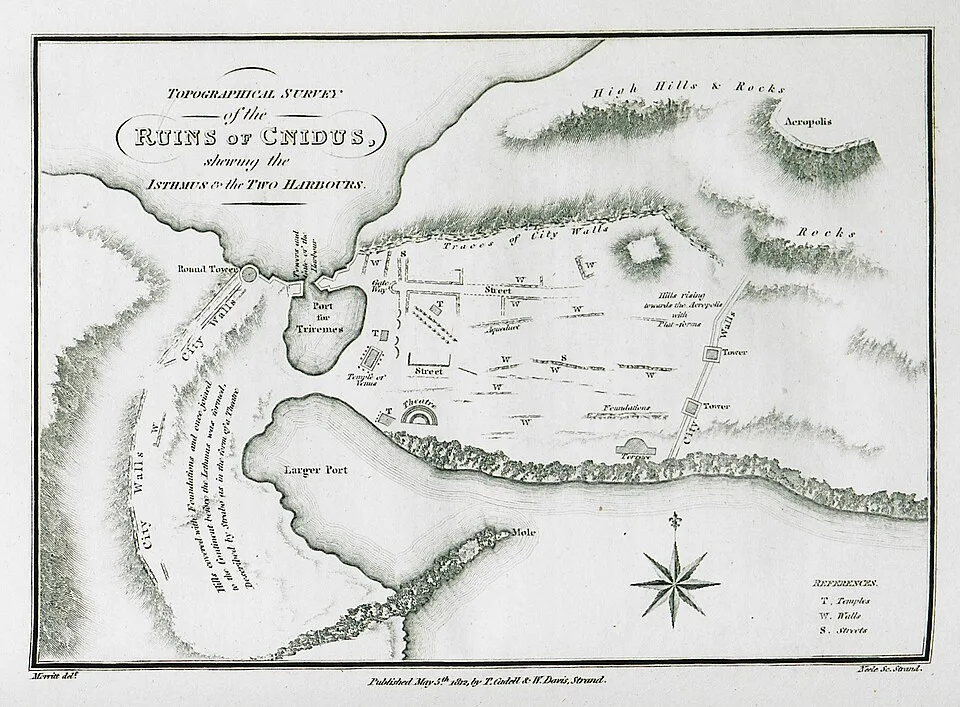
Topographic survey of the ruins of Cnidus showing the isthmus and the two harbours - Clarke Edward Daniel - 1824
Topographic survey of the ruins of Cnidus showing the isthmus and the two harbours - Clarke Edward Daniel - 1824 | Edward Daniel Clarke (Public domain)

重要性

The Aphrodite of Knidos was a watershed moment in the history of art — the first time the female nude was presented as a monumental subject, establishing a tradition that would dominate Western art for millennia. Knidos's contributions through Eudoxus and Sostratus place it among the most intellectually productive cities of the ancient world. The city's twin-harbor plan represents an engineering achievement in ancient urban design, and its position at the meeting point of two seas gave it strategic and symbolic significance. Knidos connects art history, mathematics, astronomy, and maritime architecture in a single site.

証拠と解釈

確立された事実と議論が続く事柄を区別する。

確立された事実

3
  • Pliny the Elder (Natural History 36.20-21) provides a detailed account of the Aphrodite of Knidos by Praxiteles, describing it as the finest statue in the world.
  • The round temple on the upper terrace matches ancient descriptions of the building that housed the Aphrodite, designed to allow viewing from all sides.
  • Diogenes Laertius records that Eudoxus of Knidos developed the mathematical theory of proportion and proposed a model of concentric celestial spheres.

学術的推論

1
  • The twin harbor system was likely created by connecting the island to the mainland with an artificial isthmus, based on underwater survey evidence.

議論のある解釈

2
  • Whether the original Aphrodite of Knidos survives in any form, or whether any ancient copy faithfully reproduces it, remains debated among art historians.
  • Iris Love's identification of a marble head found near the round temple as belonging to the original Aphrodite has not been accepted by most scholars.

発見と発掘調査

1857

Charles Newton excavations

指揮 Charles Newton

British Museum expedition under Newton excavated the site, discovering the Lion of Knidos and temple remains.

1967–1977

Iris Love excavations

指揮 Iris Love

Iris Love led excavations of the round temple believed to have housed the Aphrodite of Knidos, generating worldwide media attention.

1990–2010

Turkish-American excavations

Long-running excavations uncovering the agora, residential quarters, harbor installations, and Corinthian temple.

2014

Ongoing Turkish excavations

Continued excavations focusing on the harbor structures and underwater survey of the submerged portions of the ancient harbors.

コミュニティ写真

あなたの体験を共有する

この遺跡を訪れたことがありますか?写真をアップロードして魅力を共有しましょう。

このページの引用方法

Atlas Anatolia. (700). Knidos. Atlas Anatolia. https://atlasanatolia.com/ja/site/knidos

コンテンツはCC BY-SA 4.0ライセンスの下で提供されています — 再利用の際は出典表示が必要です。

World History Encyclopediaで全文を読む
World History Encyclopedia · CC BY-NC-SA

出典

  • The Aphrodite of Knidos and Her Successors — Christine Mitchell Havelock (1995)
  • Excavations at Cnidus — Iris C. Love (1970)
  • Wikipedia — Knidosリンク

よくある質問

Knidosはどこにありますか?

KnidosはMugla, Aegean, Türkiyeに位置しています。

Knidosの年代はいつ頃ですか?

Knidosはおよそ700 紀元前 – 600 西暦のものとされています。

Knidosはどの文明に関連していますか?

KnidosはGreek, Roman, Byzantine文明に関連しています。

Knidosが重要な理由は何ですか?

The Aphrodite of Knidos was a watershed moment in the history of art — the first time the female nude was presented as a monumental subject, establishing a tradition that would dominate Western art for millennia.

Knidosはユネスコ世界遺産ですか?

Knidosは現在ユネスコ世界遺産には登録されていません。