
コンテンツへスキップ
Atlas Anatolia
ニュースIce Age teeth in Sulawesi push betel-nut use back as far as 25,000 yearsRoman mosaic and Eros head uncovered in the basilica at Pompeiopolis, Kastamonu
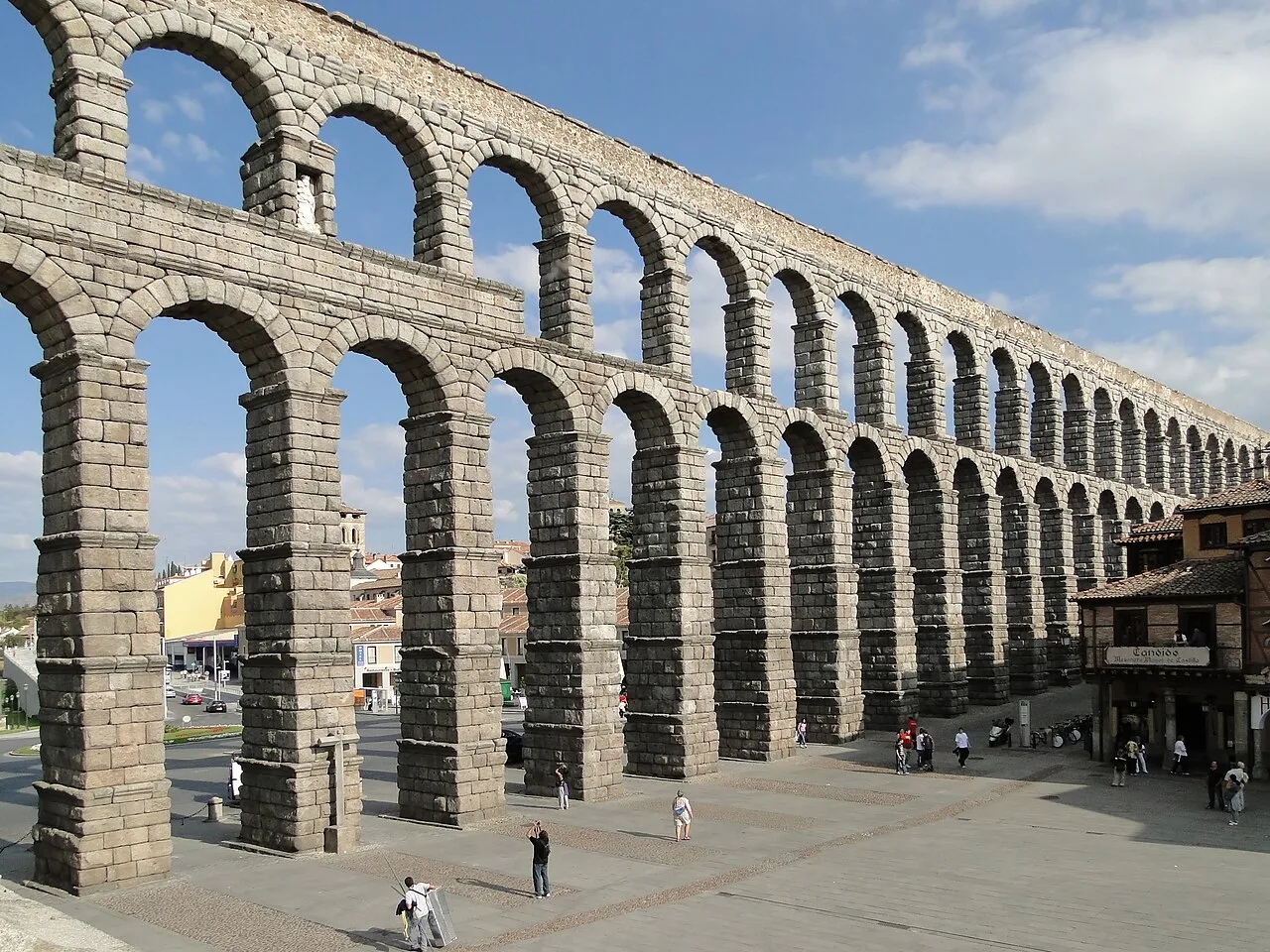
The double-tiered arches of the Roman Aqueduct of Segovia, Spain

Wikimedia Commons

Country Record

Longest Recorded History in Spain

記念碑UNESCO注目

Aqueduct of Segovia

Seyfi Cem Baskin

Acueducto de Segovia50 西暦 – 120 西暦

One of the best-preserved Roman aqueducts anywhere — a towering double-tiered arcade of some 25,000 unmortared granite blocks striding across the heart of Segovia in central Spain. Built around the late 1st century CE, it carried water more than 15 kilometres from the Frío River and remained in use into the 20th century.

311
関心 66

所在地

スペイン

40.95°N · 4.12°W · ヨーロッパ

Built

Late 1st – early 2nd century CE (Flavian/Trajanic)

Height

Up to 28.5 m at the Plaza del Azoguejo

Construction

~25,000 unmortared granite blocks; 167 arches in the main run

Source

Frío River, ~17 km away

In use until

Carried water into the 19th–20th century

UNESCO

Old Town of Segovia and its Aqueduct (1985)

Graphite pencil sketch banner of Aqueduct of Segovia

“The Aqueduct of Segovia is among the supreme surviving achievements of Roman hydraulic engineering and one of the most spectacular Roman structures still standing in Europe.”

所在地

概要

The Aqueduct of Segovia spans the Plaza del Azoguejo in the centre of the old city of Segovia, in the Castile and León region of central Spain. It is the most monumental and best-preserved Roman aqueduct on the Iberian Peninsula, and one of the most complete to survive anywhere in the former Roman world. The structure carried water from the Frío River in the Guadarrama mountains, gathering it about 17 kilometres away and channelling it by a gently sloping conduit to the city.

The visible monument is the elevated section that crosses the valley at the city's edge: a two-tiered arcade of superimposed arches that reaches a maximum height of about 28.5 metres above the lowest point of the plaza. It is built of roughly 25,000 blocks of local unmortared granite, held in place by nothing but their own weight and precise cutting — there is no mortar, clamp, or cement anywhere in the arcade. The longest and tallest stretch comprises 167 arches.

The aqueduct's exact construction date is debated but is generally placed in the late 1st or early 2nd century CE, under the Flavian emperors or Trajan. A monumental inscription once ran along the attic in bronze letters, now lost, leaving only the holes that anchored them; attempts to reconstruct the text have not produced a secure date. Two niches on the structure later held Christian statues, including one of the Virgin.

Remarkably, the aqueduct continued to deliver water to Segovia until the second half of the 19th century, and parts of the system functioned into the 20th. Its survival is owed both to the quality of its engineering and to continuous maintenance through the medieval and modern periods, including repairs under the Catholic Monarchs in the late 15th century that rebuilt arches damaged during Moorish rule.

重要性

The Aqueduct of Segovia is among the supreme surviving achievements of Roman hydraulic engineering and one of the most spectacular Roman structures still standing in Europe. That it was built entirely of dry-laid granite — tens of thousands of blocks balanced without mortar — and remained functional for some eighteen centuries is a testament to the precision and durability of Roman civil engineering. As a monument it has become the very emblem of Segovia, dominating the city it was built to serve. It is the centrepiece of the UNESCO World Heritage Site "Old Town of Segovia and its Aqueduct," inscribed in 1985.

証拠と解釈

確立された事実と議論が続く事柄を区別する。

確立された事実

3
  • The arcade is built of dry-laid granite ashlar with no mortar, confirmed by direct examination — the blocks are held by their own weight and precise cutting.
  • The attic once carried a bronze dedicatory inscription, evidenced by the surviving anchor holes for the letters; the text itself is lost.
  • Late-15th-century repairs under the Catholic Monarchs rebuilt a series of arches, documented in records and visible in the masonry of the reconstructed section.

学術的推論

1
  • The water was gathered from the Frío River and conducted via a long channel with settling tanks (such as the Caserón) before reaching the elevated arcade — reconstructed from the surviving conduit remains.

議論のある解釈

1
  • The precise construction date is debated. Lacking the inscription, scholars place it variously under Domitian, Nerva, or Trajan (late 1st to early 2nd century CE) on stylistic and archaeological grounds.

コミュニティ写真

あなたの体験を共有する

この遺跡を訪れたことがありますか?写真をアップロードして魅力を共有しましょう。

このページの引用方法

Atlas Anatolia. (50). Aqueduct of Segovia. Atlas Anatolia. https://atlasanatolia.com/ja/site/aqueduct-of-segovia

コンテンツはCC BY-SA 4.0ライセンスの下で提供されています — 再利用の際は出典表示が必要です。

出典

  • The Aqueduct of Segovia — Hauck, George F. W. (1988)
  • Roman Aqueducts and Water Supply — Hodge, A. Trevor (2002)

よくある質問

Aqueduct of Segoviaはどこにありますか?

Aqueduct of SegoviaはSpainに位置しています。

Aqueduct of Segoviaの年代はいつ頃ですか?

Aqueduct of Segoviaはおよそ50 西暦 – 120 西暦のものとされています。

Aqueduct of Segoviaはどの文明に関連していますか?

Aqueduct of SegoviaはRoman文明に関連しています。

Aqueduct of Segoviaが重要な理由は何ですか?

The Aqueduct of Segovia is among the supreme surviving achievements of Roman hydraulic engineering and one of the most spectacular Roman structures still standing in Europe.

Aqueduct of Segoviaはユネスコ世界遺産ですか?

はい — Aqueduct of Segoviaはユネスコ世界遺産に登録されています。