
Aller au contenu
Atlas Anatolia
ActualitésIce Age teeth in Sulawesi push betel-nut use back as far as 25,000 yearsRoman mosaic and Eros head uncovered in the basilica at Pompeiopolis, Kastamonu
Illuminated gopuram towers of the Meenakshi Temple at night, Madurai

Wikimedia Commons (CC BY-SA 4.0)

PatrimoineTempleEn vedette

Meenakshi Temple

Seyfi Cem Baskin

மீனாட்சி அம்மன் கோயில்1190 apr. J.-C. – 1655 apr. J.-C.

The towering gopuram gateway city at the heart of Madurai — a living Dravidian temple complex dedicated to goddess Meenakshi and Shiva Sundareswarar — whose polychrome pyramids and pillared halls draw some of the highest English Wikipedia traffic of any Indian temple not yet on the atlas.

21
Intérêt 76

Localisation

Inde

9.92°N · 78.12°E · Asie

Deities

Meenakshi (Parvati) and Sundareswarar (Shiva)

Southern gopuram

~52 m; ~1,500 stucco figures

Major rebuild

Nayak dynasty, 16th–17th centuries CE

Status

Active pilgrimage temple in historic Madurai

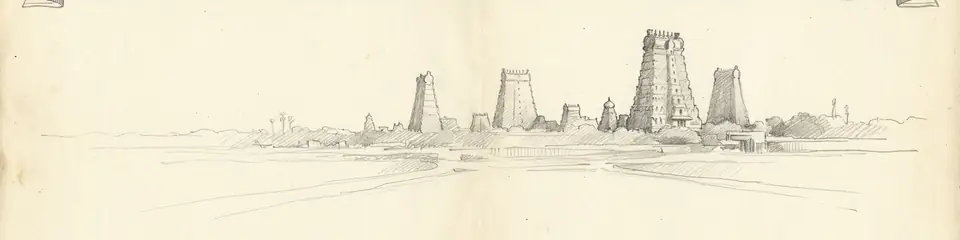
Graphite pencil sketch banner of Meenakshi Temple

“Meenakshi Temple is the archetype of the Dravidian gopuram city — colour, sculpture, and living ritual on a scale that defines Tamil Nadu's sacred landscape.”

Localisation

Aperçu

The Meenakshi Amman Temple dominates the old city of Madurai in Tamil Nadu, southern India. Tradition dates its founding to the mythic Pandyan king Kulasekara; the structures visible today largely reflect Nayak dynasty patronage of the 16th–17th centuries, especially the gopurams (gateway towers) sheathed in stucco figures of deities, heroes, and animals painted in vivid festival colours.

Fourteen gopurams punctuate the walled enclosure; the southern tower over the main entrance rises about 52 metres and contains roughly 1,500 sculptural figures. Inside, the Thousand-Pillar Hall (actually 985 pillars) supports a museum of stone reliefs; the Golden Lotus Tank is where pilgrims circumambulate before entering the inner shrines. The temple remains an active pilgrimage centre — not a ruin — with daily processions and the famous Chithirai festival re-enacting Meenakshi's marriage to Sundareswarar.

Madurai claims continuous urban life for more than two millennia; the temple is the ritual and economic engine of the old city. UNESCO lists no separate inscription for Meenakshi, but the complex is central to Tamil cultural identity and among India's most photographed religious architecture. Pair with Khajuraho or Hampi for contrasting North–South medieval temple traditions.

Pourquoi c'est important

Meenakshi Temple is the archetype of the Dravidian gopuram city — colour, sculpture, and living ritual on a scale that defines Tamil Nadu's sacred landscape. Its Nayak-era rebuilding documents how late medieval kings used temple architecture to anchor political legitimacy in goddess worship and urban pilgrimage economies.

Preuves et interprétation

Distinguer ce qui est bien établi de ce qui reste débattu.

Faits bien établis

2
  • Tamil inscriptions and Nayak-period copper plates record patronage, gopuram construction, and endowments.
  • Architectural analysis confirms Dravidian vimana and gopuram forms consistent with 16th–17th-century Madurai workshops.

Inférences savantes

1
  • Earlier Pandyan layers lie beneath Nayak rebuilds — limited excavation but supported by literary tradition.

Photos de la communauté

Partagez votre expérience

Avez-vous visité ce site ? Téléchargez vos photos pour aider les autres à le découvrir.

Comment citer cette page

Atlas Anatolia. (1190). Meenakshi Temple. Atlas Anatolia. https://atlasanatolia.com/fr/site/meenakshi-temple

Contenu sous licence CC BY-SA 4.0 — attribution requise en cas de réutilisation.

Sources

  • The Hindu Temple: An Introduction to Its Meaning and Forms — Michell, George (1988)
  • Nityasumaṅgalī: Devadasi Tradition in South India — Kersenboom-Story, Saskia C. (1987)

Questions fréquentes

Où se trouve Meenakshi Temple ?

Meenakshi Temple est situé à/en India.

De quand date Meenakshi Temple ?

Meenakshi Temple remonte approximativement à 1190 apr. J.-C. – 1655 apr. J.-C..

Quelles civilisations sont associées à Meenakshi Temple ?

Meenakshi Temple est associé à la civilisation Vedic Indian.

Pourquoi Meenakshi Temple est-il important ?

Meenakshi Temple is the archetype of the Dravidian gopuram city — colour, sculpture, and living ritual on a scale that defines Tamil Nadu's sacred landscape.

Meenakshi Temple est-il inscrit au patrimoine mondial de l'UNESCO ?

Meenakshi Temple n'est pas actuellement inscrit sur la liste du patrimoine mondial de l'UNESCO.