
Aller au contenu
Atlas Anatolia
ActualitésIce Age teeth in Sulawesi push betel-nut use back as far as 25,000 yearsRoman mosaic and Eros head uncovered in the basilica at Pompeiopolis, Kastamonu
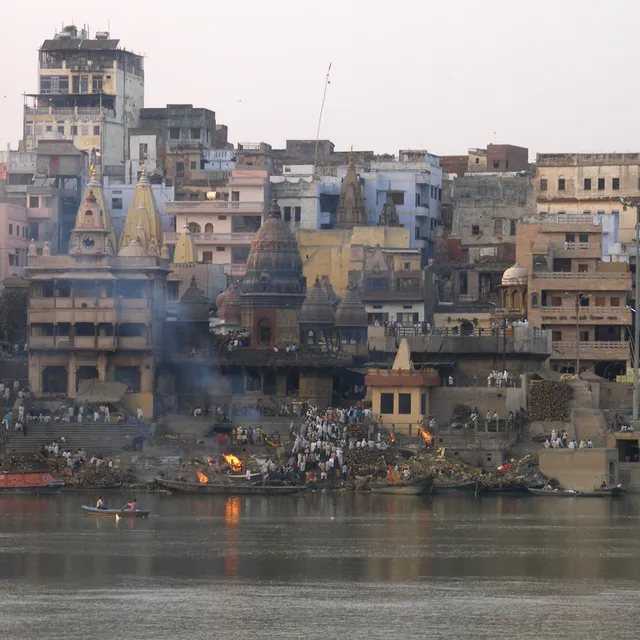
The stone ghats and Ganges riverfront at Varanasi at dawn

Wikimedia Commons

Country Record

Longest Continuously Occupied Site in India

PatrimoineCitéEn vedette

Varanasi

Seyfi Cem Baskin

वाराणसी1200 av. J.-C. – 1900 apr. J.-C.

One of the world's oldest continuously inhabited cities — on the Ganges in Uttar Pradesh — whose ghats, Kashi Vishwanath Temple, and cremation grounds at Manikarnika Ghat have drawn Hindu pilgrims, scholars, and travellers for millennia.

211
Intérêt 80

Localisation

Inde

25.31°N · 83.01°E · Asie

Ancient names

Kashi, Banaras — "oldest living city" tradition

Ghats

~80 stone steps along the Ganges riverfront

Sarnath

Buddha's first sermon preached ~8 km northeast

Kashi Vishwanath

Major Shiva temple; current shrine largely 18th century

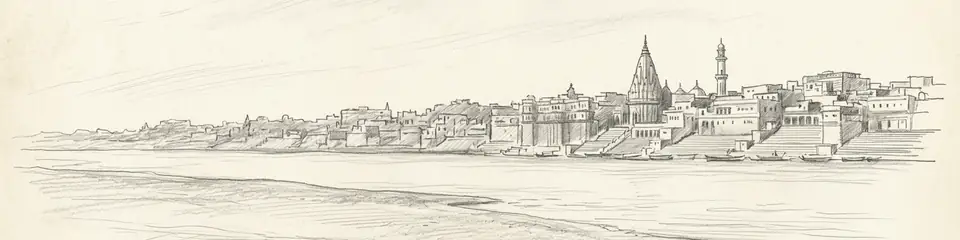
Graphite pencil sketch banner of Varanasi

“Varanasi is the living heart of Hindu sacred geography — a city where ancient ritual, death, and river worship continue uninterrupted in urban form.”

Localisation

Aperçu

Varanasi (Kashi, "City of Light") lies on the left bank of the Ganges River in Uttar Pradesh, northern India. Textual and archaeological evidence suggests settlement from the Iron Age onward; the city is central to Hindu cosmology as a tirtha where bathing in the Ganges grants spiritual merit and death within the city offers moksha (liberation). Buddha preached his first sermon at nearby Sarnath, linking Varanasi to Buddhist origins as well.

The riverfront ghats — stone steps and platforms numbering around 80 — structure urban life: Dashashwamedh Ghat for daily Ganga Aarti, Assi Ghat at the southern end, Manikarnika and Harishchandra Ghats for cremation. The Kashi Vishwanath Temple (rebuilt repeatedly, current shrine largely 18th century under the Maratha queen Ahilyabai Holkar) honours Shiva as Vishwanath, "Lord of the Universe." Narrow lanes (galis) behind the ghats preserve dense temple and residential fabric.

Varanasi has been a centre of Sanskrit learning, music (Benares gharana), and silk weaving. While not a single UNESCO monument, the living city is inscribed in intangible and cultural heritage discussions and ranks among the most visited destinations in India for both pilgrims and international travellers.
Pourquoi c'est important

Varanasi is the living heart of Hindu sacred geography — a city where ancient ritual, death, and river worship continue uninterrupted in urban form. Its ghats and proximity to Sarnath link the origins of Buddhism to the oldest traditions of the Ganges plain.

Preuves et interprétation

Distinguer ce qui est bien établi de ce qui reste débattu.

Faits bien établis

2
  • Archaeological excavations at Rajghat and nearby sites recover Iron Age and early historic pottery and structures.
  • Sarnath Ashokan pillar and Buddhist monuments document the city's role in early Buddhism from the 3rd century BCE.

Inférences savantes

1
  • Continuous urban occupation since the 1st millennium BCE is widely argued but difficult to prove uninterrupted across the entire ghats zone.

Interprétations débattues

1
  • Claims of Varanasi as the "oldest continuously inhabited city" depend on definition of continuity and comparison with Jericho, Damascus, and other candidates.

Photos de la communauté

Partagez votre expérience

Avez-vous visité ce site ? Téléchargez vos photos pour aider les autres à le découvrir.

Récits liés

Comment citer cette page

Atlas Anatolia. (1200). Varanasi. Atlas Anatolia. https://atlasanatolia.com/fr/site/varanasi

Contenu sous licence CC BY-SA 4.0 — attribution requise en cas de réutilisation.

Graphique

Connexions avec des sites et récits associés.

Sources

  • Banaras: City of Light — Eck, Diana L. (1982)
  • Banaras: Making of India's Heritage City — Singh, Rana P. B. (2009)

Questions fréquentes

Où se trouve Varanasi ?

Varanasi est situé à/en India.

De quand date Varanasi ?

Varanasi remonte approximativement à 1200 av. J.-C. – 1900 apr. J.-C..

Quelles civilisations sont associées à Varanasi ?

Varanasi est associé à la civilisation Vedic Indian, Mauryan, Gupta, Mughal.

Pourquoi Varanasi est-il important ?

Varanasi is the living heart of Hindu sacred geography — a city where ancient ritual, death, and river worship continue uninterrupted in urban form.

Varanasi est-il inscrit au patrimoine mondial de l'UNESCO ?

Varanasi n'est pas actuellement inscrit sur la liste du patrimoine mondial de l'UNESCO.