Aller au contenu
Atlas Anatolia
ActualitésIce Age teeth in Sulawesi push betel-nut use back as far as 25,000 yearsRoman mosaic and Eros head uncovered in the basilica at Pompeiopolis, Kastamonu
Temple of Concordia in the Valley of the Temples, Agrigento

Wikimedia Commons (CC BY-SA 3.0)

Country Record

Known by the Most Names in Italy

SanctuaireUNESCOEn vedette

Valley of the Temples

Seyfi Cem Baskin

Valle dei Templi580 av. J.-C. – 200 av. J.-C.

The Doric ridge of ancient Akragas — Concordia, Juno, Heracles, and Zeus among the best-preserved Greek temples outside the Aegean — is Sicily’s premier classical archaeological landscape.

21
Intérêt 49

Localisation

Italie

37.29°N · 13.59°E · Europe

Founded

c. 580 BCE (Geloan colony)

Signature temple

Concordia — among best-preserved Doric

Olympieion

Unfinished temple of Zeus with atlases

UNESCO

Inscribed 1997

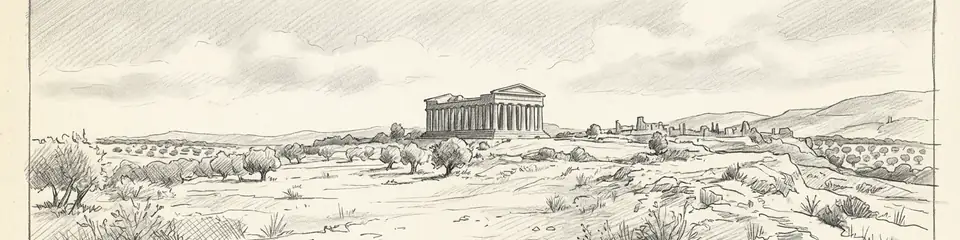
Graphite pencil sketch banner of Valley of the Temples

“Agrigento concentrates western Greek monumental religion at a scale unmatched elsewhere in Sicily and rare even in mainland Greece.”

Localisation

Aperçu

The Valley of the Temples occupies a sandstone ridge south of modern Agrigento (ancient Akragas / Agrigentum) on Sicily’s southern coast. Founded by Geloan colonists c. 580 BCE, Akragas became one of the richest Greek cities of the west. In the 5th century BCE its tyrants and citizens raised a line of monumental Doric temples along the city’s southern wall — today named for Concordia, Juno Lacinia, Heracles, Olympian Zeus (the unfinished Olympieion with giant atlas figures), Castor and Pollux, and Vulcan.

The Temple of Concordia is among the best-preserved Doric temples anywhere, owing to its medieval conversion into a church. Excavation and anastylosis from the 18th century onward, and the modern archaeological park, make the ridge a continuous outdoor museum. UNESCO inscribed the area in 1997. Pair with Paestum and the Acropolis of Athens for complementary Doric sacred landscapes.
Pourquoi c'est important

Agrigento concentrates western Greek monumental religion at a scale unmatched elsewhere in Sicily and rare even in mainland Greece. Concordia’s survival and the Olympieion’s atlases are textbook cases of Doric design, patronage, and later Christian reuse.

Preuves et interprétation

Distinguer ce qui est bien établi de ce qui reste débattu.

Faits bien établis

2
  • Standing Doric temples, dated architectural sculpture, and city-wall archaeology document the 5th-century BCE monumental programme of Akragas.
  • Medieval conversion of Concordia into a church explains its exceptional column-and-entablature survival.

Inférences savantes

1
  • The Olympieion’s giant atlas figures advertised tyrannical and civic ambition after victories over Carthage.

Photos de la communauté

Partagez votre expérience

Avez-vous visité ce site ? Téléchargez vos photos pour aider les autres à le découvrir.

Récits liés

Comment citer cette page

Atlas Anatolia. (580). Valley of the Temples. Atlas Anatolia. https://atlasanatolia.com/fr/site/agrigento

Contenu sous licence CC BY-SA 4.0 — attribution requise en cas de réutilisation.

Graphique

Connexions avec des sites et récits associés.

Sources

  • Agrigento — De Miro, Ernesto (2000)
  • UNESCO — Archaeological Area of AgrigentoLien

Questions fréquentes

Où se trouve Valley of the Temples ?

Valley of the Temples est situé à/en Italy.

De quand date Valley of the Temples ?

Valley of the Temples remonte approximativement à 580 av. J.-C. – 200 av. J.-C..

Quelles civilisations sont associées à Valley of the Temples ?

Valley of the Temples est associé à la civilisation Greek.

Pourquoi Valley of the Temples est-il important ?

Agrigento concentrates western Greek monumental religion at a scale unmatched elsewhere in Sicily and rare even in mainland Greece.

Valley of the Temples est-il inscrit au patrimoine mondial de l'UNESCO ?

Oui — Valley of the Temples est inscrit sur la liste du patrimoine mondial de l'UNESCO.