
Aller au contenu
Atlas Anatolia
ActualitésIce Age teeth in Sulawesi push betel-nut use back as far as 25,000 yearsRoman mosaic and Eros head uncovered in the basilica at Pompeiopolis, Kastamonu
Parthenon — Greece

Wikimedia Commons (CC BY-SA)

Continent Record

Oldest Temple in Europe

TempleUNESCOEn vedette

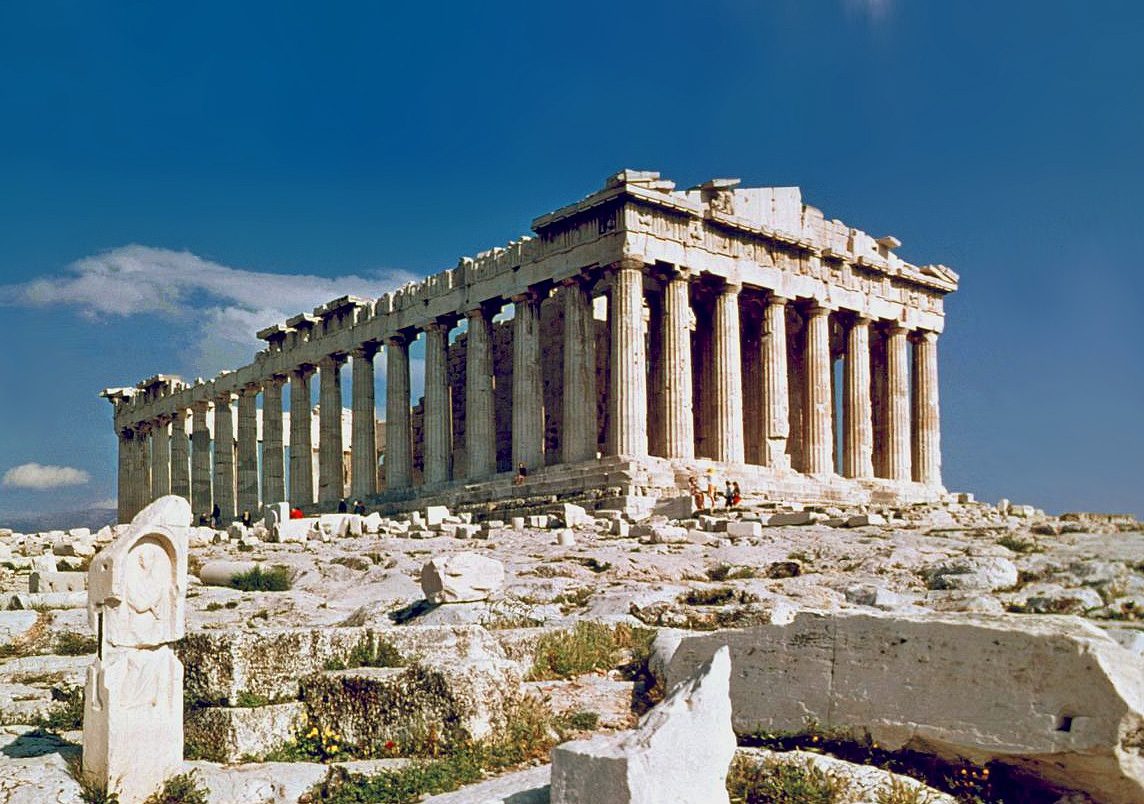
Parthenon

Seyfi Cem Baskin

Παρθενών447 av. J.-C. – 432 av. J.-C.

The Parthenon (447–432 BCE) on the Athenian Acropolis is the supreme achievement of Classical Greek temple architecture, dedicated to Athena Parthenos and embodying the ideals of Periclean democracy.

422
Intérêt 87

Localisation

Attica · Athens · Grèce

37.97°N · 23.73°E · Europe

Built

447–432 BCE

Civilization

Greek (Classical Athens)

Architects

Iktinos and Kallikrates

Sculptor

Phidias

Material

Pentelic marble

Status

UNESCO World Heritage Site (Acropolis of Athens, 1987)

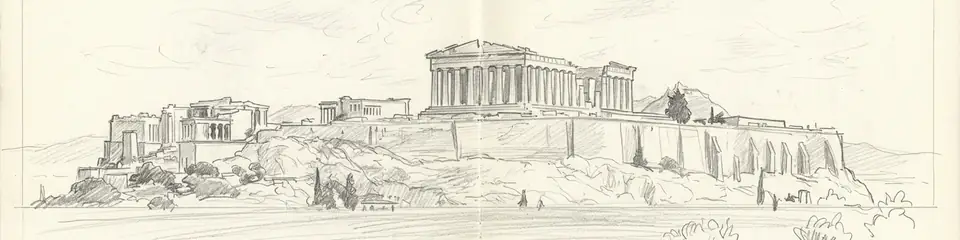
Graphite pencil sketch banner of Parthenon

“The Parthenon stands as the definitive monument of the Classical Greek world, epitomizing the artistic, architectural, and political achievements of Periclean Athens.”

Localisation

Aperçu

Architectural Brilliance

The Parthenon was designed by the architects Iktinos and Kallikrates, with the sculptor Phidias overseeing the decorative program. Constructed entirely of Pentelic marble, the temple exemplifies the Doric order with Ionic elements such as a continuous frieze. Its stylobate measures 69.5 by 30.9 meters, with 8 columns on the facades and 17 on the flanks. The structure’s renowned optical refinements—including entasis (slight swelling) of columns, curvature of the stylobate, and inward inclination of the colonnade—demonstrate a sophisticated understanding of visual perception, possibly intended to correct optical illusions.

Sculptural Decoration

The pediments depicted the birth of Athena and her contest with Poseidon for the patronage of Athens, while 92 metopes illustrated mythological battles: the Gigantomachy, Amazonomachy, Trojan War, and Centauromachy. The Ionic frieze, running 160 meters around the cella, portrayed the Panathenaic Procession, Athens’ greatest civic festival, interweaving gods and mortals. Inside, Phidias’ colossal chryselephantine statue of Athena Parthenos stood over 12 meters tall, holding a Nike figure and shield. None of the original sculptures remain in situ; the Elgin Marbles in the British Museum and other fragments in Athens and elsewhere are subjects of ongoing repatriation debate.
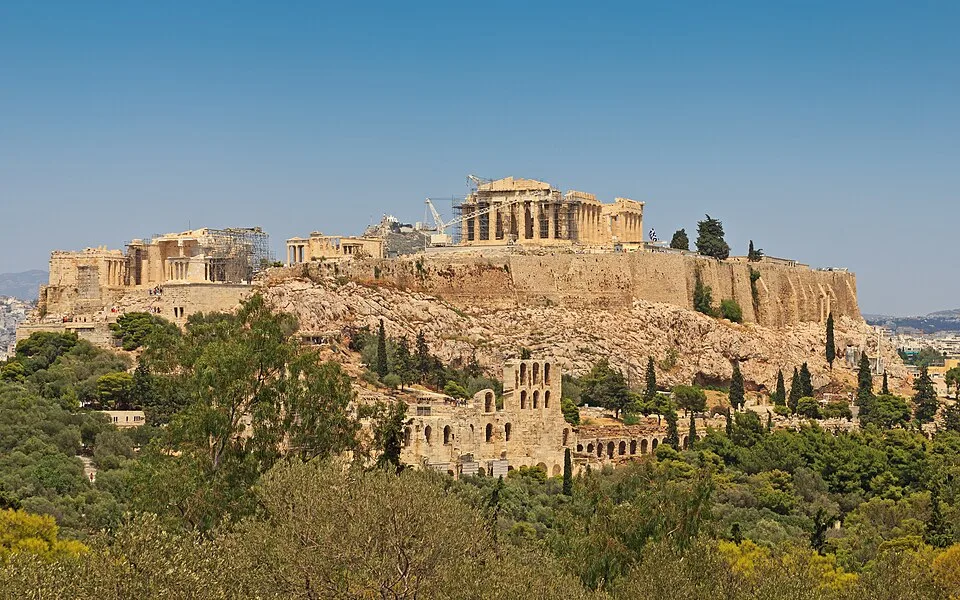
Attica 06-13 Athens 50 View from Philopappos - Acropolis Hill
Attica 06-13 Athens 50 View from Philopappos - Acropolis Hill | A.Savin (CC BY-SA 3.0)
"For though they were created in a short time, they were made to last for a very long time. Each work in its individual beauty was at the moment of its creation already venerable, yet for the freshness of its vigour it appears even now to be newly wrought."
— Plutarch, Life of Pericles 13.5, on the Acropolis building programme (1st century CE)
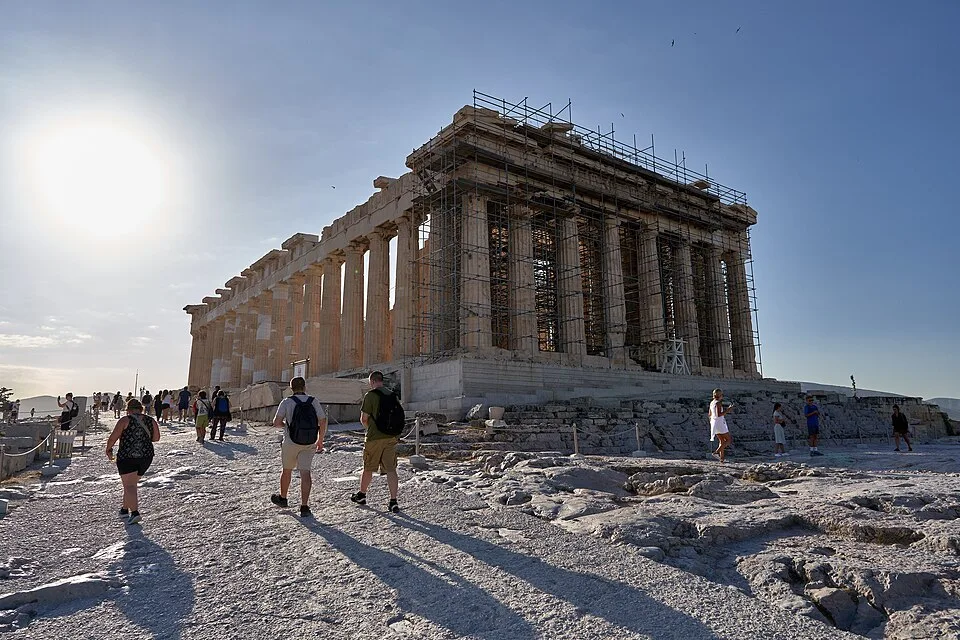
West Facade of the Parthenon on July 30, 2019
West Facade of the Parthenon on July 30, 2019 | George E. Koronaios (CC BY-SA 4.0)

Cultural and Political Context

Commissioned by Pericles during Athens’ Golden Age, the Parthenon replaced an earlier temple destroyed by the Persians in 480 BCE. Funded in part by tribute from the Delian League, it served both as a religious sanctuary and as a potent symbol of Athenian power. The integration of civic and divine imagery celebrated democracy, imperial ambition, and the city’s patron goddess.
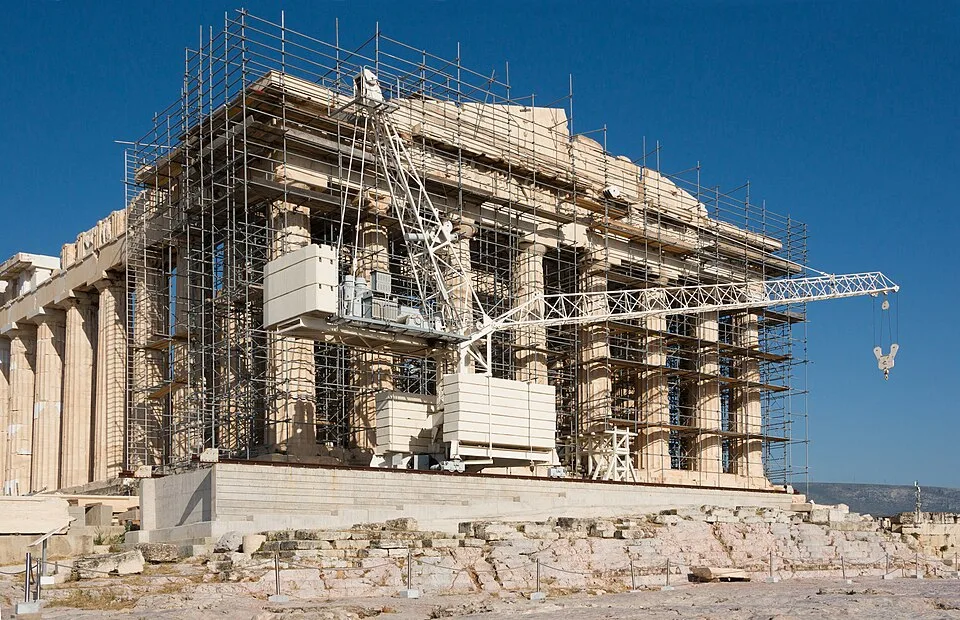
Restoration work Parthenon facade Acropolis Athens Greece
Restoration work Parthenon facade Acropolis Athens Greece | Jebulon (CC0)
"This is the temple of Athena, whom they call the Polias — guardian of the city that dared to rebuild what the Persians burned."
— Pausanias, Description of Greece I.24 (paraphrase)

From Antiquity to Modernity

Converted to a Christian church in the 6th century CE and later to a mosque under Ottoman rule, the Parthenon suffered catastrophic damage in 1687 when a Venetian mortar ignited a gunpowder store. Systematic looting by Lord Elgin (1801–1812) and subsequent removals led to the dispersion of its sculptures. The Greek state initiated excavations and restorations from the 1830s, a process that continues with the Acropolis Restoration Project, emphasizing anastylosis and structural integrity.

Scholarly Debates

Scholarship continues to explore whether the Parthenon primarily functioned as a temple (no altar has been found) or as a treasury for Athens’ empire. The nature and extent of its original polychromy remain controversial, with new pigment analyses altering previous reconstructions. Dendrochronological studies of wooden elements used in construction have provided refined dating, while the repatriation of the Parthenon Marbles remains a live cultural and diplomatic issue.
Pourquoi c'est important

The Parthenon stands as the definitive monument of the Classical Greek world, epitomizing the artistic, architectural, and political achievements of Periclean Athens. Its influence on Western art, from the Renaissance to modern democratic symbolism, is unparalleled, and its complex history encapsulates the shifting identities of the Mediterranean.

Preuves et interprétation

Distinguer ce qui est bien établi de ce qui reste débattu.

Faits bien établis

4
  • The Parthenon was built on the foundations of an earlier Archaic temple (the Older Parthenon) that was destroyed during the Persian sack of Athens in 480 BCE.
  • The Parthenon frieze depicts the Panathenaic procession, an annual festival in honor of Athena.
  • The building was converted into a Christian church by the 6th century CE and later into a mosque after the Ottoman conquest in the 15th century.
  • In 1687, a Venetian mortar hit the Parthenon, which was being used as a gunpowder magazine, causing massive destruction.

Inférences savantes

2
  • The interior cella housed a colossal chryselephantine statue of Athena Parthenos, as described by Pausanias and evidenced by Roman copies and coin representations.
  • The optical refinements (curvature, entasis) were consciously applied to correct visual distortions, as suggested by Vitruvius' architectural theories.

Interprétations débattues

2
  • Whether the Parthenon functioned primarily as a temple or as a state treasury and display of imperial wealth remains a subject of academic discussion.
  • The original polychromy of the architectural sculptures is widely debated, with recent studies indicating a much more vivid coloration than earlier reconstructions.

Découverte et fouilles

1834–1842

Initial clearance of the Acropolis

Dirigé par Kyriakos Pittakis

Under the first Greek archaeological authorities, medieval and Ottoman additions were removed to reveal the classical ruins. Kyriakos Pittakis spearheaded early excavations.

1885–1890

Systematic excavation of the Acropolis

Dirigé par Panagiotis Kavvadias

Panagiotis Kavvadias directed large-scale excavations, uncovering the ‘Persian debris’ containing archaic sculptures and establishing the stratigraphy of the site.

1901–1933

Restoration by Nikolaos Balanos

Dirigé par Nikolaos Balanos

Balanos reconstructed columns and entablature using iron clamps and cement, pioneering anastylosis on the Parthenon but causing later damage due to rust.

1975

Acropolis Restoration Project

Dirigé par Manolis Korres / Committee for the Conservation of the Acropolis Monuments

An ongoing interdisciplinary project employing laser cleaning, titanium reinforcements, and meticulous reassembly to reverse earlier interventions and stabilize the monument.

Photos de la communauté

Partagez votre expérience

Avez-vous visité ce site ? Téléchargez vos photos pour aider les autres à le découvrir.

Récits liés

Comment citer cette page

Atlas Anatolia. (447). Parthenon. Atlas Anatolia. https://atlasanatolia.com/fr/site/parthenon

Contenu sous licence CC BY-SA 4.0 — attribution requise en cas de réutilisation.

Graphique

Connexions avec des sites et récits associés.

Sources

  • Hurwit, Jeffrey M. (1999), The Athenian Acropolis: History, Mythology, and Archaeology from the Neolithic Era to the Present — Jeffrey M. Hurwit (1999)
  • Neils, Jenifer (2005), The Parthenon: From Antiquity to the Present — Jenifer Neils (2005)
  • Korres, Manolis (1994), 'The Parthenon: Architecture and Restoration', Bulletin of the Institute of Classical Studies — Manolis Korres (1994)
  • Schwab, Katherine A. (2005), 'The Parthenon Metopes: New Evidence for Interpretation', Hesperia — Katherine A. Schwab (2005)
  • Harrison, Evelyn B. (1996), 'The Composition of the Amazonomachy on the Shield of Athena Parthenos', Hesperia — Evelyn B. Harrison (1996)
  • UNESCO World Heritage Centre, 'Acropolis, Athens'Lien

Questions fréquentes

Où se trouve Parthenon ?

Parthenon est situé à/en Attica, Athens, Greece.

De quand date Parthenon ?

Parthenon remonte approximativement à 447 av. J.-C. – 432 av. J.-C..

Quelles civilisations sont associées à Parthenon ?

Parthenon est associé à la civilisation Greek.

Pourquoi Parthenon est-il important ?

The Parthenon stands as the definitive monument of the Classical Greek world, epitomizing the artistic, architectural, and political achievements of Periclean Athens.

Parthenon est-il inscrit au patrimoine mondial de l'UNESCO ?

Oui — Parthenon est inscrit sur la liste du patrimoine mondial de l'UNESCO.