
Aller au contenu
Atlas Anatolia
ActualitésIce Age teeth in Sulawesi push betel-nut use back as far as 25,000 yearsRoman mosaic and Eros head uncovered in the basilica at Pompeiopolis, Kastamonu
Delphi — Greece

Wikimedia Commons (CC BY-SA)

SanctuaireUNESCO

Delphi

Seyfi Cem Baskin

Δελφοί800 av. J.-C. – 393 apr. J.-C.

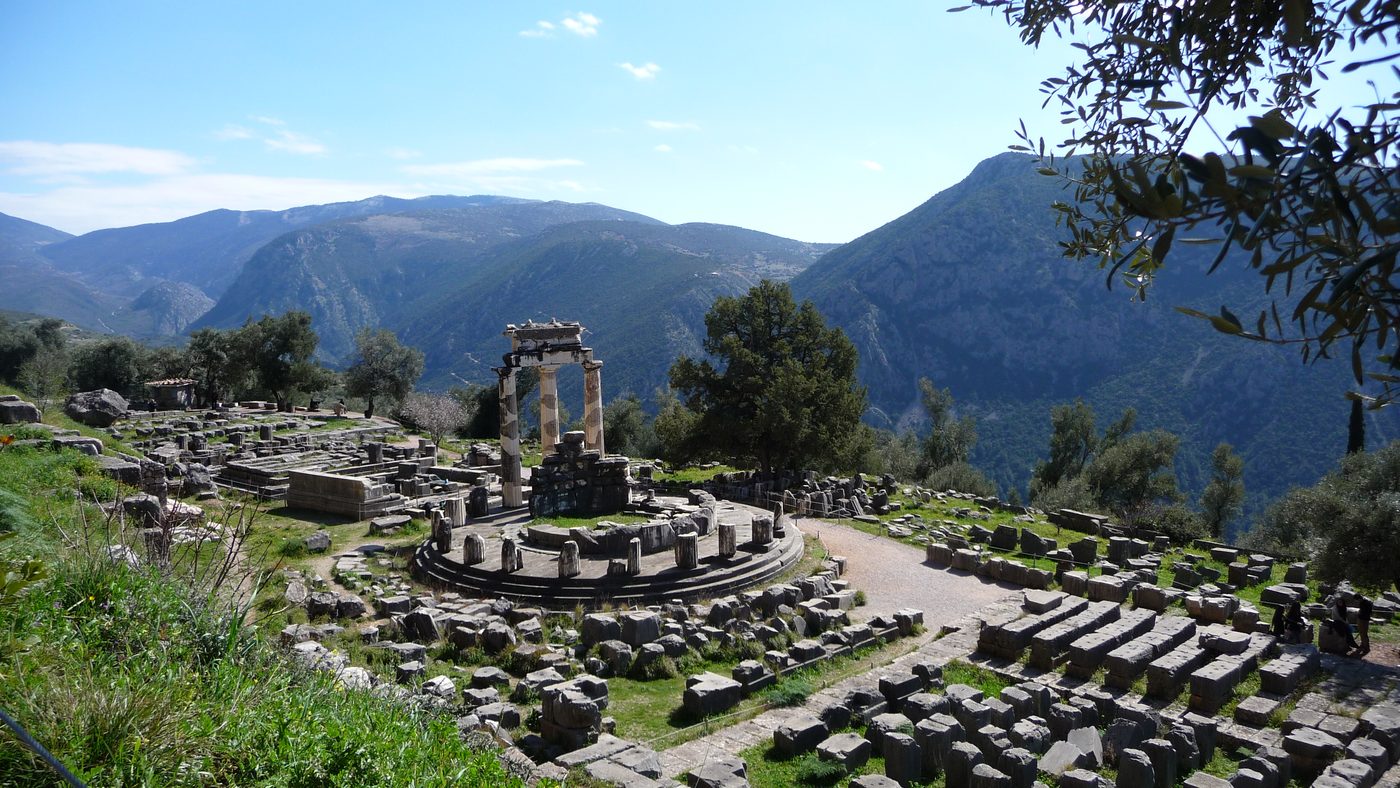
Sanctuary of Apollo on the slopes of Mount Parnassus, seat of the Pythia whose oracles shaped Greek colonisation, warfare, and personal choices. Treasury buildings, a theatre, and the stadium crown the site where Greeks imagined the omphalos, the navel of the world.

422
Intérêt 83

Localisation

Phocis · Central Greece · Grèce

38.48°N · 22.50°E · Europe

Built

c. 800 BCE (first permanent structures on site)

Civilization

Ancient Greek (Mycenaean occupation earlier)

Discovered

1892 by the French School at Athens (village relocated)

Status

UNESCO World Heritage Site (1987)

Peak Activity

6th–4th centuries BCE

Closure

393 CE (oracle silenced by Theodosius I)

Graphite pencil sketch banner of Delphi

“Delphi is the best-documented oracle in the ancient world, a place where politics and poetry met priestly performance.”

Localisation

Aperçu

Delphi clings to the south-facing cliffs of Mount Parnassus above the Gulf of Corinth, halfway between the Gulf and the Phocian plain. Springs, especially the Castalian spring, made the spot sacred before the first stone temples. By the Archaic period Delphi had become the shared sanctuary where Greeks consulted Apollo through a priestess called the Pythia.

Consultants presented questions, offered sacrifices, and received responses that attendants rendered into hexameter verse. States built treasuries along the Sacred Way to display captured booty and express gratitude. The Athenian treasury survives as a marble jewel box; the Siphnian treasury survives in fragments that still teach Archaic sculpture. Above the temple terrace sit a theatre and a stadium used for the Pythian Games.
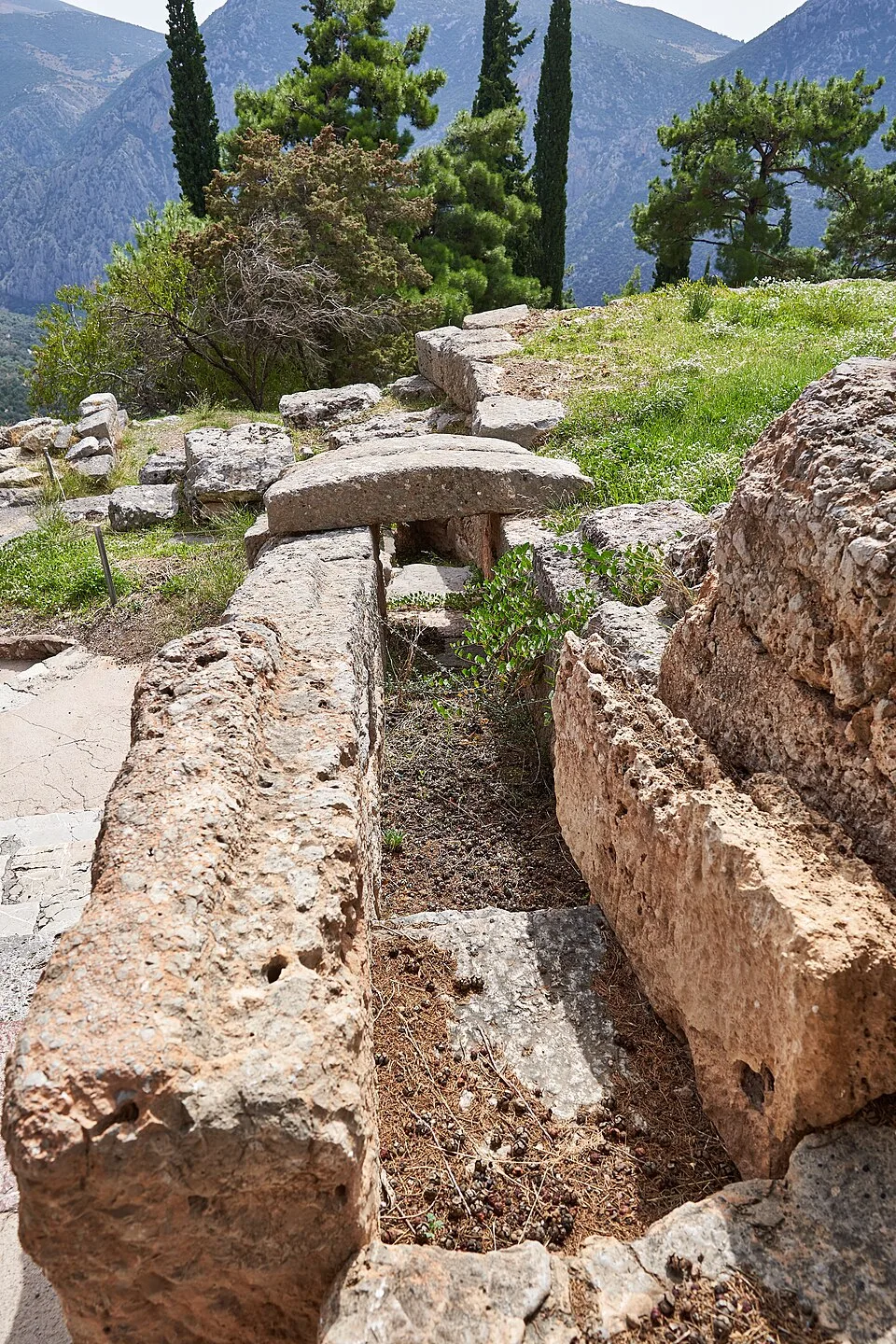
The drainage system at the Sanctuary of Apollo in Delphi on October 4, 2020
The drainage system at the Sanctuary of Apollo in Delphi on October 4, 2020 | George E. Koronaios (CC BY-SA 4.0)
"Know thyself."
— Inscription at the Temple of Apollo, Delphi (attributed to the Seven Sages of Greece)

The omphalos stone, a rounded boulder in the temple precinct, marked Delphi as the world's centre in Greek geography. Myth said Zeus released eagles from the ends of the earth and they met here. Odysseus does not consult Delphi in Homer's poems, which predate the sanctuary's greatest fame, but later Greeks read epic heroes through oracular tradition. Any modern retelling of Greek myth, including large-scale films, inherits Delphi as the place where fate speaks in riddles.
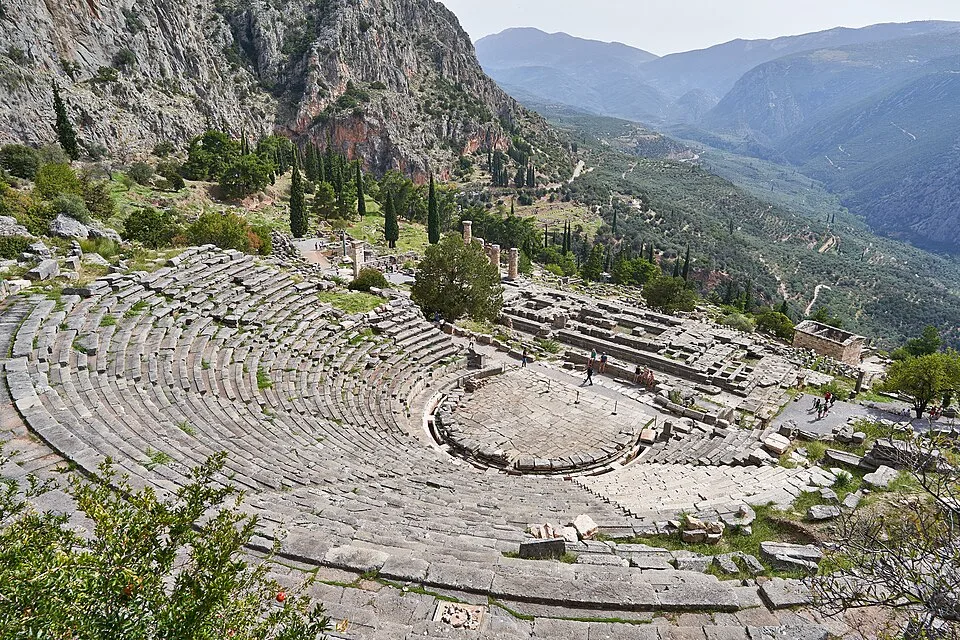
At the Theatre of Delphi (Sanctuary of Apollo) on October 4, 2020
At the Theatre of Delphi (Sanctuary of Apollo) on October 4, 2020 | George E. Koronaios (CC BY-SA 4.0)

Excavations by French archaeologists since 1892 uncovered the temple of Apollo, a earlier chthonic cult area, and thousands of inscriptions recording manumissions, treaties, and honors. The site is UNESCO listed with the wider Delphi landscape.

Visit in the morning before tour buses fill the Sacred Way. The view into the Pleistos valley explains why pilgrims felt they stood at the hinge of Greece.
Pourquoi c'est important

Delphi is the best-documented oracle in the ancient world, a place where politics and poetry met priestly performance. Its treasuries and inscriptions form an archive of interstate relations across centuries of Greek history.

Preuves et interprétation

Distinguer ce qui est bien établi de ce qui reste débattu.

Faits bien établis

4
  • The Temple of Apollo contained an adyton where the Pythia sat on a tripod to deliver prophecies.
  • The site includes a theater, stadium, treasuries, and the Sacred Way, as described by Pausanias and confirmed by excavation.
  • The Charioteer of Delphi, a bronze masterpiece, was discovered during the Great Excavation in 1896.
  • The Kastalian Spring provided water for ritual purification by Pythia and consultants before approaching the oracle.

Inférences savantes

2
  • The Pythia likely entered a trance state induced by ethylene gas seeping from a geological fault under the temple, based on modern gas measurements and ancient descriptions.
  • Delphi's Amphictyonic League functioned as a religious and political coalition that mediated conflicts among Greek city-states.

Interprétations débattues

2
  • Whether the oracle delivered prophecies in coherent verse or inarticulate sounds interpreted by priests remains a subject of scholarly dispute.
  • The extent of geological influence on the oracle's prophetic utterances, some scholars argue for purely psychological or ritualistic explanations.

Découverte et fouilles

Modern conservation

Dirigé par Greek Ministry of Culture and French School at Athens

Ongoing conservation and restoration measures, including the anastylosis of the Treasury of the Athenians and stabilization of the Temple of Apollo terraces.

1892–1903

Great Excavation of Delphi

Dirigé par Théophile Homolle (French School at Athens)

Systematic removal of the village of Kastri and revelation of the ancient sanctuary by the French School at Athens. Directed initially by Théophile Homolle, it uncovered the Sacred Way, Temple of Apollo, theater, and numerous sculptures.

1930–1940

Interwar investigations

Dirigé par French School at Athens

Further excavations and studies focused on the sanctuary's peripheries, including the Marmaria (Athena Pronaia) precinct. Directed by Pierre de La Coste-Messelière and others.

1990–2000

Geological and geophysical surveys

Dirigé par Collaboration of geologists and archaeologists

Multidisciplinary studies analyzing fault lines and gas emissions to understand the oracle's mechanics, led by Jelle Zeilinga de Boer and John R. Hale.

Photos de la communauté

Partagez votre expérience

Avez-vous visité ce site ? Téléchargez vos photos pour aider les autres à le découvrir.

Récits liés

Comment citer cette page

Atlas Anatolia. (800). Delphi. Atlas Anatolia. https://atlasanatolia.com/fr/site/delphi

Contenu sous licence CC BY-SA 4.0 — attribution requise en cas de réutilisation.

Graphique

Connexions avec des sites et récits associés.

Sources

  • Parke, H. W., and Wormell, D. E. W. (1956), The Delphic Oracle, 2 vols. — H. W. Parke and D. E. W. Wormell (1956)
  • Hale, J. R., et al. (2003), Questioning the Delphic Oracle, Scientific American 289(2), 66–73. — John R. Hale et al. (2003)
  • Scott, M. (2014), Delphi: A History of the Center of the Ancient World — Michael Scott (2014)
  • UNESCO World Heritage entry: Archaeological Site of DelphiLien
  • Pausanias (2nd cent. CE), Description of Greece, Book 10 (modern translation by W. H. S. Jones) — Pausanias (1918)
  • Amandry, P. (1950), La mantique apollinienne à Delphes — Pierre Amandry (1950)

Questions fréquentes

Où se trouve Delphi ?

Delphi est situé à/en Phocis, Central Greece, Greece.

De quand date Delphi ?

Delphi remonte approximativement à 800 av. J.-C. – 393 apr. J.-C..

Quelles civilisations sont associées à Delphi ?

Delphi est associé à la civilisation Greek, Roman.

Pourquoi Delphi est-il important ?

Delphi is the best-documented oracle in the ancient world, a place where politics and poetry met priestly performance.

Delphi est-il inscrit au patrimoine mondial de l'UNESCO ?

Oui — Delphi est inscrit sur la liste du patrimoine mondial de l'UNESCO.