


Göbekli Tepe archaeological excavations
Göbekli Tepe archaeological excavations turned a Şanlıurfa hill of “medieval” stone into the type-site of Pre-Pottery Neolithic monumentality in south-eastern Anatolia. This page is the excavation chronology — not the slogan “world’s first temple.” Read Confirmed lines on the site dossier for radiocarbon and architecture; treat dwelling claims from 2026 as a director’s first impression until floor samples are published.
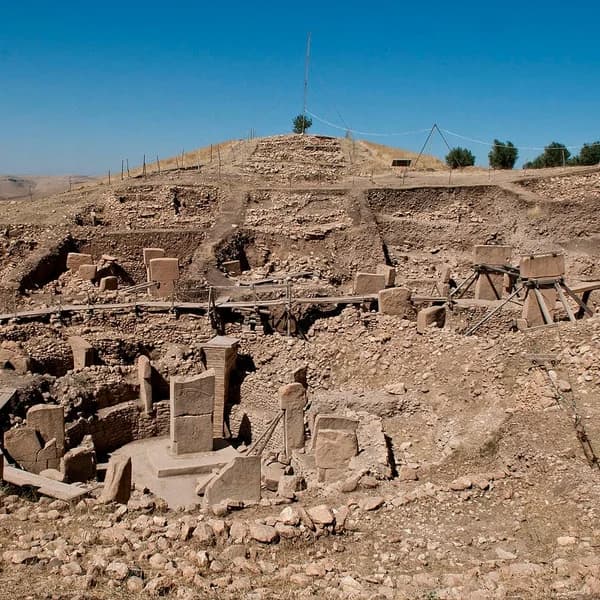
From survey scatter to a DAI excavation
The hill was not unknown. University survey in the 1960s recorded worked stone on Göbekli Tepe; the pieces were easy to misread as later cemetery markers. Klaus Schmidt of the German Archaeological Institute recognised T-shaped pillars as Pre-Pottery Neolithic architecture and opened systematic excavation in 1995.
That decision — to treat the hill as a prehistoric sanctuary rather than a medieval graveyard — is the actual beginning of Göbekli Tepe archaeological excavations as the world now cites them. Everything popular about the site (enclosures, animals in relief, backfill) is a product of those trenches and the seasons that followed, not of a sudden 1990s “discovery of a lost temple.”
What Schmidt’s seasons established
The main excavation zone under today’s visitor canopy is the circular and oval enclosure sequence often labelled Layer III: T-pillars set in stone walls, with benches and reliefs of foxes, boars, birds, and abstract signs. A later Layer II has more rectangular buildings and smaller pillars. Radiocarbon on the early enclosures sits in the 10th–9th millennia BCE — millennia before Stonehenge’s sarsen circle.
Schmidt argued that the large enclosures were backfilled in antiquity, which preserved pillars but also means we are looking at a closing event, not a frozen “opening day.” Specialists still debate how much of the fill is deliberate, how the site relates to nearby Taş Tepeler settlements, and whether “temple” is the right category. Atlas marks those sentences Debated or Inferred on the site page; the architecture and dates are the Confirmed core.
- 1995–2014: DAI excavation directed by Klaus Schmidt.
- Layer III: round/oval T-pillar enclosures (earlier).
- Layer II: more rectangular buildings, smaller pillars (later PPN).
- UNESCO World Heritage inscription: 2018.
After Schmidt: Taş Tepeler and the 2026 northern sector
After Schmidt’s death in 2014 the project continued under Turkish direction. Prof. Necmi Karul now directs the Göbekli Tepe excavation and coordinates the regional Taş Tepeler (“Stone Hills”) programme, which includes Karahan Tepe and other Pre-Pottery Neolithic sites around Şanlıurfa.
In August 2026 Karul told Anadolu Agency that a newly opened sector north of the main excavation zone had produced rectangular buildings from the site’s second phase. His first impression: they look like dwellings. His next sentence: walls alone are not enough. Floor soil samples still have to be studied. A walking path was designed so visitors can see the new work without treating unpublished rooms as a second Göbekli under glass.
That is how to read “Göbekli Tepe archaeological excavations” in the news cycle: a new trench can be true and still not rewrite the Layer III enclosures, the Stonehenge age-gap, or the temple debate. Pair this page with the 2026 story and the site dossier rather than collapsing all three into one headline.
How to read Göbekli on Atlas Anatolia
Use the site dossier for coordinates, date range, evidence items, and sources. Use the excavation page (this URL) for the history of fieldwork. Use Göbekli Tepe vs Stonehenge for the dating contrast, and The World’s First Temple? for the category fight. Compare Göbekli Tepe with Karahan Tepe when you want architecture in the same regional project rather than a British stone circle.
Göbekli Tepe excavations FAQ
When did Göbekli Tepe archaeological excavations begin?
Systematic excavation directed by Klaus Schmidt of the German Archaeological Institute began in 1995. Earlier surveys had already noted worked stone on the hill. Work continues today under Prof. Necmi Karul as part of the Taş Tepeler programme.
Did the 2026 excavations prove people lived at Göbekli Tepe?
No. Karul said rectangular buildings in a new northern sector look like dwellings at first glance, but walls are not enough. Floor samples still have to be studied. That does not cancel earlier public buildings or the T-pillar enclosures.
Is Göbekli Tepe the world’s first temple?
That is a category debate, not a radiocarbon result. The Confirmed core is Pre-Pottery Neolithic T-pillar architecture in the 10th–9th millennia BCE. Whether “temple” is the right word stays Debated on the Atlas site page.
How does Göbekli Tepe relate to Karahan Tepe?
Both sit in the Şanlıurfa Pre-Pottery Neolithic landscape often grouped as Taş Tepeler. They are neighbouring projects, not the same excavation. Compare them at atlasanatolia.com/compare?sites=gobekli-tepe,karahan-tepe.