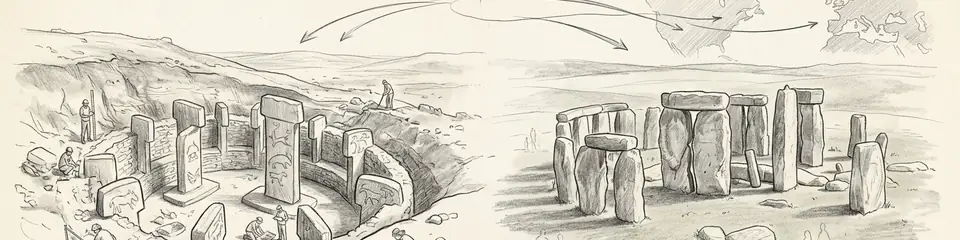
Search “Göbekli Tepe vs Stonehenge” and you will find the same sensationalist headline across thousands of forum threads and documentaries: Turkey’s southeastern Anatolian sanctuary is roughly 6,000 years older than England's famous sarsen circle. That raw chronological fact is scientifically confirmed — yet by itself, it tells only a fraction of the story.
The true archaeological significance of contrasting these two world-renowned megalithic complexes lies not in a temporal scoreboard, but in what they reveal about the evolution of human society, monumental engineering, collective labor organization, and ritual landscapes.
Atlas Anatolia documents both sites with comprehensive excavation records, peer-reviewed references, and Confirmed / Inferred / Debated evidence ratings. This comparative research dossier examines their geology, architecture, subsistence economies, and the latest archaeological discoveries.
"Stonehenge belongs to the dawn of metallurgy and domesticated farming in Britain. Göbekli Tepe belongs to a world before pottery, before agriculture, and before beasts of burden — an era where mobile hunter-gatherers shaped monumental stones."
— Klaus Schmidt, Erst kam der Tempel, dann die Stadt (2006)
1. The Chronological Divide: A 6,500-Year Chasm
To comprehend the temporal separation between the two monuments, one must invert modern historical perspective: Stonehenge is closer in time to our modern world than it was to the stone carvers of Göbekli Tepe.
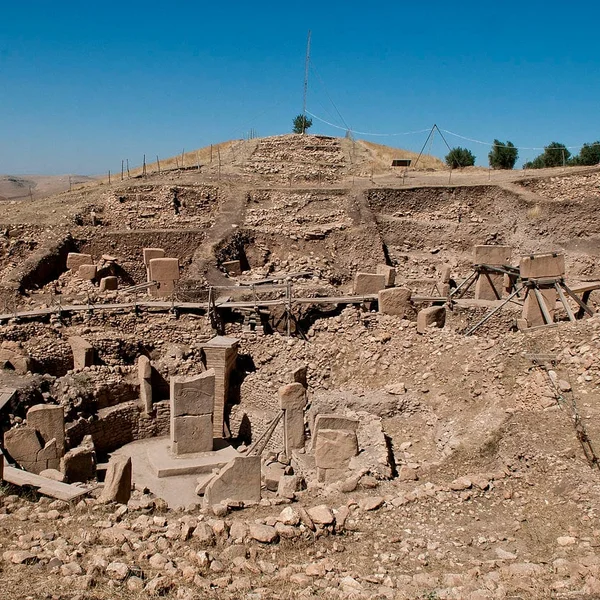
- Göbekli Tepe: Stratigraphic layers III and II date between c. 9600 and 8000 BCE. Constructed during the transition from the Pleistocene to the Holocene, its circular enclosures were established when woolly mammoths had only recently vanished and before the initial domestication of einkorn wheat in the Karacadag foothills.
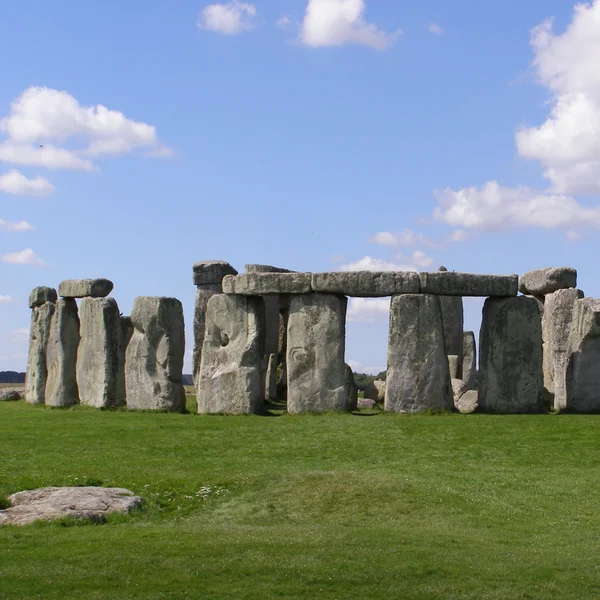
- Stonehenge: Stonehenge was not erected in a single burst of construction. Its sequence began c. 3100 BCE as a circular ditch and bank earthwork (Phase 1, with the 56 Aubrey Holes). The arrival of the Welsh bluestones occurred c. 2400 BCE (Phase 2), followed by the raising of the massive sarsen trilithons c. 2500–2200 BCE (Phase 3), with reorganizations continuing down to c. 1600 BCE in the British Early Bronze Age.
When the builders of Stonehenge raised their sarsens on Salisbury Plain, the circular enclosures of Göbekli Tepe had already been completely submerged beneath the Anatolian soil for over five thousand years.
2. Megalithic Engineering: Flint Picks vs. Woodworking in Stone
Both complexes required astronomical investments of communal physical labor, yet their architectural techniques reflect radically different technological horizons.
Göbekli Tepe: Monolithic Sculpture and Bas-Reliefs
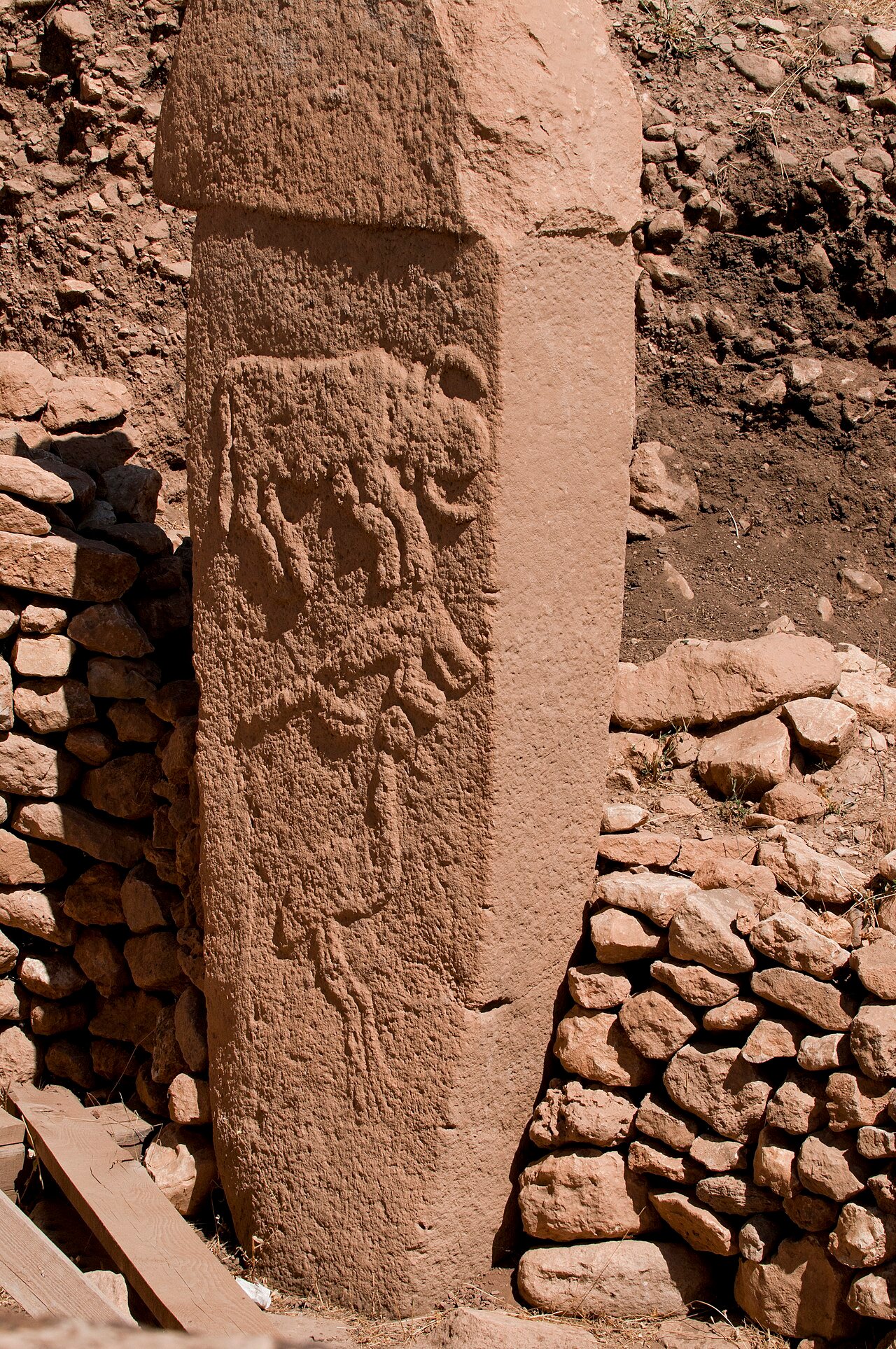
The builders of Göbekli Tepe carved monumental T-shaped limestone monoliths up to 5.5 metres tall and weighing between 10 and 20 metric tons, extracting them directly from the limestone plateau surrounding the site.
- Tooling: Lacking any metal tools, stonemasons used heavy hammerstones of basalt and flint picks to chip away surrounding bedrock, levering the blocks free with wooden wedges.
- Sculptural Mastery: The pillars are not bare monoliths; they are stylised, highly abstract representations of anthropomorphic beings, complete with carved arms, hands meeting above decorated loincloths, and fox-skin garments.
- Zoological Bas-Reliefs: The stone surfaces burst with high- and low-relief carvings of predators and venomous creatures—leopards leaping from pillar shafts, swooping vultures, snapping wild boars, coiled serpents, and scorpions—fashioned through subtractive relief carving, requiring the removal of square metres of surrounding stone to make the figures project outward.
Stonehenge: Trilithons and Carpentry Joints
Stonehenge’s engineering displays a sophisticated adaptation of timber carpentry joints to monumental stone architecture.
- Petrographic Provenance: The monument combines two distinct geologies:
- Sarsens: Hard silcrete sandstone megaliths (averaging 25 tons, with the Heel Stone weighing ~35 tons) quarried from West Woods near Marlborough, roughly 25 kilometres (15 miles) north of the site.
- Bluestones: Dolerite and rhyolite pillars (2 to 5 tons) transported over 225 kilometres (140 miles) from the Preseli Hills in southwestern Wales—a monumental overland or maritime logistics feat.
- Architectural Joinery: Stonehenge’s lintels are secured to upright sarsens using precise mortise-and-tenon joints, with curved lintels interlocking horizontally through tongue-and-groove joints. Stonemasons carefully hammered surfaces with sarsen mauls to create curved inner profiles and entasis (deliberate optical bulges) to counter perspective distortion.
3. Socio-Economic Foundation: Hunter-Gatherers vs. Agrarian Farmers
The most revolutionary revelation produced by Göbekli Tepe was the overthrow of the long-standing unilinear archaeological dogma: that agricultural surplus and sedentary farming must precede monumental public architecture.
| Dimension | Göbekli Tepe | Stonehenge |
|---|---|---|
| Archaeological Period | Pre-Pottery Neolithic A/B (PPNA / PPNB) | Late Neolithic / British Early Bronze Age |
| Subsistence Base | Mobile broad-spectrum foraging & hunting | Sedentary mixed agriculture & pastoralism |
| Domesticates Present | None in early phases (wild gazelle, aurochs, einkorn) | Fully domesticated cattle, pigs, emmer wheat, barley |
| Ceramics | Aceramic (Pre-Pottery; carved stone & wooden vessels) | Grooved Ware, Beaker pottery, Collared urns |
| Settlement Type | Ceremonial aggregation sanctuary / gathering hub | Dispersed farmsteads & village at Durrington Walls |
| Solar/Celestial Alignment | Topographic orientation (contested stellar/lunar claims) | Definite solstitial axis (Summer sunrise / Winter sunset) |
Feasting and Zooarchaeology
At both sites, monumental labor was powered and legitimized by monumental feasting:
- Göbekli Tepe: Zooarchaeological analyses by Joris Peters and Angela von den Driesch documented tens of thousands of butchered wild animal bones, with wild Persian gazelle (Gazella subgutturosa) accounting for over 60% of the assemblage, alongside aurochs (Bos primigenius) and wild boar. Massive stone basins with capacities up to 160 litres display calcium oxalate (beerstone) deposits, indicating large-scale communal brewing of wild barley gruel/beer to sustain seasonal laborers.
- Stonehenge: Excavations at the adjacent settlement of Durrington Walls by Mike Parker Pearson revealed massive deposits of domestic pork and cattle bones. Strontium and oxygen isotopic testing proved that cattle were driven to the site from as far away as northern England and Wales, converging for massive midwinter solstitial feasting ceremonies.
4. The Landscape Context: Taş Tepeler and Salisbury Plain
Neither monument existed as a solitary, isolated anomaly in an empty landscape. Modern landscape archaeology has contextualized both within dense regional complexes.
The Taş Tepeler Network of Upper Mesopotamia
Excavations directed by Necmi Karul under Turkey’s Ministry of Culture have revealed that Göbekli Tepe is one of over a dozen contemporary Pre-Pottery Neolithic sites across the Şanlıurfa plateau, collectively termed Taş Tepeler ("Stone Hills"):
- Karahan Tepe: Features over 250 T-shaped pillars, an underground chamber containing 11 phalluses carved directly from the bedrock, and a colossal three-dimensional human head protruding from the living stone.
- Sayburç: Preserves an intact 11-metre-long carved limestone bench depicting an interactive narrative scene of a human male holding his phallus flanked by attacking leopards and a menacing bull.
- Çakmaktepe & Sefertepe: Confirm that T-pillar architecture, communal subterranean buildings, and ritual aggregation were widespread across Upper Mesopotamia between 9500 and 8200 BCE.
Salisbury Plain and the Avebury Complex
Stonehenge similarly sits within an interconnected ceremonial ritual landscape:
- Durrington Walls & Woodhenge: Timber concentric henges that provided the domestic and ritual living counterpart ("land of the living") to Stonehenge's permanent stone cemetery ("land of the dead").
- The Greater Cursus & King Barrow Ridge: Monumental earthwork avenues and round barrow cemeteries defining sacred pilgrimage approaches.
- Avebury: Located 27 kilometres to the north, Avebury contains Europe's largest stone circle, enclosing over 28 acres with its henge bank and ditch.
5. Deconstructing Pop Myths: "World's First Temple" and "Deliberate Burial"
Popular media frequently distorts both sites with sensationalist tropes. Rigorous archaeological science provides vital corrections:
Myth 1: Göbekli Tepe was "The World's First Temple"
- Correction: The term "temple" carries institutional, sedentary, and bureaucratic connotations derived from historic Classical and Near Eastern religions. Göbekli Tepe is more accurately understood as a monumental pre-urban gathering sanctuary where mobile hunter-gatherer bands convened seasonally for kin-group negotiation, ritual exchange, mate selection, and cosmological ceremonies.
Myth 2: Göbekli Tepe was "Intentionally Buried by Aliens or Panicked Priests"
- Correction: Klaus Schmidt initially hypothesized that the enclosures were rapidly backfilled by their builders upon abandonment. However, extensive micro-morphological and geoarchaeological research directed by Lee Clare and the German Archaeological Institute (DAI) has demonstrated that much of the infill consists of natural post-depositional slope-wash (colluvium), combined with episodic wall collapses, landslides from the upper limestone ridges, and selective domestic backfilling over centuries.
Myth 3: Stonehenge was Built by Druids
- Correction: Iron Age Celtic Druids were recorded by Julius Caesar and Roman historians in the first century BCE—more than 1,500 to 2,000 years after Stonehenge's primary sarsen phases were completed. The monument had already fallen into ruin long before Druidical religious practices developed in Celtic Britain.
Confirmed, Inferred, and Debated Evidence
Göbekli Tepe's monumental enclosures predate Stonehenge by over 6,000 years
Stonehenge was built with solar solstitial alignments
Göbekli Tepe was constructed by non-agricultural hunter-gatherers
Stonehenge bluestones were quarried in southwestern Wales
Göbekli Tepe enclosures were roofed with wooden timbers
Göbekli Tepe was deliberately buried in an intentional single ritual event
Explore Next
- Direct side-by-side comparison: Göbekli Tepe vs Stonehenge in the Compare Tool
- Full site dossiers: Göbekli Tepe · Stonehenge · Karahan Tepe
- In-depth sanctuary analysis: Göbekli Tepe: The World's First Temple?
- Global Megalithic Map: Browse UNESCO Megalithic Sites on Atlas
Last updated: October 2026