

Pular para o conteúdo
Atlas Anatolia
NotíciasIce Age teeth in Sulawesi push betel-nut use back as far as 25,000 yearsRoman mosaic and Eros head uncovered in the basilica at Pompeiopolis, Kastamonu
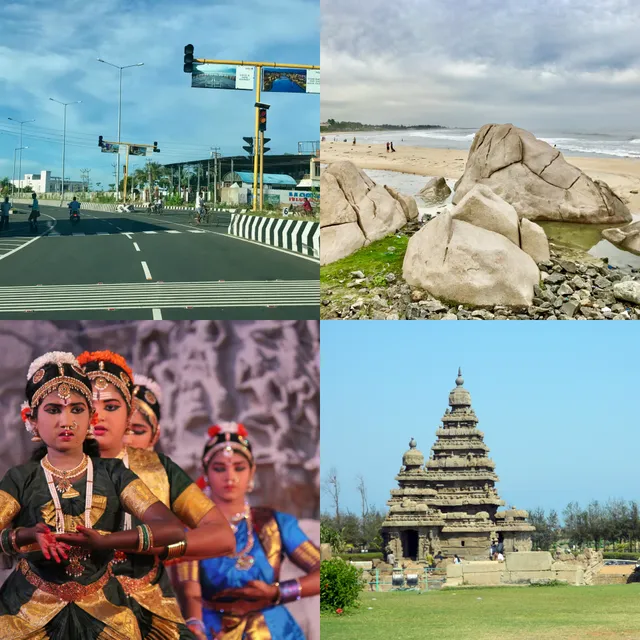
The Shore Temple at Mahabalipuram against the Bay of Bengal

Wikimedia Commons

ComplexoUNESCO

Mahabalipuram

Seyfi Cem Baskin

மாமல்லபுரம்600 d.C. – 800 d.C.

The Pallava port city on Tamil Nadu's Coromandel Coast — famous for 7th–8th-century rock-cut rathas, cave temples, the Shore Temple, and the giant open-air relief of the Descent of the Ganges — one of India's most visited UNESCO sites and a cornerstone of early Dravidian sculpture.

21
Interesse 66

Localização

Índia

12.62°N · 80.19°E · Ásia

Dynasty

Pallava kings Mahendravarman I and Narasimhavarman I (7th century CE)

Shore Temple

Structural granite temple facing the sea, c. 8th century CE

Relief

Descent of the Ganges — among the largest open-air rock reliefs

UNESCO

Group of Monuments at Mahabalipuram (1984)

Graphite pencil sketch banner of Mahabalipuram

“Mahabalipuram documents the birth of monumental Dravidian temple form — from experimental monolithic rathas to the Shore Temple that influenced centuries of South Indian architecture.”

Localização

Visão geral

Mahabalipuram (Mamallapuram) lies on the Bay of Bengal coast about 60 kilometres south of Chennai, Tamil Nadu. Under the Pallava kings Mahendravarman I (r. c. 600–630) and Narasimhavarman I (r. c. 630–668) — titled Mamalla ("great wrestler") — the site became a royal centre for rock-cut and structural temple architecture. The monuments are carved from local granite outcrops and include monolithic rathas (chariot-shaped shrines), mandapa cave temples, and the Shore Temple (c. 8th century) facing the sea.

The Descent of the Ganges (Arjuna's Penance) is one of the largest open-air bas-reliefs in the world, depicting Shiva, ascetics, elephants, and nagas on two huge boulders. Excavations after the 2004 tsunami revealed submerged structural remains offshore, suggesting a larger ancient port. The Archaeological Survey of India maintains the site; UNESCO inscribed the Group of Monuments in 1984.

Mahabalipuram remains an active stone-carving village and a mandatory stop on South India heritage circuits alongside Chennai, Kanchipuram, and Pondicherry.

Por que isso importa

Mahabalipuram documents the birth of monumental Dravidian temple form — from experimental monolithic rathas to the Shore Temple that influenced centuries of South Indian architecture. Its coastal reliefs and Pallava inscriptions are primary sources for early medieval trade, royal titles, and sculptural workshops in the Tamil country.

Evidências e interpretação

Distinguir o que está bem estabelecido do que permanece em debate.

Fatos bem estabelecidos

2
  • Pallava inscriptions and stylistic analysis date the rathas, mandapas, and Shore Temple to the 7th–8th centuries CE.
  • Submerged structural discoveries after 2004 confirm an extensive historic port zone beyond the visible shore temples.

Interpretações debatidas

1
  • The legend of "Seven Pagodas" swallowed by the sea is partially supported by offshore remains but the original count and destruction mechanism remain uncertain.

Fotos da comunidade

Compartilhe sua experiência

Você visitou este sítio? Envie suas fotos para ajudar outros a descobri-lo.

Como citar esta página

Atlas Anatolia. (600). Mahabalipuram. Atlas Anatolia. https://atlasanatolia.com/pt/site/mahabalipuram

Conteúdo licenciado sob CC BY-SA 4.0 — atribuição necessária ao reutilizar.

Fontes

  • Indian Temple Architecture: Form and Transformation — Hardy, Adam (1995)
  • UNESCO — MahabalipuramLink

Perguntas frequentes

Onde fica Mahabalipuram?

Mahabalipuram está localizado em India.

Qual é a antiguidade de Mahabalipuram?

Mahabalipuram data de aproximadamente 600 d.C. – 800 d.C..

Quais civilizações estão associadas a Mahabalipuram?

Mahabalipuram está associado à civilização Pallava.

Por que Mahabalipuram é importante?

Mahabalipuram documents the birth of monumental Dravidian temple form — from experimental monolithic rathas to the Shore Temple that influenced centuries of South Indian architecture.

Mahabalipuram é um Patrimônio Mundial da UNESCO?

Sim — Mahabalipuram está inscrito na Lista do Patrimônio Mundial da UNESCO.