
Pular para o conteúdo
Atlas Anatolia
NotíciasIce Age teeth in Sulawesi push betel-nut use back as far as 25,000 yearsRoman mosaic and Eros head uncovered in the basilica at Pompeiopolis, Kastamonu
The colonnaded forecourt of Luxor Temple illuminated at night, Luxor, Egypt

Wikimedia Commons

Country Record

Longest Recorded History in Egypt

TemploUNESCO

Luxor Temple

Seyfi Cem Baskin

معبد الأقصر1390 a.C. – 30 a.C.

The southern sanctuary of ancient Thebes — a colonnaded temple built by Amenhotep III and extended by Ramesses II on the Nile's east bank, connected to Karnak by a 3-kilometre sphinx-lined avenue and embedded inside a living city for three millennia, its innermost sanctuary repurposed as a Roman legionary shrine, then a Christian church, then a mosque.

311
Interesse 75

Localização

Egito

25.70°N · 32.64°E · África

Principal builder

Amenhotep III (c. 1390 BCE); extended by Ramesses II

Colonnade of Amenhotep III

14 papyrus-bud columns, 16 m tall

Missing obelisk

One of Ramesses II's obelisks removed to Place de la Concorde, Paris (1836)

Avenue of Sphinxes

3 km, ~1,350 sphinxes; restored and opened 2021

UNESCO

Part of "Ancient Thebes with its Necropolis" (1979)

Religious continuity

Active site from ~1400 BCE to present; Pharaonic → Roman → Christian → Islamic

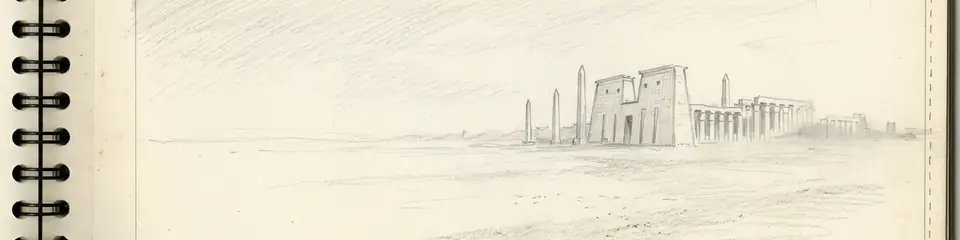
Graphite pencil sketch banner of Luxor Temple

“Luxor Temple is unique in world heritage because it was never abandoned.”

Localização

Visão geral

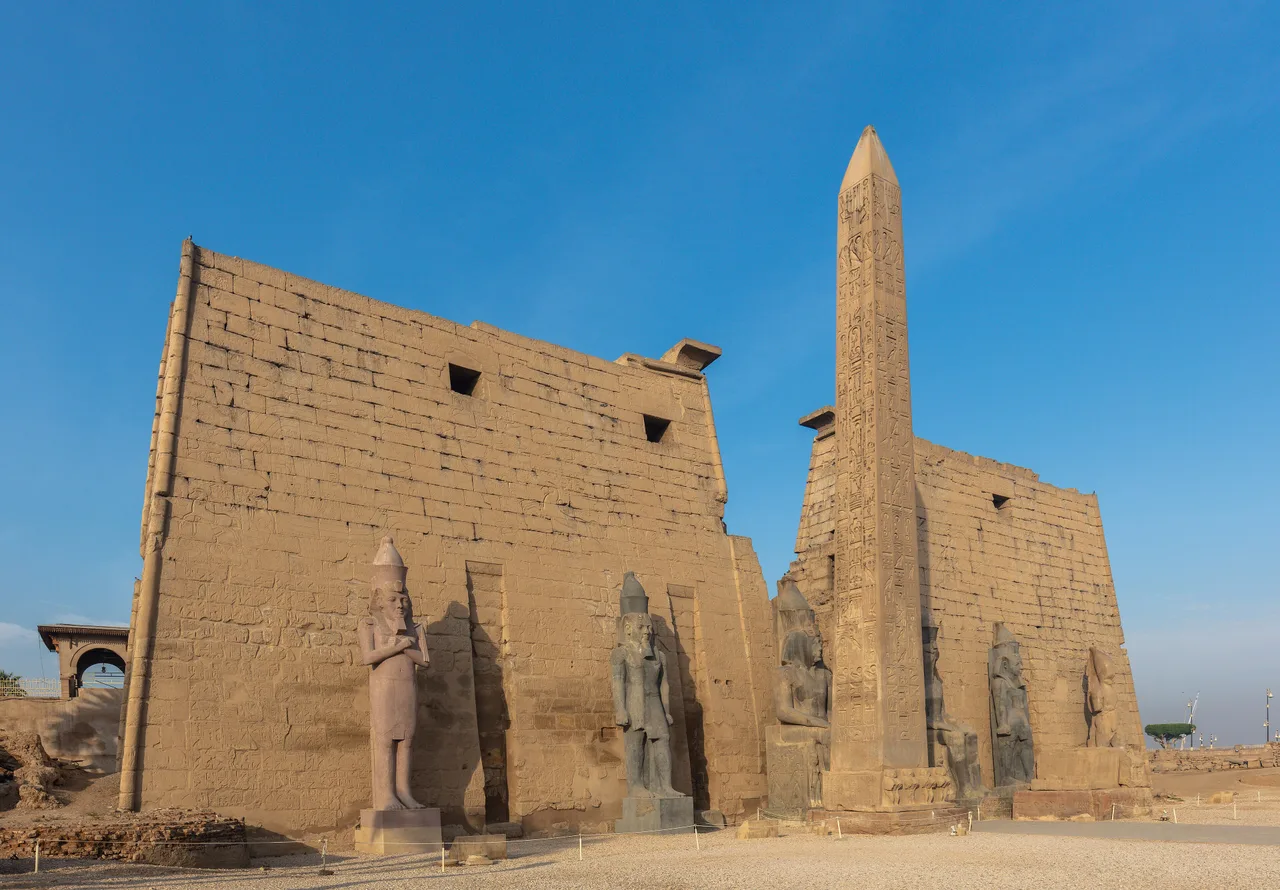
Luxor Temple stands on the east bank of the Nile in the center of modern Luxor — not outside the city but underneath it, with streets, houses, and a functioning mosque (Abu Haggag) built directly over its courts and walls. The temple was the principal venue for the Opet Festival, the annual celebration in which the divine power of kingship was renewed by transporting the sacred barque of Amun from Karnak to this temple in a procession along the Avenue of Sphinxes.

The core of the temple was built by Amenhotep III (r. 1390–1352 BCE), who constructed the colonnade hall with its 14 papyrus-bud columns and the inner sanctuary complex. Ramesses II (r. 1279–1213 BCE) added the massive First Pylon — originally flanked by six colossal statues of the king, four seated and two standing — and the open peristyle court. In front of the pylon once stood two obelisks: one remains in place; the other was removed to Paris in 1836 and now stands in the Place de la Concorde. The pylon faces are decorated with Ramesses's account of the Battle of Kadesh, one of the most extensively depicted military engagements in ancient art.

The Roman emperor Diocletian converted the innermost sanctuary into a shrine for the imperial cult in the late 3rd century CE, and the wall paintings visible today in this room — showing Roman emperors in ritual postures — are unique in Egypt. A Christian church was built in the southwest corner of the first court, later replaced by the Abu Haggag mosque. The mosque sits some 6 metres above the original temple floor on accumulated debris — a physical stratigraphy of 2,000 years of religious continuity on a single spot.

The Avenue of Sphinxes connecting Luxor Temple to Karnak — originally lined with 1,350 human-headed sphinxes over a 3-kilometre distance — was largely excavated between 2010 and 2021. The southern section, running from the First Pylon into the city, has been cleared and partially restored, with the sphinxes set back in their original alignment and lit at night.
Por que isso importa

Luxor Temple is unique in world heritage because it was never abandoned. Unlike Karnak, which was progressively deserted after the Roman period and buried under sand, Luxor Temple was continuously in use as a sacred space from roughly 1400 BCE through to the present day. The Abu Haggag mosque at the top of the accumulated debris is still an active place of worship. This uninterrupted continuity — Pharaonic, Roman imperial, Christian, Islamic — makes it a living record of three millennia of religious transformation at a single site. The recent restoration of the Avenue of Sphinxes connecting it to Karnak, completed in 2021, recreated the processional route used by millions of ancient Egyptians and opened it to the public for the first time in over a century.

Evidências e interpretação

Distinguir o que está bem estabelecido do que permanece em debate.

Fatos bem estabelecidos

3
  • The construction sequence is documented by inscriptions and cartouches. Amenhotep III's foundation inscription at the southern end of the colonnade corridor is intact. Ramesses II's additions are clearly identifiable by style, relief type, and the Battle of Kadesh text inscribed on the pylon faces.
  • The Roman conversion of the inner sanctuary is documented by wall paintings of Roman emperors — including Diocletian and his co-rulers — covering earlier Egyptian reliefs with a unique hybrid iconography. The paintings are partially preserved and dated to approximately 290–305 CE.
  • The Abu Haggag mosque (built partially atop the First Pylon) is dated by foundation inscriptions to the Ayyubid period (13th century CE). Its floor is approximately 6 metres above the Pharaonic pavement, demonstrating the depth of accumulated debris.

Inferências acadêmicas

1
  • The Opet Festival route along the Avenue of Sphinxes was the major public religious event in the Egyptian calendar. Depictions in the colonnade corridor show the barques of Amun, Mut, and Khonsu being carried by priests to Luxor Temple, where the king underwent a ritual renewal of divine identity in the innermost sanctuary. The precise content of the inner ceremony is unknown — only the approach is depicted publicly.

Interpretações debatidas

1
  • The symbolic relationship between Karnak and Luxor Temple — why Amun needed a "southern sanctuary" in addition to his principal seat — is debated. One theory proposes that Luxor Temple represented Amun in his fertility/generative aspect (Amun-Min), while Karnak represented his cosmic/royal aspect. Another interpretation sees Luxor as the location where the king's ka (divine double) was created and renewed.

Fotos da comunidade

Compartilhe sua experiência

Você visitou este sítio? Envie suas fotos para ajudar outros a descobri-lo.

Histórias relacionadas

Como citar esta página

Atlas Anatolia. (1390). Luxor Temple. Atlas Anatolia. https://atlasanatolia.com/pt/site/luxor-temple

Conteúdo licenciado sob CC BY-SA 4.0 — atribuição necessária ao reutilizar.

Gráfico

Conexões com sítios e histórias relacionados.

Fontes

  • Reliefs and Inscriptions at Luxor Temple (2 vols) — Epigraphic Survey (1994)
  • The Discovery of the Statuary Cachette of Luxor Temple — El-Saghir, Mohammed (1992)

Perguntas frequentes

Onde fica Luxor Temple?

Luxor Temple está localizado em Egypt.

Qual é a antiguidade de Luxor Temple?

Luxor Temple data de aproximadamente 1390 a.C. – 30 a.C..

Quais civilizações estão associadas a Luxor Temple?

Luxor Temple está associado à civilização Ancient Egyptian.

Por que Luxor Temple é importante?

Luxor Temple is unique in world heritage because it was never abandoned.

Luxor Temple é um Patrimônio Mundial da UNESCO?

Sim — Luxor Temple está inscrito na Lista do Patrimônio Mundial da UNESCO.