
콘텐츠로 건너뛰기
Atlas Anatolia
디그
뉴스술라웨시 빙하기 치아에서 빈랑 사용 25,000년 전까지 소급카스타모누 폼페이오폴리스 바실리카에서 로마 모자이크와 에로스 두상 발견
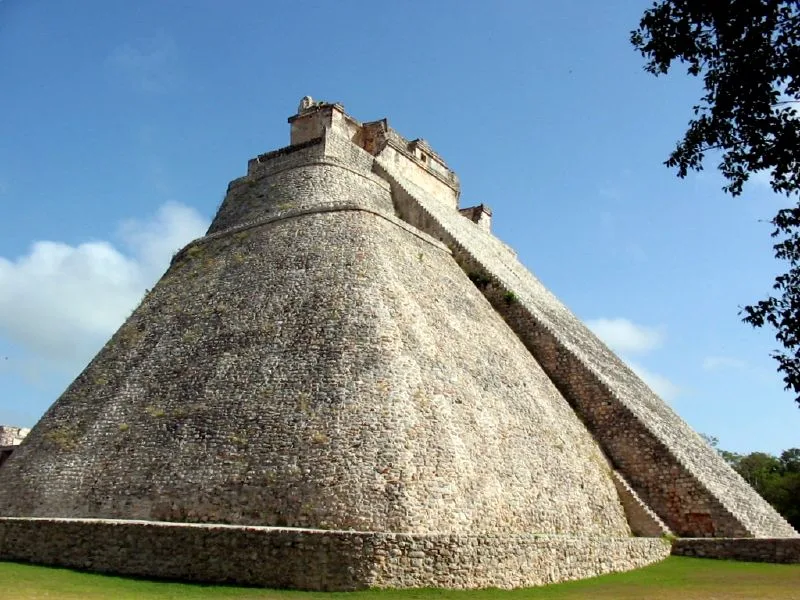
The rounded Pyramid of the Magician at Uxmal, Yucatán, Mexico

Wikimedia Commons

도시유네스코주요

Uxmal

Seyfi Cem Baskin

Óoxmáal600 서기 – 1000 서기

A great Maya city in the Puuc hills of Yucatán, Mexico, and the finest expression of the ornate Puuc architectural style — its rounded Pyramid of the Magician, sprawling Governor's Palace, and Nunnery Quadrangle covered in intricate stone latticework and masks of the rain god Chaac. It flourished between roughly 600 and 1000 CE.

41
관심 71

위치

멕시코

20.36°N · 89.77°W · 북아메리카

Peak

c. 600–1000 CE (Late/Terminal Classic Maya)

Style

The masterpiece of Puuc architecture (mosaic stone façades)

Pyramid of the Magician

Unusual rounded, elliptical-sided pyramid

Governor's Palace

~100 m façade, ~20,000 mosaic stones; aligned to Venus

Water

No rivers/cenotes — relied on chultun rain cisterns

UNESCO

World Heritage Site (1996)

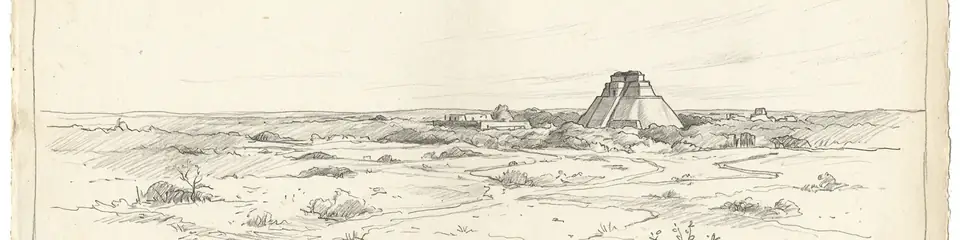
Graphite pencil sketch banner of Uxmal

“Uxmal is widely regarded as the architectural high point of the Puuc Maya region and one of the most beautiful of all Maya cities.”

위치

개요

Uxmal lies in the low Puuc hills of the western Yucatán Peninsula, about 60 kilometres south of Mérida. Its name is usually translated as "thrice built." Unlike the great cities of the Maya lowlands to the south, Uxmal had no rivers, lakes, or natural cenotes for water, and depended instead on rainfall stored in numerous plastered underground cisterns (chultuns) — a fact reflected in the obsessive repetition of masks of Chaac, the hook-nosed rain god, across its façades. The city flourished in the Late and Terminal Classic periods, roughly 600–1000 CE, with a peak population that may have reached around 15,000–25,000.

Uxmal is the showcase of the Puuc architectural style, characterised by smooth lower walls of finely cut limestone veneer surmounted by elaborately decorated upper friezes assembled from thousands of pre-cut mosaic stones — geometric lattices, colonnettes imitating bundled reeds, step-frets, and serpent and Chaac motifs. The Pyramid of the Magician (or Pyramid of the Soothsayer) dominates the site: an unusual structure with rounded, elliptical sides rising in several superimposed phases, wrapped in legend as the work of a dwarf magician built in a single night.

The Nunnery Quadrangle — so named by the Spanish for its resemblance to a convent — is a large courtyard enclosed by four richly decorated buildings, considered one of the masterpieces of Maya architecture. The Governor's Palace, raised on a vast artificial platform, has a façade nearly 100 metres long covered with an intricate mosaic frieze of some 20,000 cut stones, and is aligned to the rising point of Venus, reflecting the Maya concern with that planet. A ball court and the House of the Turtles complete the ceremonial core. Uxmal was connected by a raised causeway (sacbe) to the nearby centre of Kabah and dominated a cluster of Puuc cities.

The city declined around 1000 CE, for reasons that remain debated but probably involved the same combination of drought, political instability, and shifting trade that affected the wider Maya world. It was never entirely forgotten, and was described by the explorers John Lloyd Stephens and Frederick Catherwood in the 1840s.
중요성

Uxmal is widely regarded as the architectural high point of the Puuc Maya region and one of the most beautiful of all Maya cities. Its buildings represent the most refined development of the Puuc style, in which entire upper façades were composed as vast stone mosaics — a level of decorative sophistication unmatched elsewhere in the Maya world. The Governor's Palace and Nunnery Quadrangle are considered masterpieces of pre-Columbian architecture, and the city's ingenious adaptation to a waterless environment, with its cisterns and pervasive rain-god imagery, illuminates how the Maya thrived where surface water was absent. Uxmal was inscribed as a UNESCO World Heritage Site in 1996.

증거와 해석

확립된 사실과 논쟁 중인 사항을 구분합니다.

잘 확립된 사실

4
  • The Puuc-style mosaic façades survive across the Nunnery Quadrangle, Governor's Palace, and other buildings, assembled from thousands of pre-cut veneer stones — confirmed by direct architectural study.
  • The Governor's Palace is aligned toward the southerly rising extreme of Venus, established by archaeoastronomical survey, consistent with the Maya ritual importance of that planet.
  • Numerous chultuns (plastered underground cisterns) document the city's reliance on stored rainwater in a region lacking surface water or cenotes.
  • A sacbe (raised causeway) links Uxmal to the neighbouring Puuc centre of Kabah, evidencing political and economic ties within the Puuc region.

논쟁 중인 해석

1
  • The causes and precise timing of Uxmal's decline around 1000 CE are debated, with drought, warfare, and shifting trade networks all proposed; the relative weight of each remains uncertain.

커뮤니티 사진

당신의 경험을 공유하세요

이 유적지를 방문하셨나요? 다른 탐험가들을 위해 사진을 업로드해 보세요.

관련 이야기

이 페이지 인용 방법

Atlas Anatolia. (600). Uxmal. Atlas Anatolia. https://atlasanatolia.com/ko/site/uxmal

콘텐츠는 CC BY-SA 4.0 라이선스에 따라 제공됩니다 — 재사용 시 출처 표시가 필요합니다.

그래프

관련 유적지와 스토리로의 연결.

출처

  • The House of the Governor: A Maya Palace at Uxmal — Kowalski, Jeff Karl (1987)
  • The Maya — Coe, Michael D. (2011)

자주 묻는 질문

Uxmal은(는) 어디에 위치해 있나요?

Uxmal은(는) Mexico에 위치해 있습니다.

Uxmal의 연대는 언제인가요?

Uxmal의 연대는 대략 600 서기 – 1000 서기로 거슬러 올라갑니다.

Uxmal과(와) 관련된 고대 문명은 무엇인가요?

Uxmal은(는) Maya 문명과 관련이 있습니다.

Uxmal이(가) 중요한 이유는 무엇인가요?

Uxmal is widely regarded as the architectural high point of the Puuc Maya region and one of the most beautiful of all Maya cities.

Uxmal은(는) 유네스코 세계유산인가요?

예 — Uxmal은(는) 유네스코 세계유산으로 등재되어 있습니다.