
콘텐츠로 건너뛰기
Atlas Anatolia
디그
뉴스술라웨시 빙하기 치아에서 빈랑 사용 25,000년 전까지 소급카스타모누 폼페이오폴리스 바실리카에서 로마 모자이크와 에로스 두상 발견
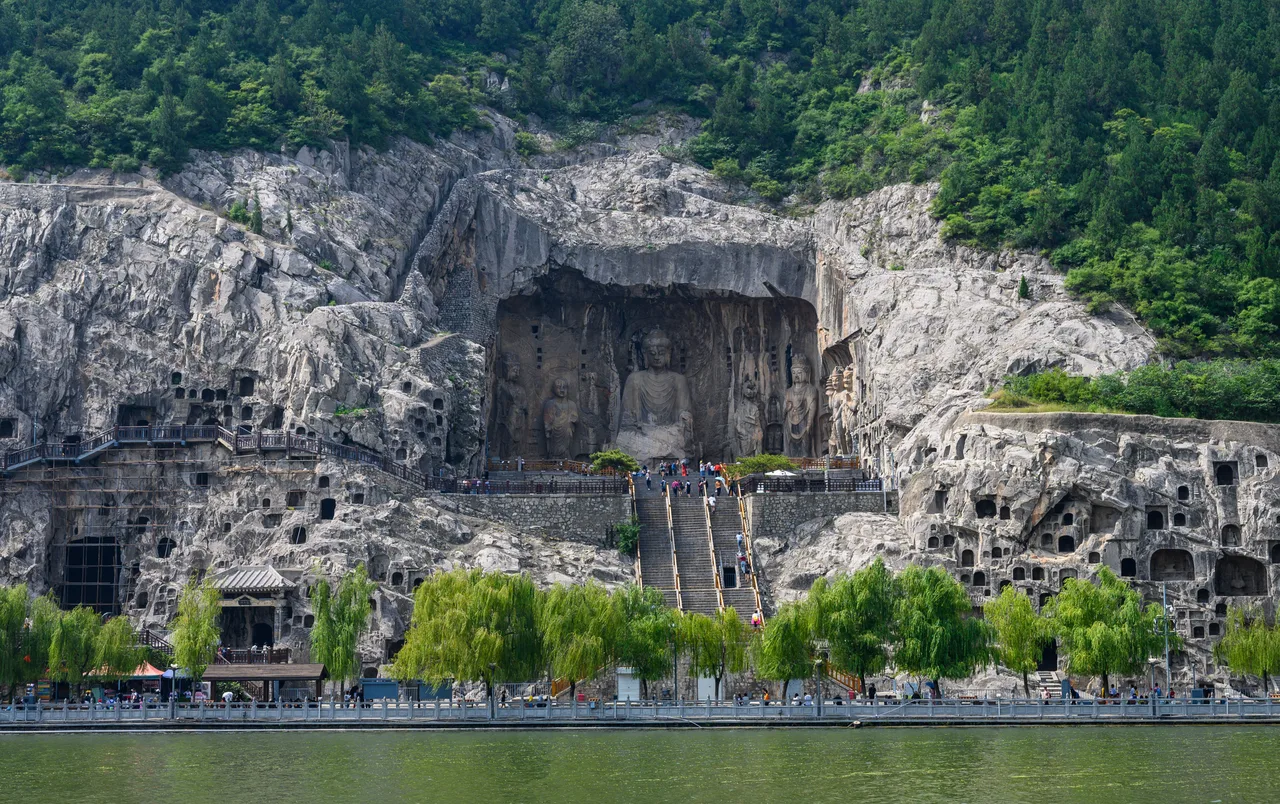
The colossal Vairocana Buddha of the Fengxian Temple at the Longmen Grottoes, Luoyang, China

Wikimedia Commons

복합 단지유네스코

Longmen Grottoes

Seyfi Cem Baskin

龙门石窟493 서기 – 1127 서기

One of the greatest treasuries of Chinese Buddhist stone sculpture — more than 2,300 caves and niches cut into the limestone cliffs above the Yi River near Luoyang, holding over 100,000 carved images of the Buddha and bodhisattvas produced across four centuries. Begun by the Northern Wei dynasty around 493 CE and reaching its height under the Tang, its colossal Vairocana Buddha at the Fengxian Temple, some 17 metres tall, ranks among the supreme achievements of East Asian religious art.

31
관심 67

위치

Luoyang · Henan · 중국

34.56°N · 112.47°E · 아시아

Begun

c. 493 CE by the Northern Wei; height under the Tang dynasty

Scale

2,300+ caves and niches, 100,000+ carved Buddhist images

Fengxian Temple

Colossal Vairocana Buddha ~17 m tall, commissioned c. 670s CE

Wu Zetian

Fengxian Temple linked to the patronage era of China's only female emperor

UNESCO

World Heritage Site 2000

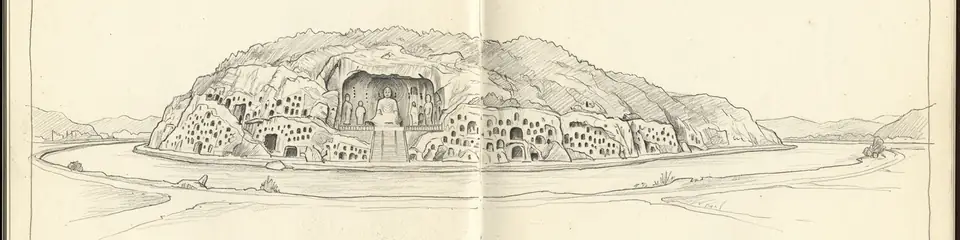
Graphite pencil sketch banner of Longmen Grottoes

“Longmen provides an unmatched continuous record of the development of Chinese Buddhist art across one of its most important transitions — from the linear, otherworldly Northern Wei style of the late 5th and early 6th centuries to the rounded, humane naturalism of the high Tang.”

위치

개요

The Longmen Grottoes ("Dragon's Gate") are cut into the limestone cliffs on both banks of the Yi River, about 12 kilometres south of the city of Luoyang in Henan province — a location where the river passes between two hills, framing a natural "gate" that gave the site its name. Together with the Mogao Caves of Dunhuang and the Yungang Grottoes near Datong, Longmen is counted among the three greatest ancient Buddhist cave-sculpture sites in China, and it holds the largest and most concentrated collection of monumental Chinese stone Buddhist carving anywhere.

Carving began around 493 CE, when the Northern Wei dynasty — a state founded by the Xianbei, a people of the northern steppe who had adopted Buddhism and much of Chinese culture — moved its capital to Luoyang and began sponsoring cave temples in the manner it had earlier developed at Yungang. The earliest Longmen caves, such as the Guyang Cave and the Binyang Caves, reflect the elongated, ethereal, linear style characteristic of Northern Wei Buddhist art, and their walls preserve some of the most important early examples of Chinese calligraphy carved in stone, including many of the celebrated "Twenty Masterworks" of Longmen dedicatory inscriptions prized by later Chinese calligraphers.

After a period of reduced activity, patronage surged again under the Tang dynasty (618–907 CE), when Luoyang served as a secondary and sometimes primary imperial capital. Tang-era carving at Longmen is fuller, rounder, and more naturalistic than the austere Northern Wei style, reflecting the confident cosmopolitan aesthetic of the Tang. The supreme achievement of this period — and of the entire site — is the Fengxian Temple (Fengxiansi), a vast open-air niche dominated by a colossal seated image of Vairocana Buddha rising roughly 17 metres, flanked by monumental attendant bodhisattvas, disciples, and fierce guardian figures. Commissioned in the 670s CE with financial support associated with Empress Wu Zetian — the only woman to rule China as emperor in her own right — the serene, powerful face of the Vairocana Buddha has become one of the most iconic images in all of Chinese art, and is popularly, if not certainly, said to reflect the features of the empress herself.

Across the two riverbanks, the site's more than 2,300 grottoes and niches contain over 100,000 individual carved Buddhist images ranging from a few centimetres to many metres in height, along with roughly 2,800 inscriptions and dozens of pagodas — an immense corpus documenting not only the evolution of Chinese Buddhist art across the pivotal Northern Wei to Tang transition, but also, through its dedicatory inscriptions, the religious devotion, social identities, and political networks of the emperors, officials, monks, and ordinary donors who paid for the carvings. Longmen suffered significant looting in the early 20th century, when many heads and reliefs were removed and sold to foreign collectors, and some damage during later periods, but the great majority of its sculpture survives in place. The Longmen Grottoes were inscribed as a UNESCO World Heritage Site in 2000.

중요성

Longmen provides an unmatched continuous record of the development of Chinese Buddhist art across one of its most important transitions — from the linear, otherworldly Northern Wei style of the late 5th and early 6th centuries to the rounded, humane naturalism of the high Tang. Because so much of the carving is precisely dated by dedicatory inscription, art historians can trace this stylistic evolution with a chronological precision rarely possible at other sites. The colossal Vairocana Buddha of the Fengxian Temple, created under the patronage of the era of Empress Wu Zetian, is both a peak of monumental religious sculpture and a direct material link to one of the most remarkable political stories in Chinese history — the reign of China's only female emperor — illustrating how imperial power, gender, and Buddhist devotion intertwined at the highest level of the Tang state. Beyond the sculpture itself, Longmen's roughly 2,800 inscriptions constitute an extraordinary primary archive of medieval Chinese religious and social life, recording who commissioned each image and why, and preserving in the "Twenty Masterworks" some of the most revered examples of early Chinese stone calligraphy — making the site simultaneously a monument of art, religion, epigraphy, and social history.

증거와 해석

확립된 사실과 논쟁 중인 사항을 구분합니다.

잘 확립된 사실

3
  • Roughly 2,800 dated dedicatory inscriptions carved at Longmen allow precise chronological placement of many caves and niches, confirming the site's development from the Northern Wei period (from c. 493 CE) through the Tang dynasty.
  • Historical records document the commissioning of the Fengxian Temple's Vairocana Buddha in the 670s CE with financial support associated with the court of Empress Wu Zetian.
  • Stylistic analysis across securely dated caves confirms the transition from the linear Northern Wei sculptural style to the fuller, more naturalistic Tang style, making Longmen a key reference sequence for Chinese Buddhist art history.

논쟁 중인 해석

1
  • The popular claim that the face of the Fengxian Vairocana Buddha was modelled on the features of Empress Wu Zetian herself is a widely repeated tradition that cannot be independently confirmed.

발견과 발굴

1906

Early scholarly documentation

Systematic photographic and epigraphic documentation of the grottoes by scholars including Édouard Chavannes, coinciding with a period of significant looting.

1953

Longmen Grottoes Research Institute

Establishment of the dedicated Chinese research and conservation body responsible for ongoing study, protection, and restoration of the site.

커뮤니티 사진

당신의 경험을 공유하세요

이 유적지를 방문하셨나요? 다른 탐험가들을 위해 사진을 업로드해 보세요.

이 페이지 인용 방법

Atlas Anatolia. (493). Longmen Grottoes. Atlas Anatolia. https://atlasanatolia.com/ko/site/longmen-grottoes

콘텐츠는 CC BY-SA 4.0 라이선스에 따라 제공됩니다 — 재사용 시 출처 표시가 필요합니다.

출처

  • Donors of Longmen: Faith, Politics, and Patronage in Medieval Chinese Buddhist Sculpture — McNair, Amy (2007)
  • Chinese Steles: Pre-Buddhist and Buddhist Use of a Symbolic Form — Wong, Dorothy C. (2004)
  • UNESCO — Longmen Grottoes링크

자주 묻는 질문

Longmen Grottoes은(는) 어디에 위치해 있나요?

Longmen Grottoes은(는) Luoyang, Henan, China에 위치해 있습니다.

Longmen Grottoes의 연대는 언제인가요?

Longmen Grottoes의 연대는 대략 493 서기 – 1127 서기로 거슬러 올라갑니다.

Longmen Grottoes과(와) 관련된 고대 문명은 무엇인가요?

Longmen Grottoes은(는) Tang, Northern Wei 문명과 관련이 있습니다.

Longmen Grottoes이(가) 중요한 이유는 무엇인가요?

Longmen provides an unmatched continuous record of the development of Chinese Buddhist art across one of its most important transitions — from the linear, otherworldly Northern Wei style of the late 5th and early 6th centuries to the rounded, humane naturalism of the high Tang.

Longmen Grottoes은(는) 유네스코 세계유산인가요?

예 — Longmen Grottoes은(는) 유네스코 세계유산으로 등재되어 있습니다.