
콘텐츠로 건너뛰기
Atlas Anatolia
디그
뉴스술라웨시 빙하기 치아에서 빈랑 사용 25,000년 전까지 소급카스타모누 폼페이오폴리스 바실리카에서 로마 모자이크와 에로스 두상 발견
The Canopus canal and colonnade at Hadrian’s Villa, Tivoli

Wikimedia Commons (CC BY-SA 4.0)

복합 단지유네스코주요

Hadrian's Villa

Seyfi Cem Baskin

Villa Adriana118 서기 – 138 서기

Emperor Hadrian’s sprawling second-century retreat at Tivoli — Canopus canal, Maritime Theatre, baths, and colonnades quoting Greece and Egypt — is a UNESCO World Heritage site and among the highest pageview Roman archaeological complexes still missing from the atlas.

21
관심 74

위치

이탈리아

41.94°N · 12.80°E · 유럽

Builder

Emperor Hadrian, mainly 118–138 CE

Area

>120 ha of pavilions and gardens

Landmarks

Canopus, Maritime Theatre, baths, Piazza d’Oro

UNESCO

Inscribed 1999

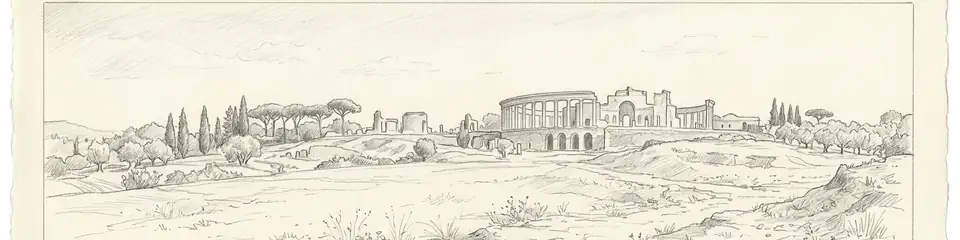
Graphite pencil sketch banner of Hadrian's Villa

“Hadrian’s Villa is the fullest surviving expression of a Roman emperor’s personal landscape architecture — a catalogue of imperial taste after conquest.”

위치

개요

Hadrian’s Villa occupies the plain below the Tiburtine Hills east of Rome. Built largely between 118 and 138 CE for the emperor who spent much of his reign travelling the provinces, the estate covers over 120 hectares of residential pavilions, gardens, libraries, baths, and service quarters. Designed as a landscape of memories, its named spaces evoke Athens (Poikile), Egypt (Canopus/Serapeum), and Greece (Prytaneum, Stoa Poikile).

Key monuments include the circular Maritime Theatre — a “island villa” within a moat — the long reflecting canal of the Canopus lined with caryatids and statues, the Large and Small Baths, the Piazza d’Oro complex, and imperial apartments. Excavations since the Renaissance (and systematic digs from the 19th century onward) recovered sculpture now dispersed in museums; modern conservation grapples with tourism and seismic risk.

The villa models how imperial identity was staged through architecture after the High Empire’s territorial apex. Pair with the Colosseum, Pantheon, and Roman Forum for metropolitan counterparts, and with Pompeii for Campanian domestic life outside the court.

중요성

Hadrian’s Villa is the fullest surviving expression of a Roman emperor’s personal landscape architecture — a catalogue of imperial taste after conquest. Its Canopus and Maritime Theatre are foundational for studying how Rome appropriated eastern and Greek forms into private palatial space.

증거와 해석

확립된 사실과 논쟁 중인 사항을 구분합니다.

잘 확립된 사실

2
  • Brick stamps, literary references (Historia Augusta), and stratified finds date major construction to Hadrian’s reign.
  • Named spaces in Renaissance and modern plans match Egyptian and Greek architectural quotes in sculpture and layout.

학술적 추론

1
  • Some pavilions may have functioned as temporary diplomatic stages for provincial elites visiting Italy.

커뮤니티 사진

당신의 경험을 공유하세요

이 유적지를 방문하셨나요? 다른 탐험가들을 위해 사진을 업로드해 보세요.

이 페이지 인용 방법

Atlas Anatolia. (118). Hadrian's Villa. Atlas Anatolia. https://atlasanatolia.com/ko/site/hadrians-villa

콘텐츠는 CC BY-SA 4.0 라이선스에 따라 제공됩니다 — 재사용 시 출처 표시가 필요합니다.

출처

  • Hadrian's Villa and Its Legacy — MacDonald, William L.; Pinto, John A. (1995)
  • UNESCO — Villa Adriana (Tivoli)링크

자주 묻는 질문

Hadrian's Villa은(는) 어디에 위치해 있나요?

Hadrian's Villa은(는) Italy에 위치해 있습니다.

Hadrian's Villa의 연대는 언제인가요?

Hadrian's Villa의 연대는 대략 118 서기 – 138 서기로 거슬러 올라갑니다.

Hadrian's Villa과(와) 관련된 고대 문명은 무엇인가요?

Hadrian's Villa은(는) Roman 문명과 관련이 있습니다.

Hadrian's Villa이(가) 중요한 이유는 무엇인가요?

Hadrian’s Villa is the fullest surviving expression of a Roman emperor’s personal landscape architecture — a catalogue of imperial taste after conquest.

Hadrian's Villa은(는) 유네스코 세계유산인가요?

예 — Hadrian's Villa은(는) 유네스코 세계유산으로 등재되어 있습니다.