
콘텐츠로 건너뛰기
Atlas Anatolia
디그
뉴스술라웨시 빙하기 치아에서 빈랑 사용 25,000년 전까지 소급카스타모누 폼페이오폴리스 바실리카에서 로마 모자이크와 에로스 두상 발견
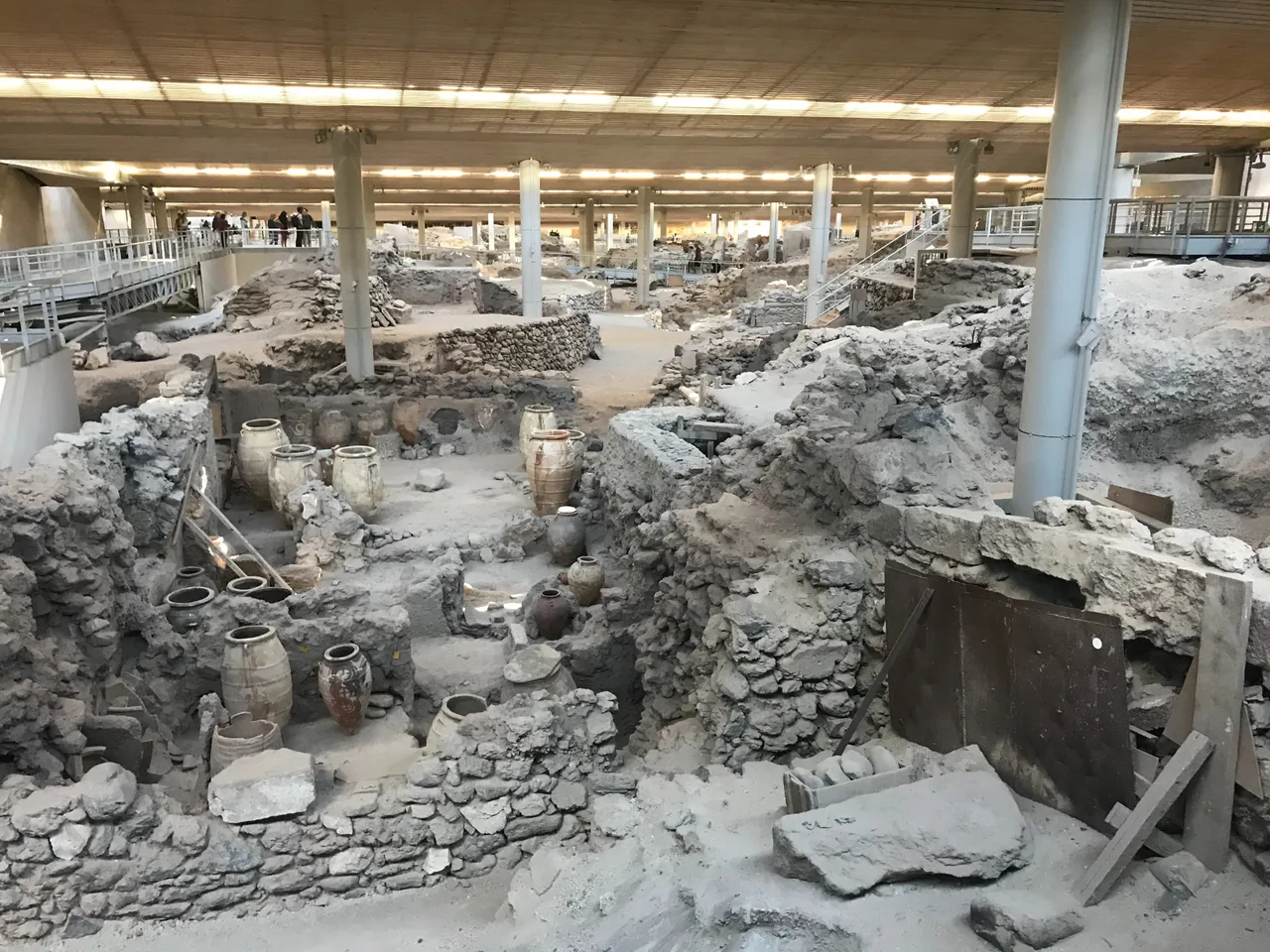
Excavated multi-storey buildings at Akrotiri under the protective roof

Wikimedia Commons

Country Record

Oldest Settlement in Greece

정착지주요

Akrotiri

Seyfi Cem Baskin

Ακρωτήρι3000 기원전 – 1620 기원전

A Bronze Age Aegean city on Santorini buried by one of the largest volcanic eruptions in human history c. 1600 BCE, preserving multi-storey buildings, vivid frescoes, and stone-paved streets in near-intact condition.

32
관심 63

위치

그리스

36.35°N · 25.40°E · 유럽

Eruption date (estimated)

c. 1627–1600 BCE (disputed)

VEI (eruption magnitude)

7 — one of the largest Holocene eruptions

Human remains found

None — population evidently evacuated

Building heights

Up to 3 storeys surviving

Frescoes

Extensive polychrome fresco cycles, now in Athens National Museum

Excavation began

1967, by Spyridon Marinatos

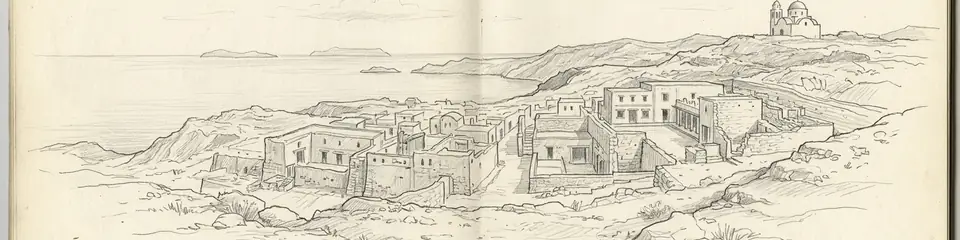
Graphite pencil sketch banner of Akrotiri

“Akrotiri reframes what the Bronze Age Aegean looked like.”

위치

개요

Akrotiri lies at the southern end of Santorini (ancient Thera), the crescent-shaped caldera island in the southern Aegean. Around 1600–1627 BCE (the exact date is disputed between radiocarbon and ice-core evidence), the island's volcanic system erupted catastrophically — an event with a Volcanic Explosivity Index of 7, comparable to Tambora (1815) and roughly five times the energy of Krakatau (1883). The tephra fallout can be traced across the eastern Mediterranean, Egypt, and the Greenland ice cores. The eruption destroyed Minoan settlements across Thera and, some argue, contributed to the collapse of the Minoan civilization on Crete. Akrotiri itself, excavated by Spyridon Marinatos from 1967, is the best-preserved Bronze Age settlement in the Aegean. The volcanic pumice blanket sealed buildings intact: multi-storey structures survive to their original height, with stone staircases, clay pipes (running water), beds of carbonized grain, pottery in situ on shelves, and most remarkably, fresco cycles of extraordinary quality. The frescoes — depicting fishermen, boxers, antelopes, swallows, a blue flotilla fleet, and detailed landscape paintings — are the most extensive figurative paintings surviving from the Bronze Age world. Crucially, no human remains have been found at Akrotiri, suggesting the population evacuated before the eruption.
중요성

Akrotiri reframes what the Bronze Age Aegean looked like. The frescoes — particularly the Flotilla Fresco, a continuous panoramic painting of a sea voyage between two towns — show a sophisticated urban maritime civilization with detailed knowledge of ships, landscape, and costume. The running water system, piped through clay tubes under pressure, demonstrates a level of hydraulic engineering not seen again in Europe until Roman times. The question of whether Akrotiri's destruction inspired the Atlantis legend — as Plato's Timaeus and Critias describe an island civilization swallowed by the sea — is one of the most persistent debates in popular archaeology, though mainstream scholarship remains skeptical.

증거와 해석

확립된 사실과 논쟁 중인 사항을 구분합니다.

잘 확립된 사실

3
  • The eruption date is constrained by the Greenland GISP2 ice core, which records a major volcanic layer around 1645–1628 BCE, and by radiocarbon dating of olive branches buried by the tephra, which gives 1627–1600 BCE at 95% confidence.
  • Multi-storey buildings at Akrotiri survive intact under the pumice, including a water supply system consisting of clay pipes with socketed joints running under building floors and streets — the earliest known urban pressurized water system in the Aegean.
  • The complete absence of human skeletal remains and of valuables such as metal objects or jewelry indicates the population evacuated in an orderly manner before the main eruption phase, probably following precursor earthquakes.

논쟁 중인 해석

2
  • The eruption's role in causing the collapse of Minoan civilization on Crete is actively debated. Minoan Crete continued for at least one to two centuries after the eruption, and the collapse is now attributed to a combination of factors including drought, internal conflict, and Mycenaean encroachment.
  • The identification of Akrotiri's eruption as the inspiration for Plato's Atlantis story (Timaeus, c. 360 BCE) is widely discussed in popular literature but not accepted by most classicists, who view Atlantis as a philosophical device invented by Plato.

커뮤니티 사진

당신의 경험을 공유하세요

이 유적지를 방문하셨나요? 다른 탐험가들을 위해 사진을 업로드해 보세요.

관련 이야기

이 페이지 인용 방법

Atlas Anatolia. (3000). Akrotiri. Atlas Anatolia. https://atlasanatolia.com/ko/site/akrotiri

콘텐츠는 CC BY-SA 4.0 라이선스에 따라 제공됩니다 — 재사용 시 출처 표시가 필요합니다.

그래프

관련 유적지와 스토리로의 연결.

출처

  • Excavations at Thera I–VII — Spyridon Marinatos (1968)
  • The Date of the Minoan Eruption of Santorini — Friedrich et al. (2006)링크

자주 묻는 질문

Akrotiri은(는) 어디에 위치해 있나요?

Akrotiri은(는) Greece에 위치해 있습니다.

Akrotiri의 연대는 언제인가요?

Akrotiri의 연대는 대략 3000 기원전 – 1620 기원전로 거슬러 올라갑니다.

Akrotiri과(와) 관련된 고대 문명은 무엇인가요?

Akrotiri은(는) Minoan 문명과 관련이 있습니다.

Akrotiri이(가) 중요한 이유는 무엇인가요?

Akrotiri reframes what the Bronze Age Aegean looked like.

Akrotiri은(는) 유네스코 세계유산인가요?

Akrotiri은(는) 현재 유네스코 세계유산 목록에 등재되어 있지 않습니다.