
コンテンツへスキップ
Atlas Anatolia
ニュースIce Age teeth in Sulawesi push betel-nut use back as far as 25,000 yearsRoman mosaic and Eros head uncovered in the basilica at Pompeiopolis, Kastamonu
Aerial view of the Winter Palace green facade on the Neva River, St Petersburg

Wikimedia Commons (CC BY)

遺産複合体UNESCO注目

Winter Palace

Seyfi Cem Baskin

Зимний дворец1754 西暦 – 1917 西暦

The green-and-white Baroque palace on Palace Embankment in St Petersburg — seat of the Romanov tsars from 1762 and core of the State Hermitage Museum — ranks second among missing sites in our multilingual pageview audit and defines Russian imperial spectacle.

21
関心 76

所在地

ロシア

59.94°N · 30.31°E · ヨーロッパ

Built

1754–1762 under Empress Elizabeth (Rastrelli)

Hermitage

Catherine II began collection 1764; museum from 1852

1917

Stormed 25 October — Bolshevik revolution icon

UNESCO

Historic Centre of Saint Petersburg (1990)

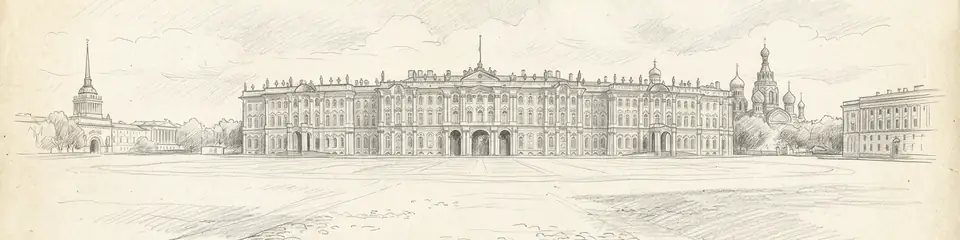
Graphite pencil sketch banner of Winter Palace

“The Winter Palace is where Romanov court ritual met global art collecting — architecture, monarchy, and museum in one Neva frontage.”

所在地

概要

The Winter Palace stands on the Neva River embankment in central St Petersburg, Russia. Peter the Great founded the city in 1703; after intermediate palaces, Empress Elizabeth commissioned Bartolomeo Rastrelli's Baroque masterpiece (1754–1762), a facade nearly a kilometre long with hundreds of rooms, gilded state apartments, and the Jordan Staircase where courtiers greeted the tsar on feast days.

Catherine the Great added the Small Hermitage (1764) to house her art collection — the nucleus of what became the State Hermitage Museum, one of the world's largest museums. Nicholas I rebuilt interiors after the 1837 fire. The palace witnessed the 1905 Bloody Sunday massacre on Palace Square and the Bolshevik storming of 25 October 1917 that toppled the Provisional Government.

The Romanovs abandoned it for the Alexander Palace after 1905, but the building remained the revolution's symbolic target. Today the state rooms and Hermitage galleries display imperial decor alongside Egyptian, Renaissance, and modern collections. UNESCO listed the "Historic Centre of Saint Petersburg" in 1990. Pair with Palace of Versailles for contrasting Baroque absolutist residences.

重要性

The Winter Palace is where Romanov court ritual met global art collecting — architecture, monarchy, and museum in one Neva frontage. Its 1917 storming makes it the built icon of the Russian Revolution, driving search interest that links imperial luxury to modern political rupture.

証拠と解釈

確立された事実と議論が続く事柄を区別する。

確立された事実

2
  • Architectural plans, court records, and post-1837 fire rebuild documents date Baroque phases.
  • Photographs and Bolshevik accounts record the 1917 assault on the palace.

学術的推論

1
  • Elizabeth and Catherine used scale and art patronage to legitimise Romanov rule on a newly built capital.

コミュニティ写真

あなたの体験を共有する

この遺跡を訪れたことがありますか?写真をアップロードして魅力を共有しましょう。

このページの引用方法

Atlas Anatolia. (1754). Winter Palace. Atlas Anatolia. https://atlasanatolia.com/ja/site/winter-palace

コンテンツはCC BY-SA 4.0ライセンスの下で提供されています — 再利用の際は出典表示が必要です。

出典

  • A People's Tragedy: The Russian Revolution — Orlando Figes (1996)
  • State Hermitage Museumリンク

よくある質問

Winter Palaceはどこにありますか?

Winter PalaceはRussiaに位置しています。

Winter Palaceの年代はいつ頃ですか?

Winter Palaceはおよそ1754 西暦 – 1917 西暦のものとされています。

Winter Palaceはどの文明に関連していますか?

Winter PalaceはRomanov文明に関連しています。

Winter Palaceが重要な理由は何ですか?

The Winter Palace is where Romanov court ritual met global art collecting — architecture, monarchy, and museum in one Neva frontage.

Winter Palaceはユネスコ世界遺産ですか?

はい — Winter Palaceはユネスコ世界遺産に登録されています。