
コンテンツへスキップ
Atlas Anatolia
ニュースIce Age teeth in Sulawesi push betel-nut use back as far as 25,000 yearsRoman mosaic and Eros head uncovered in the basilica at Pompeiopolis, Kastamonu
Trier — Germany

Wikimedia Commons (CC BY-SA)

Country Record

Longest Continuously Occupied Site in Germany

都市UNESCO

Trier

Seyfi Cem Baskin

16 紀元前 – 1300 西暦

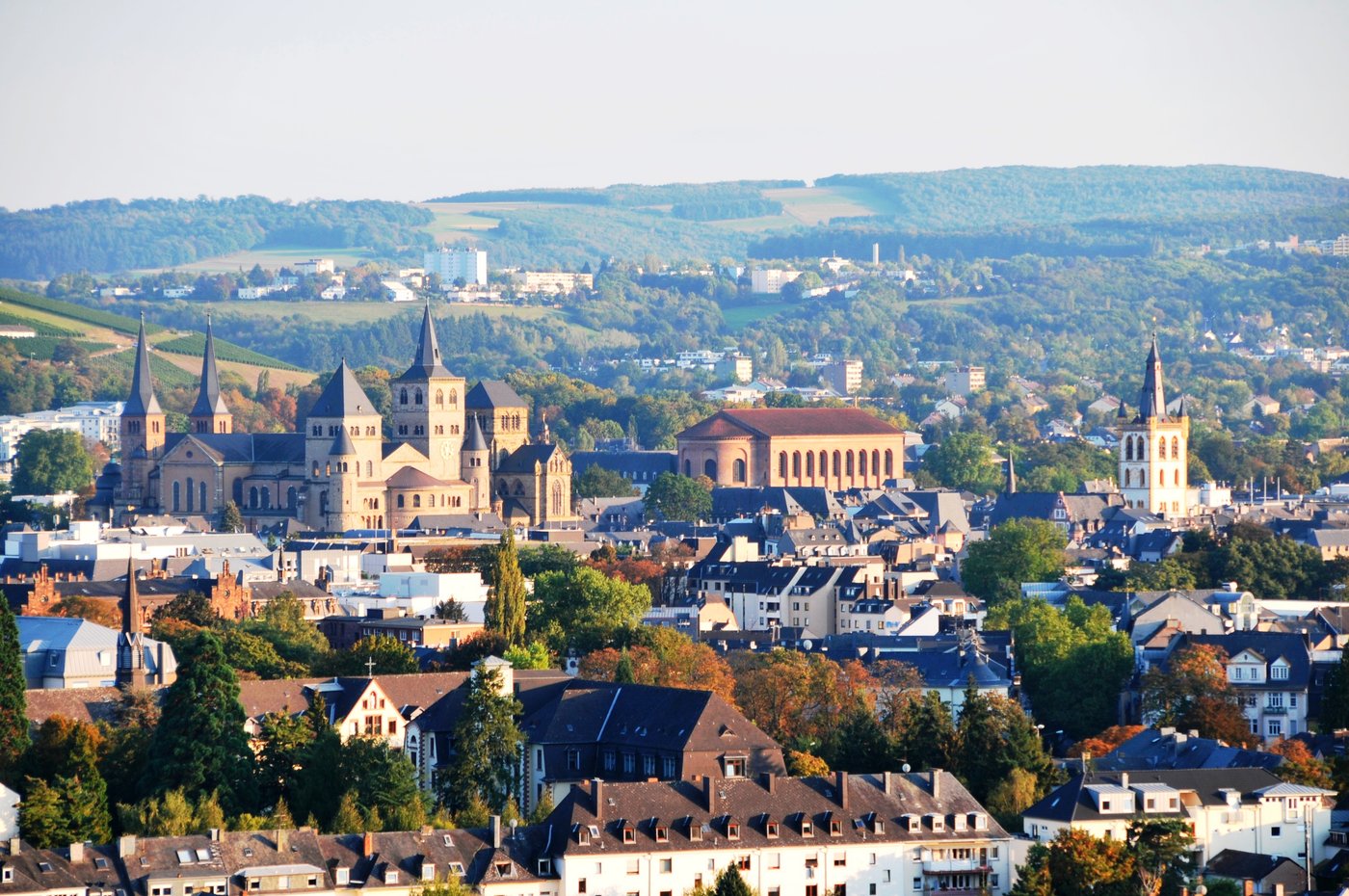
Roman colony founded c. 16 BCE, Trier preserves the largest ensemble of Roman architecture north of the Alps, including the Porta Nigra, Imperial Baths, and Constantine’s basilica, with continuous settlement into the medieval period.

422
関心 73

所在地

Rhineland-Palatinate · Moselle Valley · ドイツ

49.76°N · 6.64°E · ヨーロッパ

Built

c. 16 BCE as Augusta Treverorum

Civilization

Roman Empire, then Frankish and medieval successor states

Area within Roman walls

285 ha, the largest Roman city north of the Alps

Peak population

Estimated 70,000–100,000 during the late 3rd–4th centuries AD

Status

UNESCO World Heritage Site (Roman Monuments, Cathedral of St Peter and Church of Our Lady in Trier, inscribed 1986)

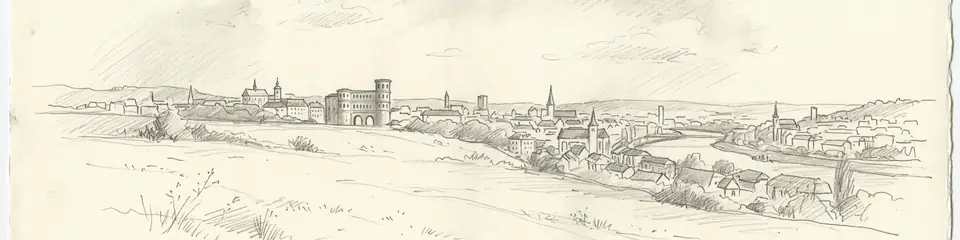
Graphite pencil sketch banner of Trier

“Trier stands as a unique palimpsest of Roman, early Christian, and medieval architecture in one continuous urban setting.”

所在地

概要

Trier, known in antiquity as Augusta Treverorum, was founded around 16 BCE under Augustus at the site of a pre-existing Treveri settlement. Its strategic location on the Moselle River and its role as the capital of the Roman province of Gallia Belgica fostered rapid growth into a major commercial and administrative centre. The city’s Roman monuments, including the still-imposing Porta Nigra, the largest Roman city gate north of the Alps, testify to its ancient grandeur.

Urban Layout and Monuments

The Roman city was laid out on a regular grid enclosed by a wall circuit of approximately 6.4 km, enclosing 285 hectares—the largest walled area of any Roman city north of the Alps. Among its best-preserved structures are the Porta Nigra, built in the late 2nd century AD as part of the fortification system; the mid-2nd-century amphitheatre, which doubled as a city gate; and the 2nd-century stone bridge over the Moselle, although its visible piers are largely medieval reconstructions. The Imperial Baths (Kaiserthermen), begun in the 3rd century, were never completed as planned and were later partially reused as a castle. The Basilica of Constantine (Aula Palatina), built in the early 4th century, served as the imperial audience hall and remains the largest surviving single-room structure from Roman times. Archaeological evidence confirms that the cathedral complex incorporates walls from a 4th-century church, making it the oldest Christian church in Germany.
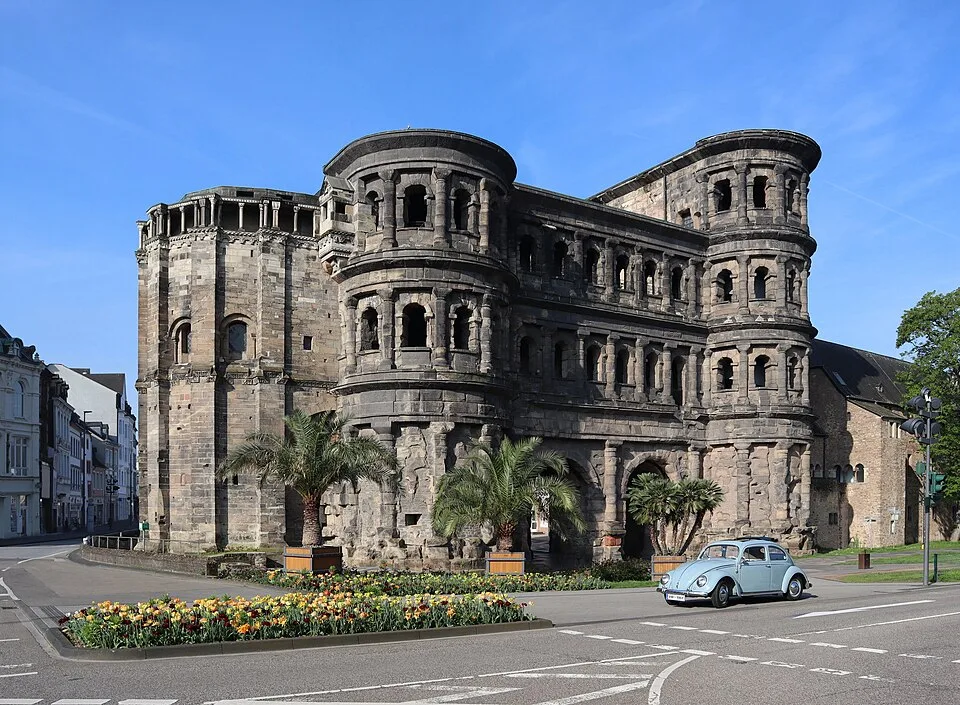
1957 Volkswagen Beetle, export model, in front of Porta Nigra in Trier 2023-05-01
1957 Volkswagen Beetle, export model, in front of Porta Nigra in Trier 2023-05-01 | Palauenc05 (CC BY-SA 4.0)
"Trier, ringed by walls and watered by the swift Moselle, exalts in arms, in laws, and in the schooling of her sons; in fattening peace she nourishes the regions she protects, lodging on this Belgic soil the seat of imperial majesty."
— Ausonius, Ordo Urbium Nobilium 6, c. 388 CE

Late Antiquity and Imperial Residence

During the 3rd and 4th centuries, Trier experienced a second golden age as a key imperial residence. It was frequently the seat of the Western Roman emperors, particularly under Constantine the Great, who used the city as a base for his campaigns along the Rhine. His mother, Helena, was closely associated with the city, and the construction of the massive double cathedral and the imperial baths reflect the wealth and political importance of Trier at this time. Historical documents and architectural investment strongly suggest that Trier functioned as a de facto capital of the Western Empire under Valentinian I and Gratian (367–383 AD). Estimates based on the size of the walled area and infrastructure place the peak population at 70,000–100,000, making it one of the largest cities in the Roman world north of the Alps.
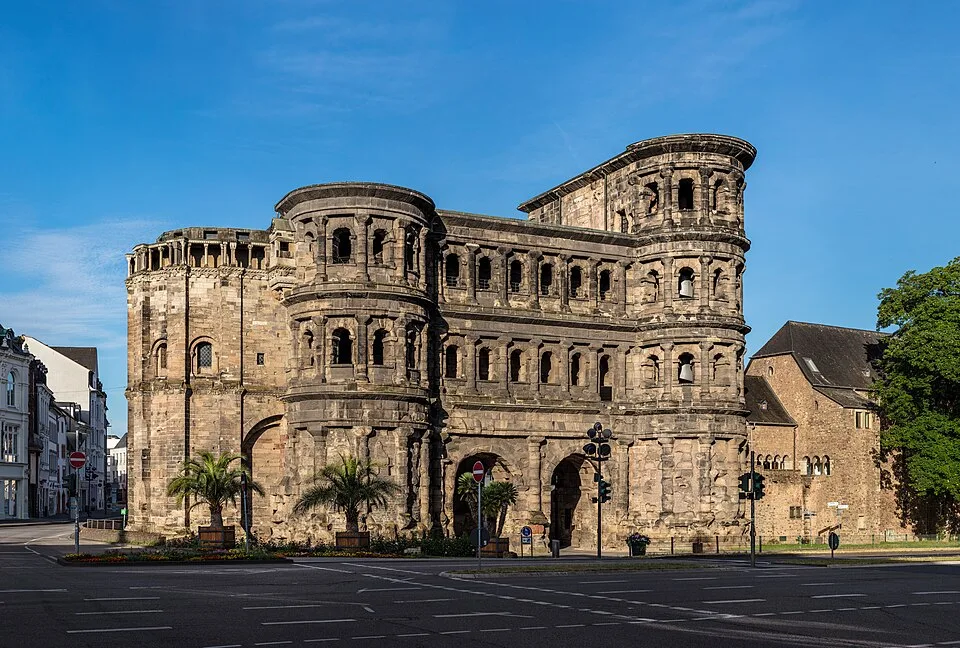
Porta Nigra morgens (100MP)
Porta Nigra morgens (100MP) | Thomas Wolf, www.foto-tw.de (CC BY-SA 3.0 de)

Transition and Medieval Trier

With the withdrawal of Roman administration around 407 AD, Trier declined in political importance but retained its role as a bishopric. The city contracted, yet large Roman buildings such as the Basilica were repurposed, and the cathedral was rebuilt and expanded over centuries, preserving the early Christian core. The medieval city rose within the old Roman walls, and its ecclesiastical centre, including the Liebfrauenkirche (Church of Our Lady) built in the 13th century alongside the cathedral, forms a remarkable architectural ensemble. Trier’s long, continuous occupation directly links the Roman and medieval periods without a clear break.

Archaeological Investigations

Systematic study of Trier’s Roman heritage began in 1801 with the founding of the Gesellschaft für nützliche Forschungen. Major excavations in the 19th and early 20th centuries uncovered and restored the Imperial Baths, the Amphitheatre, and the Basilica. Since the 1960s, extensive work beneath the cathedral has revealed layers of Roman and early medieval structures, including the so-called Bishop’s Palace. The 1993 discovery of the Trier Gold Hoard—2,516 gold solidi from the late 4th century—during construction work brought to light one of the largest late Roman coin treasures ever found. These investigations continue to refine our understanding of the city’s evolution from a provincial capital to an imperial residence and finally a medieval bishopric.
重要性

Trier stands as a unique palimpsest of Roman, early Christian, and medieval architecture in one continuous urban setting. Its exceptionally preserved Roman monuments—surviving through reuse rather than burial—offer tangible evidence of imperial grandeur on the northern frontier and the transition to Christian Europe. As a direct predecessor of modern administrative and religious centres, it illuminates the roots of western urbanism.

証拠と解釈

確立された事実と議論が続く事柄を区別する。

確立された事実

4
  • Augusta Treverorum was founded around 16 BCE at a pre-existing Treveri settlement, as confirmed by archaeological strata and historical accounts.
  • The Porta Nigra was built in the late 2nd century AD (c. 180), evidenced by dendrochronology and coin finds during restoration.
  • The Imperial Baths were begun in the 3rd century and never fully completed; later parts were converted into an early medieval castle.
  • The Basilica of Constantine was erected in the early 4th century as an imperial audience hall, corroborated by brick stamps and early Christian literary sources.

学術的推論

2
  • The amphitheatre had a dual function as an eastern gate in the city wall, inferred from its alignment with the decumanus maximus and similarities to other Roman civic gates.
  • Trier served as the de facto capital of the Western Roman Empire under Valentinian I and Gratian, deduced from the concentration of imperial constitutions issued from Trier and the scale of palace construction.

議論のある解釈

2
  • The exact design of the early 4th-century church beneath the cathedral—whether a single-nave hall or a twin-cathedral complex—remains unresolved due to partial preservation and conflicting excavation interpretations.
  • The date of the first city wall is disputed: some scholars argue for a late 2nd-century origin, while others contend it was built under Probus in the 270s AD, based on differing readings of numismatic evidence and historical context.

発見と発掘調査

1801

Early systematic investigations

指揮 Gesellschaft für nützliche Forschungen

The Gesellschaft für nützliche Forschungen was founded, initiating the first methodical study, measurement, and preservation of Trier's Roman monuments.

1850–1870

Excavation of the Imperial Baths and Basilica

指揮 Friedrich Quednow, Felix Hettner

Under Prussian patronage, large-scale clearance and restoration of the Imperial Baths and Basilica were carried out, led by Friedrich Quednow and later supervised by Felix Hettner.

1914

Amphitheatre excavation and restoration

指揮 Römisch-Germanisches Zentralmuseum, Mainz

The amphitheatre was excavated and partially restored, revealing its substructures and confirming its dual role as performance space and fortified gate.

1960–1989

Cathedral subterranean investigations

指揮 Klaus-Peter Goethert and the Rheinisches Landesmuseum Trier

Decades of excavations beneath Trier Cathedral uncovered Roman residential areas, a late 4th-century church complex, and early medieval structures, clarifying the site's continuous sacred use.

1993

Discovery of the Trier Gold Hoard

指揮 Rheinisches Landesmuseum Trier

During construction work at Feldstraße, a treasure of 2,516 gold solidi from the late 4th century AD was unearthed, providing crucial numismatic evidence for the city's prosperity during the late Empire.

コミュニティ写真

あなたの体験を共有する

この遺跡を訪れたことがありますか?写真をアップロードして魅力を共有しましょう。

関連記事

このページの引用方法

Atlas Anatolia. (16). Trier. Atlas Anatolia. https://atlasanatolia.com/ja/site/trier

コンテンツはCC BY-SA 4.0ライセンスの下で提供されています — 再利用の際は出典表示が必要です。

グラフ

関連する遺跡やストーリーへのつながり。

出典

  • Wightman, E.M. (1970), Roman Trier and the Treveri — Edith M. Wightman (1970)
  • Cüppers, H. (1990), Roman Trier: A Guide to the Monuments — Heinz Cüppers (1990)
  • Goethert, K.-P. (2003), 'Die Porta Nigra in Trier: Neue Untersuchungen zur Datierung', Funde und Ausgrabungen im Bezirk Trier 35, 32–43. — Klaus-Peter Goethert (2003)
  • Weber, W. (1999), 'Trier in Late Antiquity: Episcopal Residence and Imperial Court', in Burns, T.S. and Eadie, J.W. (eds.), Urban Centers and Rural Contexts in Late Antiquity, Michigan State University Press. — Winfried Weber (1999)
  • UNESCO World Heritage Centre entry: Roman Monuments, Cathedral of St Peter and Church of Our Lady in Trierリンク

よくある質問

Trierはどこにありますか?

TrierはRhineland-Palatinate, Moselle Valley, Germanyに位置しています。

Trierの年代はいつ頃ですか?

Trierはおよそ16 紀元前 – 1300 西暦のものとされています。

Trierはどの文明に関連していますか?

TrierはRoman文明に関連しています。

Trierが重要な理由は何ですか?

Trier stands as a unique palimpsest of Roman, early Christian, and medieval architecture in one continuous urban setting.

Trierはユネスコ世界遺産ですか?

はい — Trierはユネスコ世界遺産に登録されています。