
コンテンツへスキップ
Atlas Anatolia
ニュースIce Age teeth in Sulawesi push betel-nut use back as far as 25,000 yearsRoman mosaic and Eros head uncovered in the basilica at Pompeiopolis, Kastamonu
Tiwanaku — Bolivia

Wikimedia Commons (CC BY-SA)

複合体UNESCO注目

Tiwanaku

Seyfi Cem Baskin

200 紀元前 – 1000 西暦

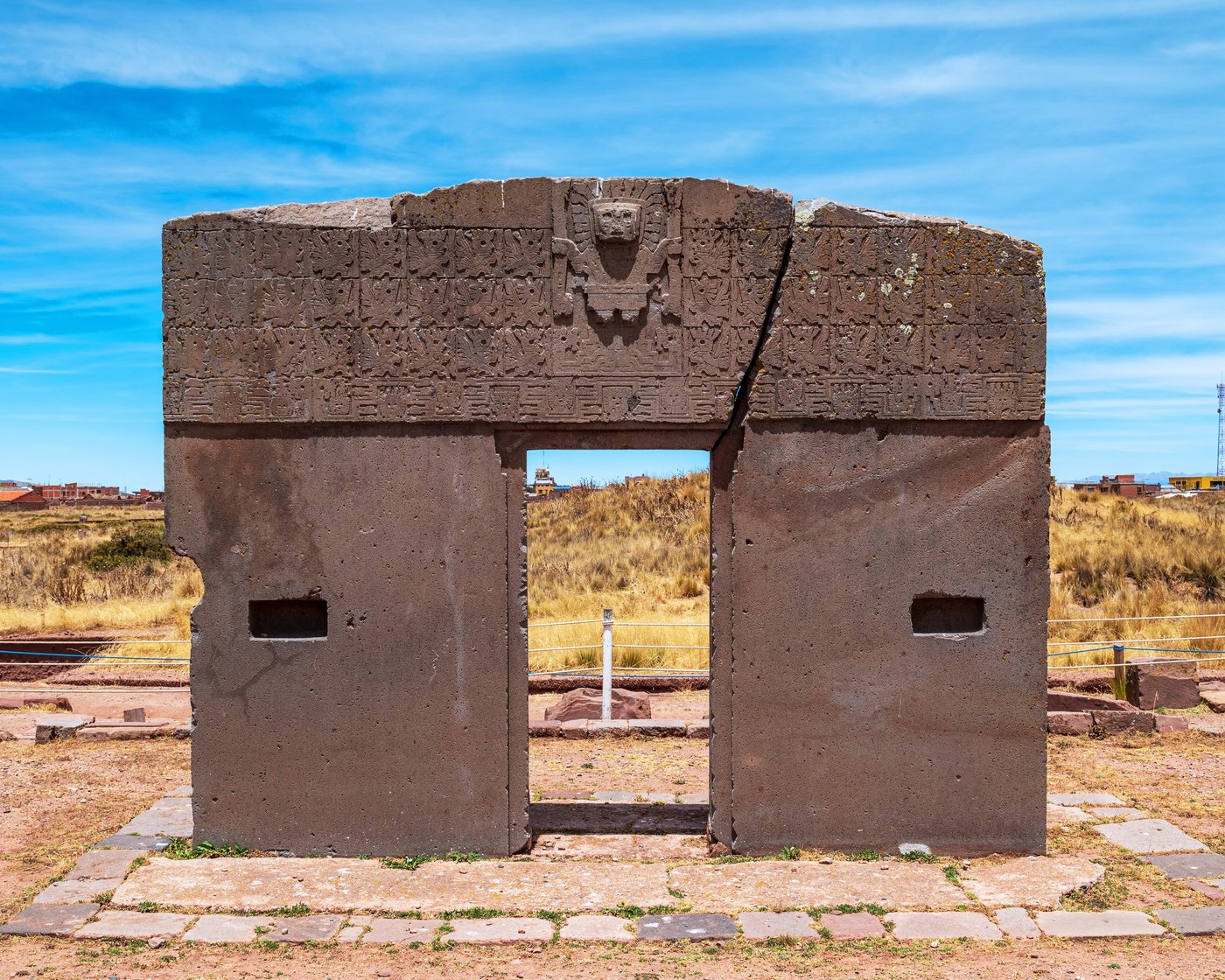
The monumental center of a pre-Inca Andean civilization (200 BCE–1000 CE) known for its colossal stone architecture, advanced agricultural systems, and artistic influence across the south-central Andes.

422
関心 73

所在地

La Paz Department · Altiplano · Bolivia

16.55°S · 68.67°W · 南アメリカ

Built

200 BCE – 1000 CE

Civilization

Tiwanaku

Altitude

3,850 meters above sea level

Period of prominence

300 – 800 CE (Classic period)

First Western documentation

16th century by Spanish chroniclers

Status

UNESCO World Heritage Site (inscribed 2000)

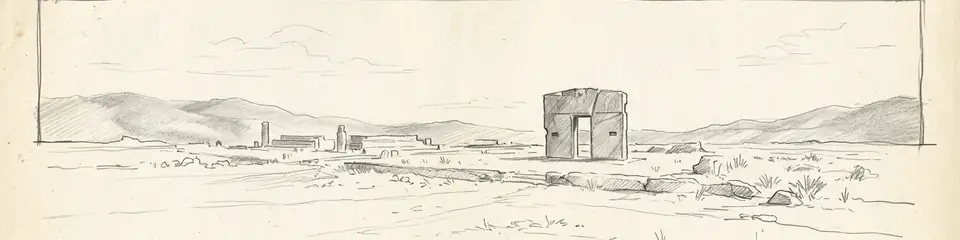
Graphite pencil sketch banner of Tiwanaku

“Tiwanaku stands as one of the most important pre-Columbian civilizations of the Andes, demonstrating urban planning, hydraulic engineering, and expansive cultural influence centuries before the Inca.”

所在地

概要

Location and Chronology

Tiwanaku stands at an elevation of about 3,850 meters near the southern shore of Lake Titicaca in Bolivia. The site’s occupation spans roughly 200 BCE to 1000 CE, with its apogee during the Classic period (ca. 300–800 CE). Precise radiocarbon dates from construction fill and organic remains anchor this chronology.

Discovery and Research

The site has been continuously known to local inhabitants, but the first Western descriptions appear in 16th-century Spanish chronicles, notably by Pedro Cieza de León. Systematic archaeology began with Arthur Posnansky (early 1900s), who produced detailed maps and advanced early astronomical interpretations. Wendell C. Bennett’s 1932 stratigraphic excavations established the first ceramic sequences. From the 1950s, Carlos Ponce Sanginés led massive reconstructions that shape the modern visitor experience. Later, Alan L. Kolata’s Proyecto Wila Jawira (1980s–90s) integrated ecology, settlement patterns, and experimental raised-field studies.
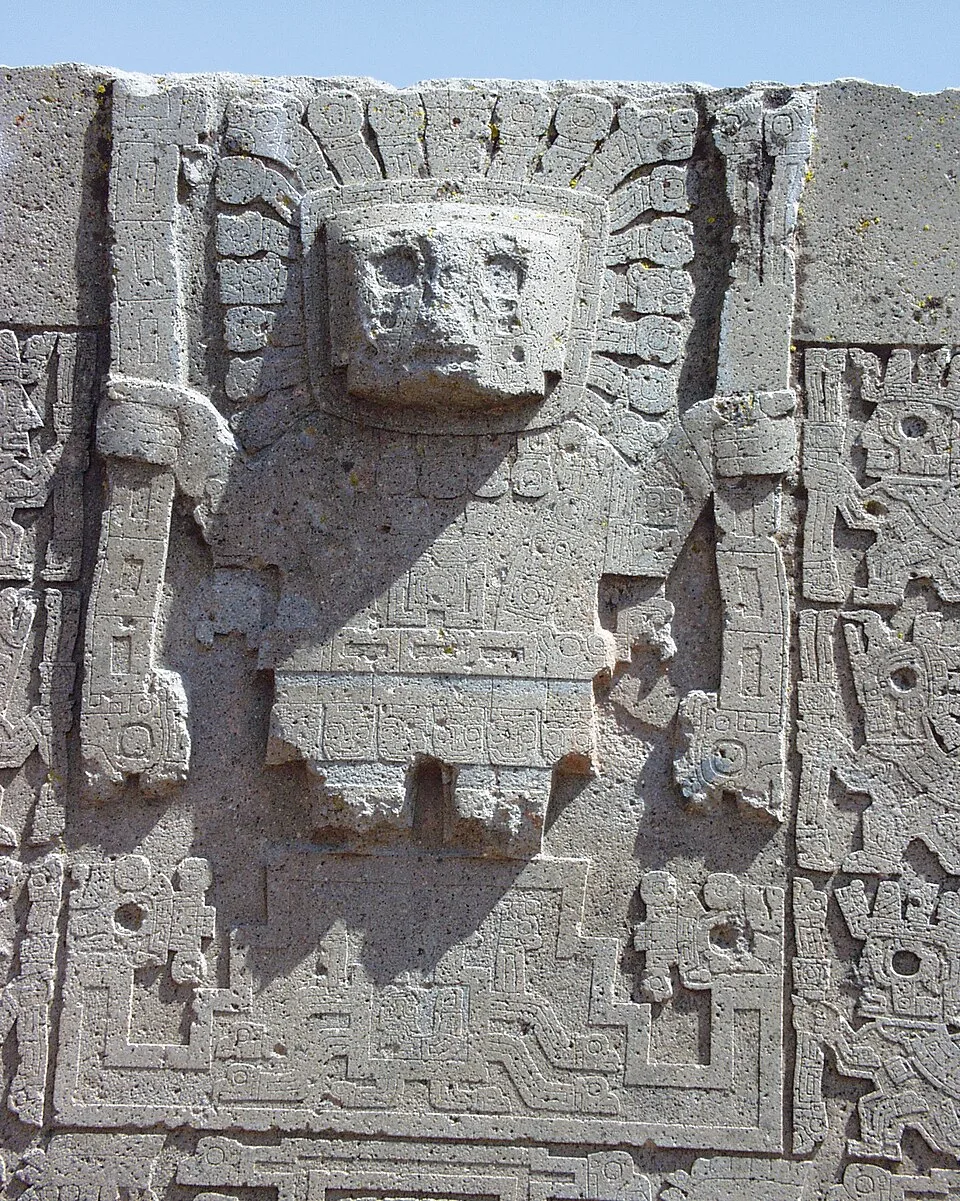
Bolivia - Gate of the Sun detail - Tiwanaku or Tiahuanaco 04
Bolivia - Gate of the Sun detail - Tiwanaku or Tiahuanaco 04 | Marc Davis (CC BY 2.0)
"They say that great works were built before the sun shone in the heavens — that the people of Tiahuanaco erected them in a single night, before they were turned to stone for their pride."
— Pedro Cieza de León, Crónica del Perú, recording the Aymara tradition of Tiwanaku (1553)

Monumental Architecture

The core urban area covers roughly 4 km² and is dominated by the Akapana, a terraced platform mound once surmounted by temples and a sophisticated drainage system. Adjacent lies the Kalasasaya, a rectangular enclosure containing the iconic Gateway of the Sun, carved from a single andesite block with low-relief iconography. The semi-subterranean temple features stone heads set into its walls. Approximately 1 km southwest, the Pumapunku complex displays precisely cut andesite blocks with complex interlocking joints, often cited as a high point of Tiwanaku masonry.
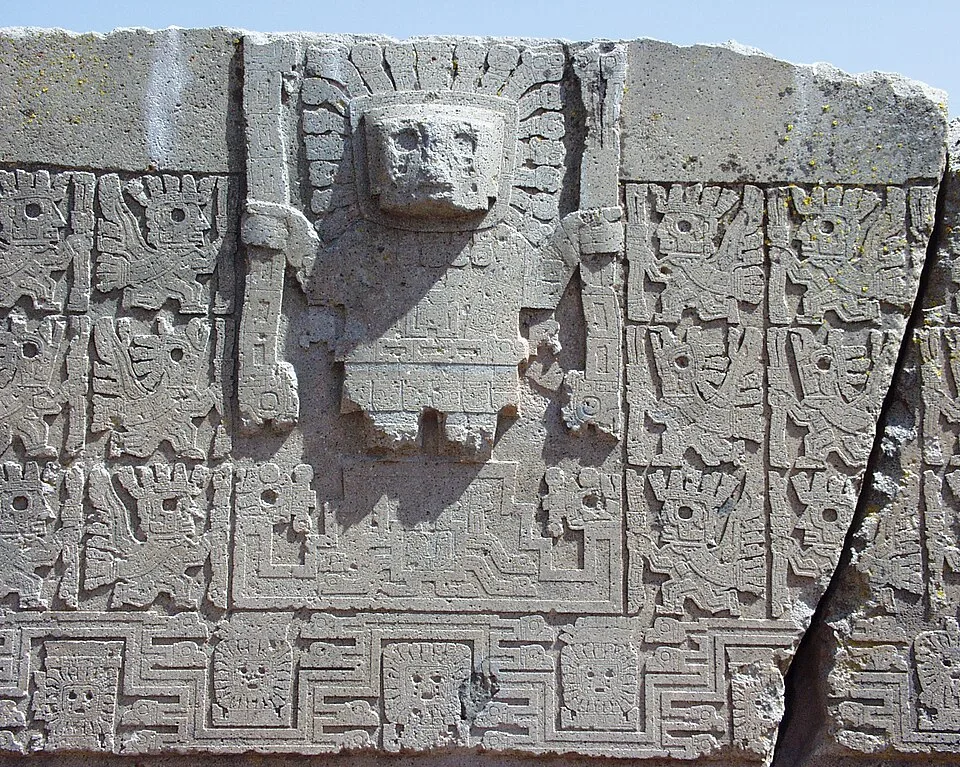
Bolivia - Gate of the Sun detail - Tiwanaku or Tiahuanaco 02
Bolivia - Gate of the Sun detail - Tiwanaku or Tiahuanaco 02 | Marc Davis (CC BY 2.0)

Society and Economy

Tiwanaku’s economic base was rooted in raised-field agriculture (suka kollus) that mitigated altiplano frosts and waterlogging. Camelid herding, lake resources, and long-distance exchange in obsidian, metals, and hallucinogenic snuffs supplemented subsistence. The city likely housed a stratified population of 20,000–70,000, including artisans, priests, and administrators. Ceramics and textiles bearing Tiwanaku’s distinctive iconography spread across the southern Andes, signaling a sphere of cultural and perhaps political influence.

Decline and Legacy

Around 1000 CE, the center declined rapidly, likely triggered by prolonged drought documented in Lake Titicaca sediment cores, which undermined the raised-field system. The monumental core was abandoned, but Tiwanaku’s imagery and notions of sacred geography persisted in later cultures, including the Inca, who co-opted its prestige as a place of origin. Today, Tiwanaku is a UNESCO World Heritage Site and an enduring symbol of Bolivia’s pre-Hispanic heritage.
重要性

Tiwanaku stands as one of the most important pre-Columbian civilizations of the Andes, demonstrating urban planning, hydraulic engineering, and expansive cultural influence centuries before the Inca. Its monumental core and iconography shaped subsequent Andean cosmologies, and its agricultural techniques offer insights into sustainable high-altitude farming.

証拠と解釈

確立された事実と議論が続く事柄を区別する。

確立された事実

4
  • Tiwanaku's monumental core covers approximately 4 square kilometers and includes the Akapana pyramid, Kalasasaya, and Pumapunku.
  • Radiocarbon dating places the height of Tiwanaku’s construction and occupation between AD 300 and 800.
  • The site’s inhabitants engineered raised-field agricultural systems (suka kollus) that mitigated frost and waterlogging, as evidenced by extensive field remains and experimental archaeology.
  • Tiwanaku iconography and ceramic styles spread across the southern Andes, from southern Peru to northern Chile and Argentina, during the Middle Horizon.

学術的推論

2
  • Based on residential and agricultural capacity, Tiwanaku’s peak population may have reached 20,000–70,000 in the urban core and immediate hinterland.
  • The Tiwanaku state likely controlled territories through a combination of direct administration, elite colonization, and ideological influence rather than a centralized military empire.

議論のある解釈

2
  • Scholars dispute whether the iconography on the Gateway of the Sun represents a calendar or purely religious symbolism.
  • The relationship between Tiwanaku and the contemporary Wari state of Peru is debated, with models ranging from alliance to indirect cultural exchange.

発見と発掘調査

UNESCO World Heritage Site management

指揮 Bolivian Ministry of Cultures and UNESCO

Ongoing conservation and management plans implemented by the Bolivian government and UNESCO to protect the monumental core.

1903–1940

Early archaeological mapping and conservation

指揮 Arthur Posnansky

Arthur Posnansky conducted pioneering surveys and excavations at Tiwanaku, proposing early chronologies and interpreting the site’s astronomical alignments.

1932

Stratigraphic excavations at Tiwanaku

指揮 Wendell C. Bennett

Wendell C. Bennett established the first stratigraphic sequence at Tiwanaku, identifying earlier and later ceramic phases.

1957–1975

Extensive excavations and restoration

指揮 Carlos Ponce Sanginés

Carlos Ponce Sanginés directed large-scale excavations and reconstructions of the Kalasasaya and Akapana, shaping much of the modern visible site.

1986–1996

Interdisciplinary research on Tiwanaku urbanism and agriculture

指揮 Alan L. Kolata

Alan L. Kolata led a multidisciplinary project studying raised-field agriculture, urban organization, and environmental collapse at Tiwanaku.

コミュニティ写真

あなたの体験を共有する

この遺跡を訪れたことがありますか?写真をアップロードして魅力を共有しましょう。

関連記事

このページの引用方法

Atlas Anatolia. (200). Tiwanaku. Atlas Anatolia. https://atlasanatolia.com/ja/site/tiwanaku

コンテンツはCC BY-SA 4.0ライセンスの下で提供されています — 再利用の際は出典表示が必要です。

グラフ

関連する遺跡やストーリーへのつながり。

出典

  • Kolata, Alan L. (1993) The Tiwanaku: Portrait of an Andean Civilization — Alan L. Kolata (1993)
  • Janusek, John W. (2008) Ancient Tiwanaku — John W. Janusek (2008)
  • Isbell, William H. (2008) Wari and Tiwanaku: International Identities in the Central Andean Middle Horizon — William H. Isbell (2008)
  • Bermann, Marc (1994) Lukurmata: Household Archaeology in Prehispanic Bolivia — Marc Bermann (1994)
  • Vranich, Alexei (1999) Interpreting the Meaning of Ritual Spaces: The Temple Complex of Pumapunku, Tiwanaku, Bolivia — Alexei Vranich (1999)
  • UNESCO World Heritage entry: Tiwanaku: Spiritual and Political Centre of the Tiwanaku Cultureリンク

よくある質問

Tiwanakuはどこにありますか?

TiwanakuはLa Paz Department, Altiplano, Boliviaに位置しています。

Tiwanakuの年代はいつ頃ですか?

Tiwanakuはおよそ200 紀元前 – 1000 西暦のものとされています。

Tiwanakuはどの文明に関連していますか?

TiwanakuはTiwanaku文明に関連しています。

Tiwanakuが重要な理由は何ですか?

Tiwanaku stands as one of the most important pre-Columbian civilizations of the Andes, demonstrating urban planning, hydraulic engineering, and expansive cultural influence centuries before the Inca.

Tiwanakuはユネスコ世界遺産ですか?

はい — Tiwanakuはユネスコ世界遺産に登録されています。