
コンテンツへスキップ
Atlas Anatolia
ニュースIce Age teeth in Sulawesi push betel-nut use back as far as 25,000 yearsRoman mosaic and Eros head uncovered in the basilica at Pompeiopolis, Kastamonu
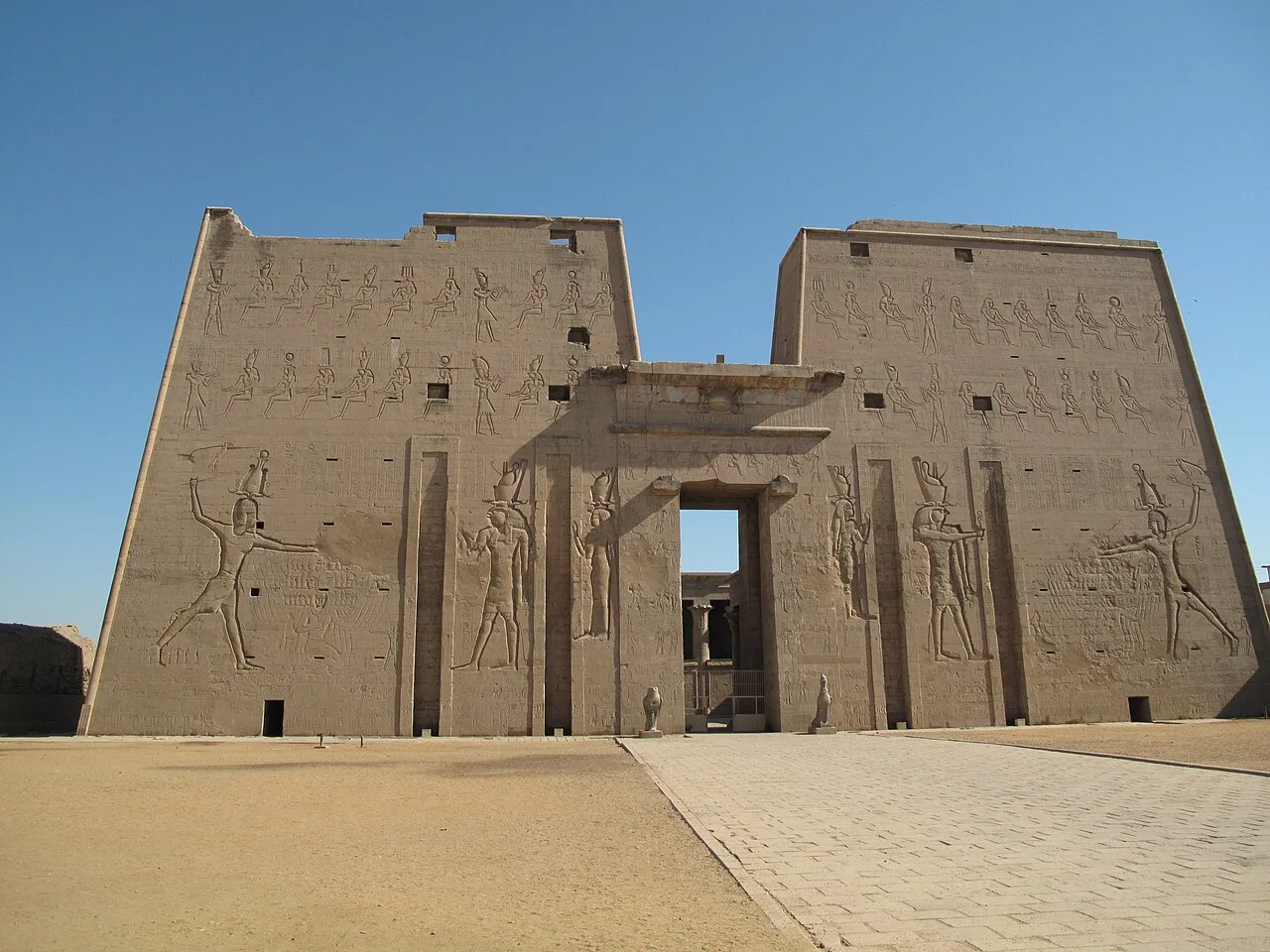
The great pylon of the Ptolemaic Temple of Horus at Edfu, Egypt

Wikimedia Commons

Country Record

Known by the Most Names in Egypt

神殿

Temple of Edfu

Seyfi Cem Baskin

معبد إدفو237 紀元前 – 57 紀元前

The most completely preserved temple in all of Egypt — the great Temple of Horus at Edfu, built by the Ptolemies between 237 and 57 BCE. Its towering pylon, columned courts, and dark inner sanctuary survive almost intact, and its walls carry some of the most complete temple texts to come down from the ancient world.

41
関心 66

所在地

エジプト

24.98°N · 32.87°E · アフリカ

Built

237–57 BCE (Ptolemaic dynasty)

Dedicated to

Horus, the falcon god

Preservation

Most complete temple in Egypt; pylon ~36 m high

Excavated by

Auguste Mariette, 1860s (from beneath sand and silt)

Inscriptions

Among the fullest temple texts surviving (ritual, myth, festivals)

Size

Second-largest Egyptian temple after Karnak

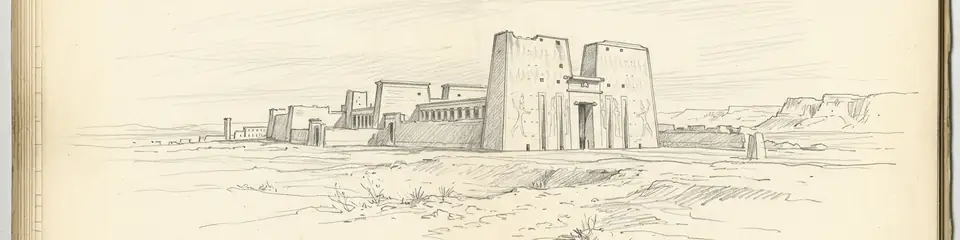
Graphite pencil sketch banner of Temple of Edfu

“The Temple of Edfu is the most complete and best-preserved temple of ancient Egypt, providing an almost intact example of what a major Egyptian temple looked like — from its towering pylon down to the shrine that held the god's image.”

所在地

概要

The Temple of Edfu stands on the west bank of the Nile between Aswan and Luxor, in the town of Edfu (ancient Behdet, called Apollonopolis Magna by the Greeks). Dedicated to the falcon god Horus, it is the best-preserved major temple in Egypt and, after Karnak, the second largest. It is also one of the latest, built entirely during the Ptolemaic period — Greek-descended pharaohs ruling Egypt — between 237 BCE, under Ptolemy III, and 57 BCE, under Ptolemy XII, the father of Cleopatra VII. Despite its late date and Greek royal patrons, it was built and decorated in the fully traditional Egyptian manner.

The temple's survival is owed to the desert sand and Nile silt that buried it almost completely after the cult ended, protecting the structure from quarrying and weathering until it was excavated by the French Egyptologist Auguste Mariette in the 1860s. As a result, the building survives to an extent unmatched elsewhere: the great entrance pylon stands some 36 metres high, still decorated with colossal reliefs of the king smiting his enemies; behind it lie a colonnaded court, two hypostyle halls, and the inner sanctuary, which still contains a granite naos (shrine) and a replica of the sacred barque in which the god's image was carried. Two black-granite statues of Horus as a falcon flank the entrance.

What makes Edfu uniquely valuable to scholars is the vast quantity of inscriptions covering almost every surface. Because the temple was conceived and decorated as a single, coherent programme over roughly 180 years, its texts form one of the most complete records of Egyptian temple ritual, mythology, festivals, and even the building's own construction and dimensions. The walls record the "Myth of Horus," including the dramatic battle between Horus and his rival Seth, and the annual festivals — such as the "Sacred Marriage," when the image of the goddess Hathor travelled upriver from Dendera to be united with Horus at Edfu.

The temple functioned until the suppression of pagan worship in the Roman period; some reliefs bear deliberate damage from later iconoclasm, and soot on the hypostyle ceiling marks a period when people lived inside the buried structure.

重要性

The Temple of Edfu is the most complete and best-preserved temple of ancient Egypt, providing an almost intact example of what a major Egyptian temple looked like — from its towering pylon down to the shrine that held the god's image. Because it was built and decorated as a single coherent project over about 180 years, its inscriptions are among the fullest sources we possess for Egyptian temple ritual, mythology, festival calendars, and even the symbolic meaning and measurements of the building itself. For Egyptologists it is effectively a stone encyclopaedia of late temple religion. It is one of the most visited monuments on the Nile and part of the rich heritage landscape of Upper Egypt.

証拠と解釈

確立された事実と議論が続く事柄を区別する。

確立された事実

4
  • Construction dates of 237–57 BCE are fixed by the dated cartouches and building texts of successive Ptolemaic kings inscribed on the temple itself.
  • The inner sanctuary retains its granite naos and a replica processional barque, preserving the layout of the temple's holiest space — exceptional among Egyptian temples.
  • The walls carry extensive texts including the "Myth of Horus" and the temple's festival calendar (e.g. the Sacred Marriage with Hathor of Dendera), forming a near-complete ritual record.
  • Deliberate damage to certain divine figures, and soot deposits on the hypostyle ceiling, evidence later iconoclasm and a period of habitation within the buried temple.

学術的推論

1
  • The temple's exceptional preservation is attributed to its near-total burial by wind-blown sand and Nile silt after the cult ceased, sheltering it until 19th-century excavation.

コミュニティ写真

あなたの体験を共有する

この遺跡を訪れたことがありますか?写真をアップロードして魅力を共有しましょう。

このページの引用方法

Atlas Anatolia. (237). Temple of Edfu. Atlas Anatolia. https://atlasanatolia.com/ja/site/edfu

コンテンツはCC BY-SA 4.0ライセンスの下で提供されています — 再利用の際は出典表示が必要です。

出典

  • The Complete Temples of Ancient Egypt — Wilkinson, Richard H. (2000)
  • The Temple of Edfu: A Guide by an Ancient Egyptian Priest — Kurth, Dieter (2004)

よくある質問

Temple of Edfuはどこにありますか?

Temple of EdfuはEgyptに位置しています。

Temple of Edfuの年代はいつ頃ですか?

Temple of Edfuはおよそ237 紀元前 – 57 紀元前のものとされています。

Temple of Edfuはどの文明に関連していますか?

Temple of EdfuはAncient Egyptian文明に関連しています。

Temple of Edfuが重要な理由は何ですか?

The Temple of Edfu is the most complete and best-preserved temple of ancient Egypt, providing an almost intact example of what a major Egyptian temple looked like — from its towering pylon down to the shrine that held the god's image.

Temple of Edfuはユネスコ世界遺産ですか?

Temple of Edfuは現在ユネスコ世界遺産には登録されていません。