
コンテンツへスキップ
Atlas Anatolia
ニュースIce Age teeth in Sulawesi push betel-nut use back as far as 25,000 yearsRoman mosaic and Eros head uncovered in the basilica at Pompeiopolis, Kastamonu
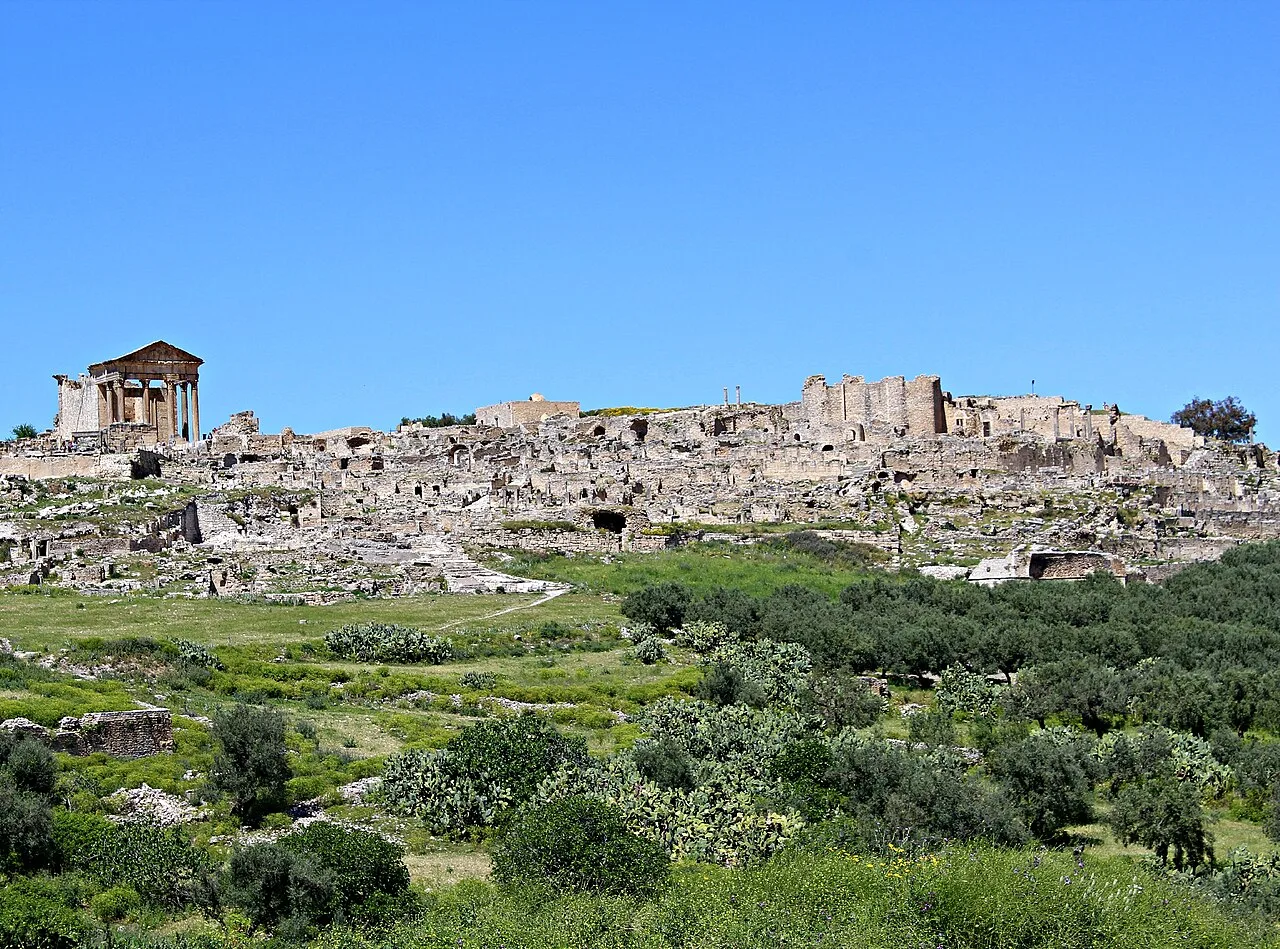
The Capitol and ruins of the Roman town of Dougga (Thugga), Tunisia

Wikimedia Commons

Country Record

Oldest City in Tunisia

都市UNESCO

Dougga

Seyfi Cem Baskin

دڨة / Thugga300 紀元前 – 600 西暦

The best-preserved Roman town in North Africa — a small city spread across a hilltop in northern Tunisia, with a near-complete theatre, the elegant Capitol temple, baths, and forum, all overlooking olive-covered countryside. Its Numidian roots also survive in the rare Libyco-Punic Mausoleum, a key monument of pre-Roman Africa.

311
関心 54

所在地

チュニジア

36.42°N · 9.22°E · アフリカ

Ancient name

Thugga; Numidian then Roman town

Preservation

Best-preserved Roman town in North Africa (~65 ha)

Theatre

Built 168–169 CE, seats ~3,500; still in use

Capitol

Temple of Jupiter, Juno, Minerva — standing Corinthian portico

Libyco-Punic Mausoleum

2nd c. BCE; its bilingual text helped decipher Libyan script

UNESCO

World Heritage Site (1997)

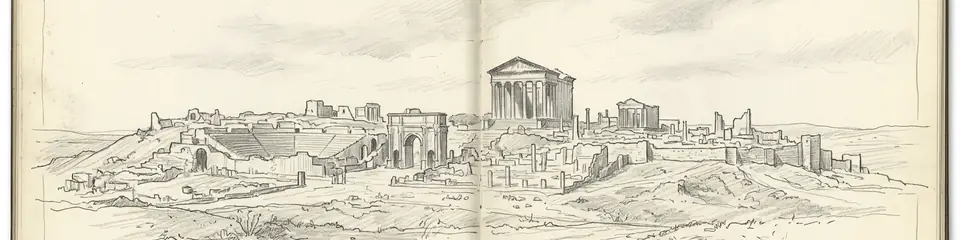
Graphite pencil sketch banner of Dougga

“Dougga is the finest and most complete Roman town surviving in North Africa, offering an almost intact picture of how a modest provincial African city looked and functioned — its theatre, Capitol, baths, forum, temples, and houses all preserved together in their landscape.”

所在地

概要

Dougga, ancient Thugga, occupies a hilltop site about 100 kilometres southwest of Tunis in northern Tunisia, commanding wide views over the fertile valley of the Oued Khalled. It is the most complete and best-preserved Roman town in North Africa, spread over some 65 hectares, and uniquely it preserves not only its Roman monuments but also substantial traces of the Numidian (Berber) and Punic settlement that preceded Roman rule.

The town existed as a Numidian settlement well before the Romans, and was for a time a royal seat of the Numidian kingdom. Its most important pre-Roman monument is the Libyco-Punic Mausoleum, a tall tower-tomb of the 2nd century BCE that once bore a bilingual inscription in Punic and the Libyan (Numidian) language. That inscription, removed in the 19th century and now in the British Museum, was a key to the decipherment of the Libyan script — making Dougga important far beyond its size.

Under Roman rule, especially in the 2nd and 3rd centuries CE, Thugga was monumentalised by wealthy local benefactors. Because it grew on a hill from an older irregular street plan rather than being laid out on a fresh Roman grid, its streets wind and its public buildings are fitted to the terrain, giving it an unusually organic, intimate character. Its theatre, built in 168–169 CE and seating around 3,500, is remarkably well preserved and still used for performances. The Capitol, dedicated to the triad of Jupiter, Juno, and Minerva, is one of the finest in Africa, its tall Corinthian portico still standing. The site also preserves a forum, the Square of the Winds (with a compass rose naming the twelve winds inscribed in the pavement), temples to numerous gods, public baths with underground service passages, latrines, cisterns, markets, and private houses with mosaics.

The town continued into the Byzantine period, when a fortress was built reusing earlier stone, and gradually contracted thereafter. Its rural isolation spared it from being built over, leaving the ancient townscape exceptionally intact.

重要性

Dougga is the finest and most complete Roman town surviving in North Africa, offering an almost intact picture of how a modest provincial African city looked and functioned — its theatre, Capitol, baths, forum, temples, and houses all preserved together in their landscape. Because it grew organically on a hilltop rather than on a standardised grid, it conveys the texture of a real, lived-in ancient town better than many more famous sites. Its pre-Roman monuments, above all the Libyco-Punic Mausoleum whose bilingual inscription helped decipher the ancient Libyan script, also make it a key site for the indigenous Numidian civilisation of North Africa. It was inscribed as a UNESCO World Heritage Site in 1997.

証拠と解釈

確立された事実と議論が続く事柄を区別する。

確立された事実

3
  • The theatre carries a dedicatory inscription dating it to 168–169 CE and naming its benefactor, P. Marcius Quadratus — a documented act of local euergetism (civic gift-giving).
  • The Libyco-Punic Mausoleum's bilingual Punic–Libyan inscription (removed to the British Museum in 1842) was instrumental in deciphering the ancient Libyan/Numidian script.
  • The standing Capitol, forum, Square of the Winds with its inscribed wind-rose, baths, and numerous temples survive in situ, documenting a full Roman civic centre.

学術的推論

1
  • The town's irregular, terrain-following street plan is interpreted as the result of Roman monuments being grafted onto a pre-existing Numidian settlement rather than a planned colonial grid.

議論のある解釈

1
  • The early history and exact status of Numidian Thugga — including the extent of its role as a royal seat under kings such as Massinissa — is only partly understood, given limited pre-Roman textual evidence.

コミュニティ写真

あなたの体験を共有する

この遺跡を訪れたことがありますか?写真をアップロードして魅力を共有しましょう。

このページの引用方法

Atlas Anatolia. (300). Dougga. Atlas Anatolia. https://atlasanatolia.com/ja/site/dougga

コンテンツはCC BY-SA 4.0ライセンスの下で提供されています — 再利用の際は出典表示が必要です。

出典

  • Les ruines de Dougga — Poinssot, Claude (1983)
  • Dougga (Thugga) — Khanoussi, Mustapha (2008)

よくある質問

Douggaはどこにありますか?

DouggaはTunisiaに位置しています。

Douggaの年代はいつ頃ですか?

Douggaはおよそ300 紀元前 – 600 西暦のものとされています。

Douggaはどの文明に関連していますか?

DouggaはCarthaginian / Phoenician, Roman文明に関連しています。

Douggaが重要な理由は何ですか?

Dougga is the finest and most complete Roman town surviving in North Africa, offering an almost intact picture of how a modest provincial African city looked and functioned — its theatre, Capitol, baths, forum, temples, and houses all preserved together in their landscape.

Douggaはユネスコ世界遺産ですか?

はい — Douggaはユネスコ世界遺産に登録されています。