
Vai al contenuto
Atlas Anatolia
NotizieIce Age teeth in Sulawesi push betel-nut use back as far as 25,000 yearsRoman mosaic and Eros head uncovered in the basilica at Pompeiopolis, Kastamonu
Courtyard and domes of the Blue Mosque (Sultan Ahmed Mosque), Istanbul

Wikimedia Commons (CC BY-SA 4.0)

Record nazionale

Known by the Most Names in Turkey

PatrimonioTempioIn evidenza

Blue Mosque

Seyfi Cem Baskin

Sultanahmet Camii1609 d.C. – 1617 d.C.

The early 17th-century imperial mosque facing Hagia Sophia in Istanbul — six minarets, cascading domes, and Iznik tiles that earned it the nickname "Blue Mosque" — is among the most searched Ottoman monuments in Turkish, German, and English Wikipedia.

21
Interesse 81

Posizione

Turchia

41.01°N · 28.98°E · Europa

Built

1609–1617 CE under Sultan Ahmed I

Architect

Sedefkar Mehmed Aga (student of Sinan)

Minarets

Six — controversial at completion

Tiles

20,000+ Iznik ceramic tiles in prayer hall

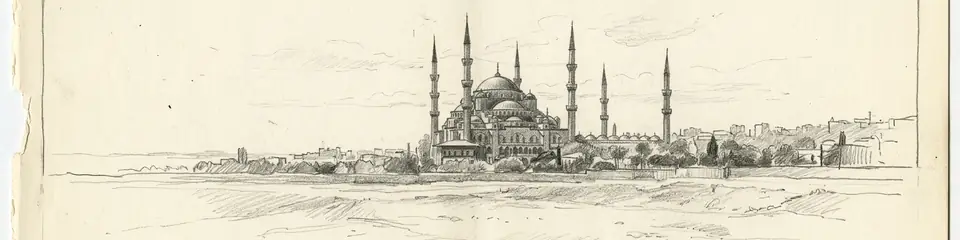
Graphite pencil sketch banner of Blue Mosque

The Blue Mosque closes the arc from Byzantine dome architecture to Ottoman imperial mosque design — Mehmed Aga's answer to Hagia Sophia across the square.”

Posizione

Panoramica

The Sultan Ahmed Mosque stands on the historical peninsula of Istanbul, directly opposite Hagia Sophia and beside the Byzantine hippodrome. Sultan Ahmed I commissioned the building between 1609 and 1617 during a pause in Ottoman military expansion — a bold statement of piety when the empire could not match Selim II or Suleiman's conquests with new campaigns. Architect Sedefkar Mehmed Aga, a pupil of Sinan, synthesised his master's vocabulary with a cascade of domes and semi-domes around a central dome about 23 metres in diameter.

The interior owes its popular name to more than 20,000 Iznik tiles in turquoise and cobalt floral patterns on the lower walls and galleries. Stained glass (much restored) once flooded the prayer hall with coloured light. Six minarets caused controversy at completion — only the Mecca sanctuary had six at the time — resolved by adding a seventh minaret in Mecca. The mosque remains an active place of worship; visitors enter outside prayer times through the courtyard gate.

The complex (külliye) originally included a hospital, school, market, and the sultan's tomb. Ahmed I is buried in the türbe on the north side. Together with Hagia Sophia and the Basilica Cistern, Sultanahmet Square forms Istanbul's densest cluster of Byzantine and Ottoman superstars.

Perché è importante

The Blue Mosque closes the arc from Byzantine dome architecture to Ottoman imperial mosque design — Mehmed Aga's answer to Hagia Sophia across the square. Its Iznik tile programme is a high-water mark of 17th-century ceramic production and a primary reason Istanbul dominates Turkish-language heritage search.

Evidenze e interpretazione

Distinguere ciò che è ben consolidato da ciò che rimane dibattuto.

Fatti ben consolidati

2
  • Ottoman foundation charters (vakfiye) and inscriptions date construction and name Ahmed I and Mehmed Aga.
  • Iznik tile batches match early 17th-century workshop styles documented in ceramic studies.

Deduzioni accademiche

1
  • Six minarets were intended to rival or echo Mecca's sanctuary — inferred from contemporary court accounts.

Foto della comunità

Condividi la tua esperienza

Hai visitato questo sito? Carica le tue foto per aiutare gli altri a scoprirlo.

Come citare questa pagina

Atlas Anatolia. (1609). Blue Mosque. Atlas Anatolia. https://atlasanatolia.com/it/site/blue-mosque

Contenuto con licenza CC BY-SA 4.0 — è richiesta l'attribuzione in caso di riutilizzo.

Fonti

  • A History of Ottoman ArchitectureGoodwin, Godfrey (1971)
  • Turkish Ministry of Culture — Sultanahmet MosqueCollegamento

Domande frequenti

Dove si trova Blue Mosque?

Blue Mosque si trova in Turkey.

A quando risale Blue Mosque?

Blue Mosque risale all'incirca al 1609 d.C. – 1617 d.C..

Quali civiltà sono associate a Blue Mosque?

Blue Mosque è associato alla civiltà Islamic / Medieval, Ottoman.

Perché Blue Mosque è importante?

The Blue Mosque closes the arc from Byzantine dome architecture to Ottoman imperial mosque design — Mehmed Aga's answer to Hagia Sophia across the square.

Blue Mosque è un sito Patrimonio Mondiale dell'UNESCO?

Blue Mosque non è attualmente iscritto nella lista del Patrimonio Mondiale dell'UNESCO.