
Aller au contenu
Atlas Anatolia
ActualitésIce Age teeth in Sulawesi push betel-nut use back as far as 25,000 yearsRoman mosaic and Eros head uncovered in the basilica at Pompeiopolis, Kastamonu
Registan square with three madrasas in Samarkand

Wikimedia Commons (CC BY-SA 3.0)

PatrimoineCitéUNESCOEn vedette

Samarkand

Seyfi Cem Baskin

Самарқанд700 av. J.-C. – 1700 apr. J.-C.

Timur’s capital on the Zeravshan — crowned by the Registan’s three tiled madrasas — was the ceremonial and scholarly heart of a Silk Road empire linking Persia, India, and the steppe.

21
Intérêt 81

Localisation

Ouzbékistan

39.65°N · 66.98°E · Asie

Ancient name

Maracanda (Sogdian)

Timurid capital

Late 14th century under Timur

Registan

Three madrasas, 15th–17th c.

UNESCO

Historic Town of Samarkand (2001)

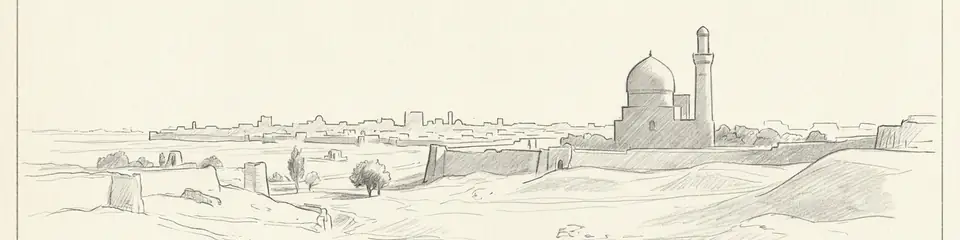
Graphite pencil sketch banner of Samarkand

“Samarkand concentrates Timurid political theology, astronomy, and tile architecture in one walkable historic centre.”

Localisation

Aperçu

Samarkand (ancient Maracanda) sits in the Zeravshan Valley of modern Uzbekistan. An Iron Age and Sogdian centre conquered by Alexander, it later flourished under Sogdian merchants before Mongol destruction in 1220. Timur (Tamerlane) made Samarkand his capital in the late 14th century; his grandson Ulugh Beg built a madrasa and observatory that made the city a scientific as well as dynastic stage. The Registan square — Ulugh Beg Madrasa (1417–21), Sher-Dor (1619–36), and Tilya-Kori (17th century) — forms the postcard ensemble of turquoise domes and pishtaq façades.

Beyond the Registan, the Bibi-Khanym Mosque, Gur-e-Amir mausoleum, and Shah-i-Zinda necropolis preserve Timurid brick and tile craft at imperial scale. UNESCO inscribed the Historic Town of Samarkand in 2001. Pair with Merv and Jiaohe for earlier Silk Road urbanisms further east and west.

Pourquoi c'est important

Samarkand concentrates Timurid political theology, astronomy, and tile architecture in one walkable historic centre. It is essential for understanding how post-Mongol Central Asian empires staged legitimacy on the Silk Road.

Preuves et interprétation

Distinguer ce qui est bien établi de ce qui reste débattu.

Faits bien établis

2
  • Timurid building inscriptions, waqf documents, and standing madrasas securely date the Registan ensemble and Gur-e-Amir complex.
  • Archaeology at Afrasiyab (ancient Samarkand) documents Sogdian and earlier occupation beneath and beside the Timurid city.

Inférences savantes

1
  • Ulugh Beg’s observatory programme positioned Samarkand as a scientific capital rivaling contemporary Islamic and European courts.

Photos de la communauté

Partagez votre expérience

Avez-vous visité ce site ? Téléchargez vos photos pour aider les autres à le découvrir.

Comment citer cette page

Atlas Anatolia. (700). Samarkand. Atlas Anatolia. https://atlasanatolia.com/fr/site/samarkand

Contenu sous licence CC BY-SA 4.0 — attribution requise en cas de réutilisation.

Sources

  • The Rise and Rule of Tamerlane — Manz, Beatrice Forbes (1989)
  • UNESCO — Samarkand – Crossroad of CulturesLien

Questions fréquentes

Où se trouve Samarkand ?

Samarkand est situé à/en Uzbekistan.

De quand date Samarkand ?

Samarkand remonte approximativement à 700 av. J.-C. – 1700 apr. J.-C..

Quelles civilisations sont associées à Samarkand ?

Samarkand est associé à la civilisation Timurid, Sogdian.

Pourquoi Samarkand est-il important ?

Samarkand concentrates Timurid political theology, astronomy, and tile architecture in one walkable historic centre.

Samarkand est-il inscrit au patrimoine mondial de l'UNESCO ?

Oui — Samarkand est inscrit sur la liste du patrimoine mondial de l'UNESCO.