Aller au contenu
Atlas Anatolia
ActualitésIce Age teeth in Sulawesi push betel-nut use back as far as 25,000 yearsRoman mosaic and Eros head uncovered in the basilica at Pompeiopolis, Kastamonu
Pyramids of Giza — Egypt

Wikimedia Commons (CC BY-SA)

Continent Record

Oldest Necropolis in Africa

NécropoleUNESCOEn vedette

Pyramids of Giza

Seyfi Cem Baskin

الأهرامات الجيزة2580 av. J.-C. – 2510 av. J.-C.

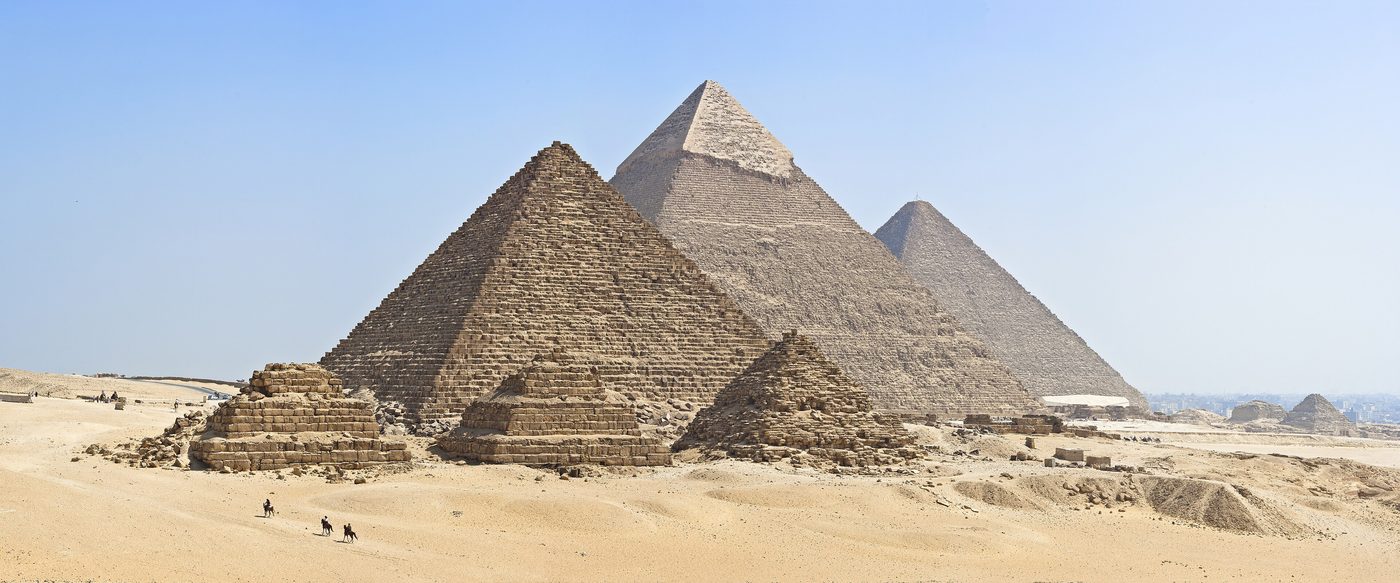
The Pyramids of Giza, monumental tombs of Old Kingdom pharaohs Khufu, Khafre, and Menkaure, represent the zenith of ancient Egyptian architectural achievement and religious expression.

313
Intérêt 86

Localisation

Giza Governorate · Lower Egypt · Égypte

29.98°N · 31.13°E · Afrique

Built

c. 2580–2510 BCE

Civilization

Ancient Egyptian (Old Kingdom)

Discovered

Continuously known; first scientific surveys in 1646 (John Greaves) and 1798 (Napoleonic expedition)

Status

UNESCO World Heritage Site (1979)

Material

Limestone (core and casing), granite (interior chambers and Menkaure casing)

Original Height (Khufu)

146.6 meters (now 138.8 m with missing pyramidion and casing)

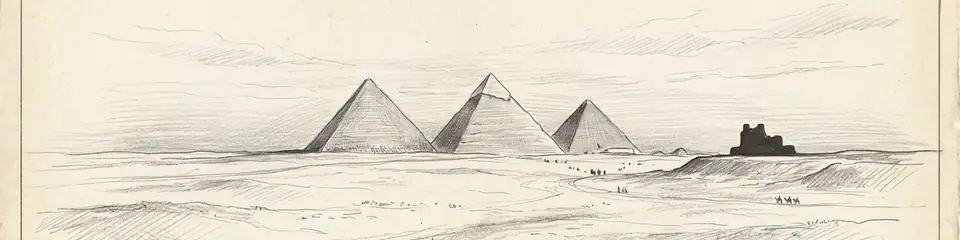
Graphite pencil sketch banner of Pyramids of Giza

“The Pyramids of Giza stand as the only surviving member of the Seven Wonders of the Ancient World and epitomize the organizational and technological capabilities of Old Kingdom Egypt.”

Localisation

Aperçu

Discovery and Early Exploration

The Pyramids of Giza have never been truly "lost" to history, but systematic study began in the 17th century. John Greaves conducted the first accurate measurements of the Great Pyramid in 1646, published in his Pyramidographia. The Napoleonic expedition of 1798–1801 brought a scientific team whose Description de l'Égypte provided detailed engravings and fueled European Egyptomania. Modern archaeology commenced with Flinders Petrie’s precise survey in 1880–1882, which established baseline data still referenced today.

Architectural Mastery

The Great Pyramid of Khufu originally stood 146.6 meters tall, with a base length of 230.3 meters, oriented to the cardinal directions with an accuracy of 1/15th of a degree. Its core consists of locally quarried limestone, while the now-missing casing was of fine Tura limestone. The interior chambers include the King’s Chamber, lined with granite blocks from Aswan, and the Queen’s Chamber. The pyramid of Khafre retains remnants of its casing at the apex, and the smaller pyramid of Menkaure was originally clad in granite. The precise construction methods remain a subject of intense study; ramp systems, levers, and lubricated sledges have been proposed, but no contemporary texts describe the process.

"Cheops employed at the building of his pyramid a hundred thousand men, working in parties of three months at a time. The work went on in this way during ten years for the road on which they dragged the stones, then for twenty years more on the pyramid itself."
— Herodotus, Histories II.124, c. 440 BCE

Religious and Funerary Context

The pyramids were integral to the pharaonic mortuary cult, designed to ensure the king’s ascension to the sky and his endurance as a divine ruler. Each complex included a mortuary temple, a valley temple, and a causeway. The Great Sphinx, likely associated with Khafre’s complex, served as a guardian. Solar alignments and supposed stellar correlations suggest a deep integration of astronomical observation with theological symbolism, though interpretations vary.

Workforce and Society

Historical portrayals of slaves toiling under the lash are not supported by evidence. Archaeological discoveries of workers’ villages, bakeries, and cemeteries at Giza indicate a permanent, skilled labor force organized into rotating crews. Skeletal analysis reveals healed injuries, suggesting medical care. These workers were likely conscripted during the inundation season when agricultural land was flooded, but they were not slaves in the classical sense. The social organization behind the construction remains a fertile area of research, with new insights emerging from excavations of the Heit el-Ghurab settlement.
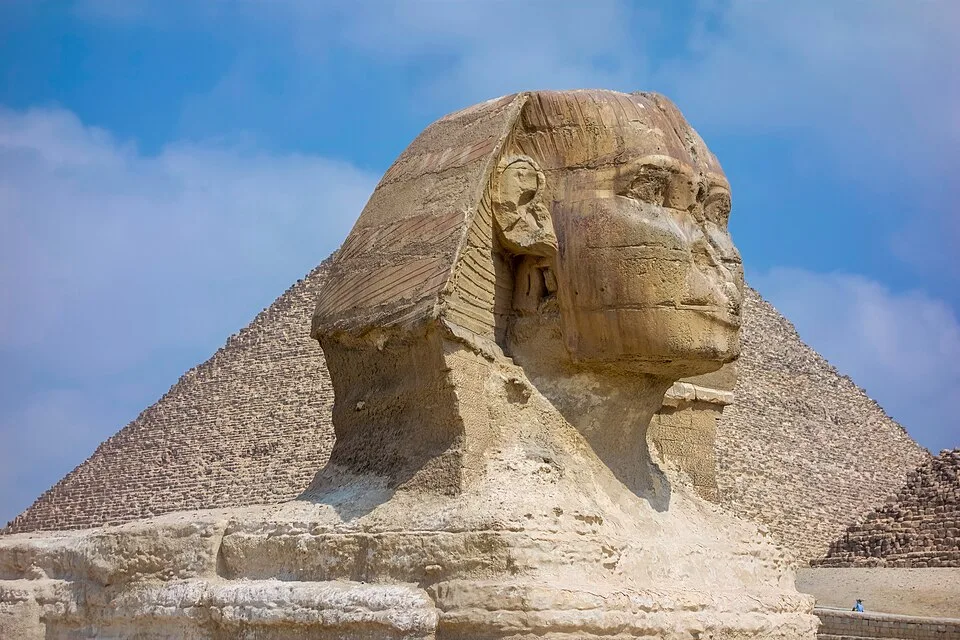
Great Sphinx of Giza (أبو الهول)
Great Sphinx of Giza (أبو الهول) | Petar Milošević (CC BY-SA 4.0)

Conservation and Modern Study

Since the early 20th century, conservation efforts have focused on stabilizing structures, managing tourism, and mitigating environmental damage. The Giza Plateau was inscribed as a UNESCO World Heritage Site in 1979. Recent projects employ non-invasive technologies like muon radiography (the ScanPyramids project) which revealed a previously unknown large void above the Grand Gallery in the Great Pyramid, rekindling debate about internal design features.
Pourquoi c'est important

The Pyramids of Giza stand as the only surviving member of the Seven Wonders of the Ancient World and epitomize the organizational and technological capabilities of Old Kingdom Egypt. They anchor our understanding of early state formation, monumental architecture, and royal ideology, while continuing to inspire archaeological innovation and global cultural heritage preservation.

Preuves et interprétation

Distinguer ce qui est bien établi de ce qui reste débattu.

Faits bien établis

3
  • The Great Pyramid was built as the tomb of Pharaoh Khufu (Cheops), evidenced by cartouches found in the relieving chambers above the King's Chamber.
  • The pyramid complex included a mortuary temple, causeway, and valley temple, integral to the royal funerary cult.
  • Casing stones were of fine white Tura limestone, polished to reflect sunlight, but were largely removed in the medieval period for construction in Cairo.

Inférences savantes

1
  • The workforce consisted of skilled, rotating labor gangs rather than slaves, based on workers' village archaeology and textual evidence from contemporaneous sites.

Interprétations débattues

3
  • The construction method for transporting and lifting multi-ton blocks remains unresolved, with leading theories including straight, zigzag, or spiral ramps, and lubricated sledges.
  • The purpose of the so-called 'air shafts' in the Great Pyramid is disputed: some argue for ventilation, others for stellar alignment (Orion's belt or polar stars) within the theology of the king's ascension.
  • The presence and meaning of the large void detected by muon radiography in 2017 above the Grand Gallery are debated; it may be a construction-relief space or a yet undiscovered chamber.

Découverte et fouilles

Modern Conservation and Non-Invasive Research

Dirigé par Egyptian Ministry of Antiquities and global partners

Ongoing conservation management, remote sensing, and international projects like ScanPyramids (2015–) use muon radiography, infrared thermography, and 3D modeling to study internal structure without excavation.

1646

Pyramidographia Survey

Dirigé par John Greaves

John Greaves conducted the first accurate measurements of the Great Pyramid, documenting the interior and establishing a basis for later scientific study.

1798–1801

Description de l'Égypte

Dirigé par Commission des Sciences et Arts

Napoleon's expedition included a commission of scholars who systematically recorded the pyramids, initiating modern Egyptology.

1880–1882

Survey of the Giza Plateau

Dirigé par Flinders Petrie

Flinders Petrie performed meticulous surveys and excavations, establishing core masonry dimensions and publishing 'The Pyramids and Temples of Gizeh'.

1902–1902

Mastabas and Rock Tombs Clearance

Dirigé par George Reisner

George Reisner led excavations of the surrounding mastaba fields, uncovering the tomb of Queen Hetepheres I and revealing the complex social landscape of Giza.

Photos de la communauté

Partagez votre expérience

Avez-vous visité ce site ? Téléchargez vos photos pour aider les autres à le découvrir.

Récits liés

Comment citer cette page

Atlas Anatolia. (2580). Pyramids of Giza. Atlas Anatolia. https://atlasanatolia.com/fr/site/pyramids-giza

Contenu sous licence CC BY-SA 4.0 — attribution requise en cas de réutilisation.

Graphique

Connexions avec des sites et récits associés.

Sources

  • Lehner (1997), The Complete Pyramids — Mark Lehner (1997)
  • Petrie (1883), The Pyramids and Temples of Gizeh — W. M. Flinders Petrie (1883)
  • Tallet & Lehner (2021), 'The Red Sea Scrolls: How Ancient Papyri Reveal the Secrets of the Pyramids', Journal of Egyptian Archaeology — Pierre Tallet and Mark Lehner (2021)
  • Morishima et al. (2017), 'Discovery of a big void in Khufu’s Pyramid by observation of cosmic-ray muons', Nature — Kunihiro Morishima et al. (2017)
  • UNESCO World Heritage List: Memphis and its Necropolis – the Pyramid Fields from Giza to DahshurLien

Questions fréquentes

Où se trouve Pyramids of Giza ?

Pyramids of Giza est situé à/en Giza Governorate, Lower Egypt, Egypt.

De quand date Pyramids of Giza ?

Pyramids of Giza remonte approximativement à 2580 av. J.-C. – 2510 av. J.-C..

Quelles civilisations sont associées à Pyramids of Giza ?

Pyramids of Giza est associé à la civilisation Ancient Egyptian.

Pourquoi Pyramids of Giza est-il important ?

The Pyramids of Giza stand as the only surviving member of the Seven Wonders of the Ancient World and epitomize the organizational and technological capabilities of Old Kingdom Egypt.

Pyramids of Giza est-il inscrit au patrimoine mondial de l'UNESCO ?

Oui — Pyramids of Giza est inscrit sur la liste du patrimoine mondial de l'UNESCO.