Aller au contenu
Atlas Anatolia
ActualitésIce Age teeth in Sulawesi push betel-nut use back as far as 25,000 yearsRoman mosaic and Eros head uncovered in the basilica at Pompeiopolis, Kastamonu
Karnak — Egypt

Wikimedia Commons (CC BY-SA)

Continent Record

Oldest Temple in Africa

TempleUNESCOEn vedette

Karnak

Seyfi Cem Baskin

الكرنك2055 av. J.-C. – 100 av. J.-C.

The Karnak Temple Complex, the largest religious site ever built, developed over two thousand years as the preeminent cult center of the god Amun-Ra, showcasing the architectural ambitions of dozens of pharaohs and the evolving political power of Thebes.

322
Intérêt 80

Localisation

Luxor Governorate · Upper Egypt · Égypte

25.72°N · 32.66°E · Afrique

Built

c. 2055 BCE – 100 BCE (Middle Kingdom to Ptolemaic period)

Civilization

Ancient Egyptian (Theban cult center of Amun-Ra)

Discovered

Continuously known; modern excavation begins with Napoleonic expedition 1799

Status

UNESCO World Heritage Site (part of Ancient Thebes with its Necropolis, 1979)

Dedication

Amun-Ra, Mut, Montu (Theban Triad)

Area

Over 100 hectares (main temple precinct)

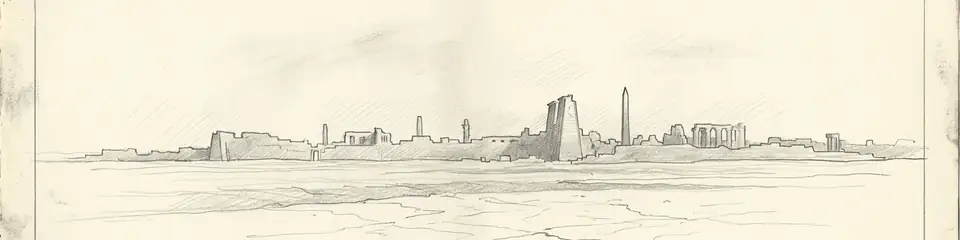
Graphite pencil sketch banner of Karnak

“Karnak stands as the most ambitious sacred building project of the ancient world, a testament to centuries of royal piety and architectural innovation.”

Localisation

Aperçu

Historical Development

Karnak's origins trace to the early Middle Kingdom, around 2055 BCE, when Thebes became a prominent political center. The earliest securely dated construction is a limestone temple erected by Senusret I (c. 1971–1926 BCE), dedicated to Amun, who would later merge with the sun god Ra. Throughout the New Kingdom (c. 1550–1070 BCE), successive rulers vastly expanded the complex, adding pylons, courtyards, obelisks, and chapels. The site's core grew organically, with the main axis aligned to the Nile and subsidiary avenues connecting to the temples of Mut and Montu. By the Ptolemaic period (post-332 BCE), additions became smaller but continued until around 100 BCE, marking three millennia of near-continuous sacred construction.

Architectural Grandeur

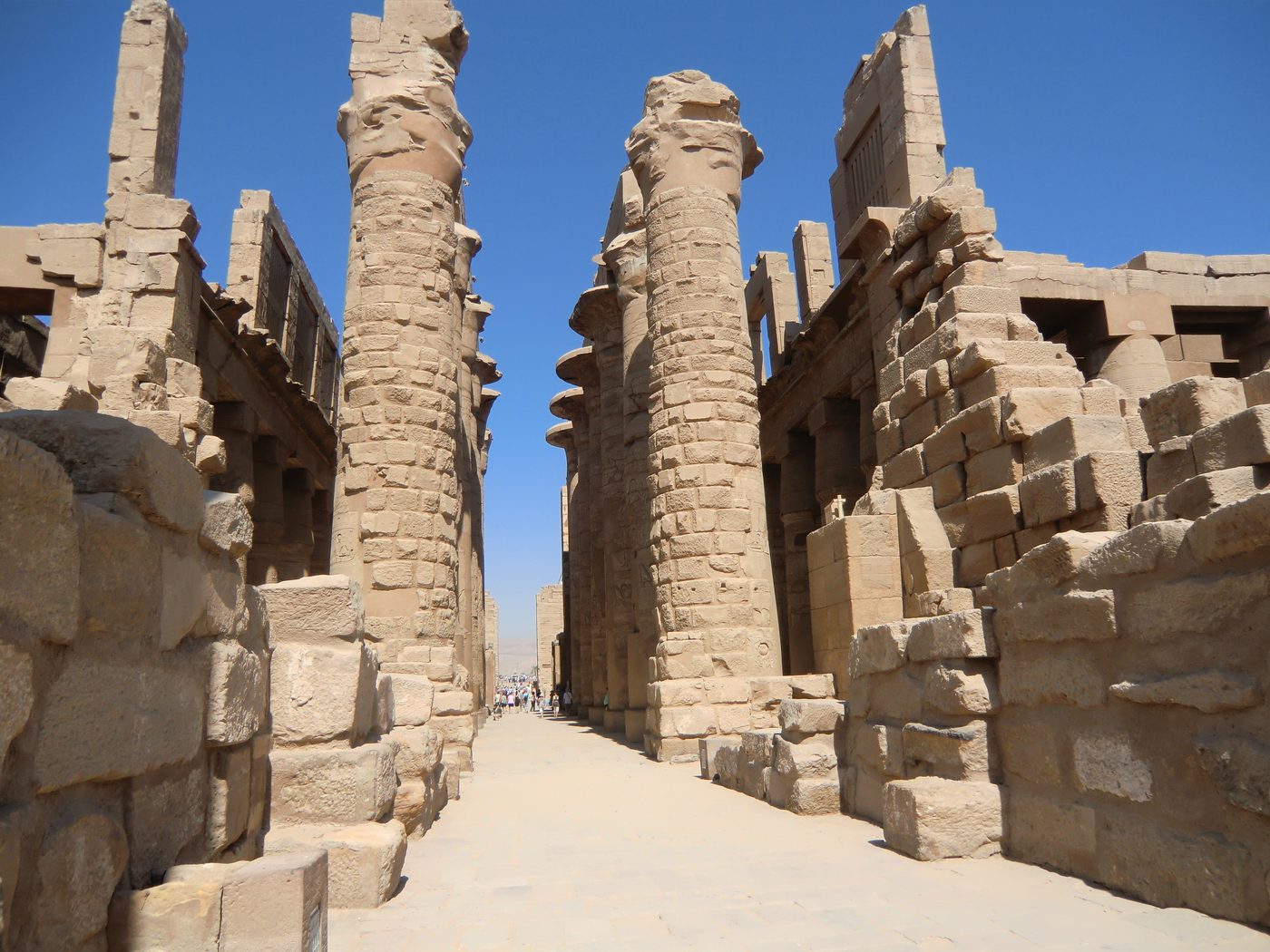
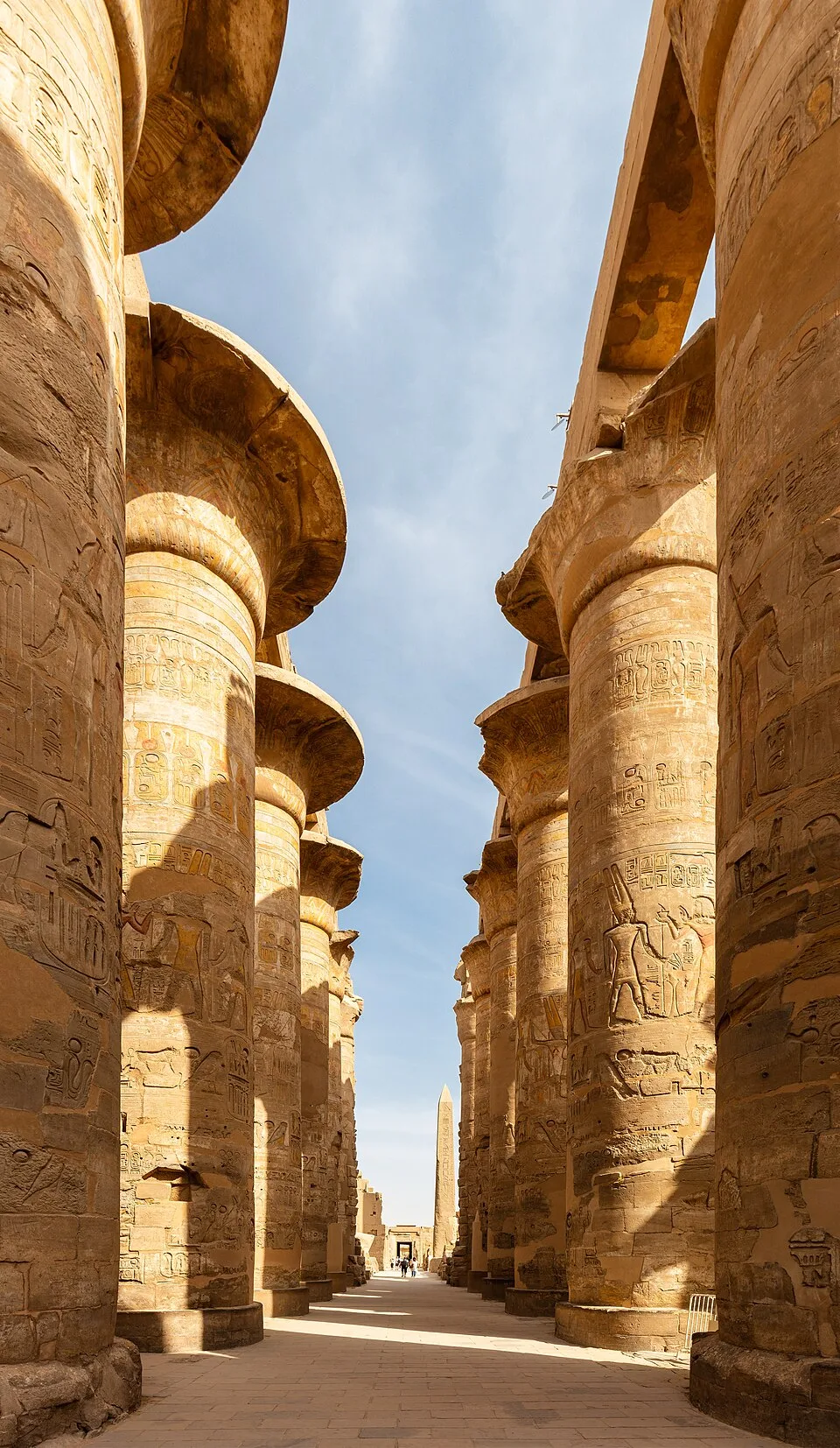
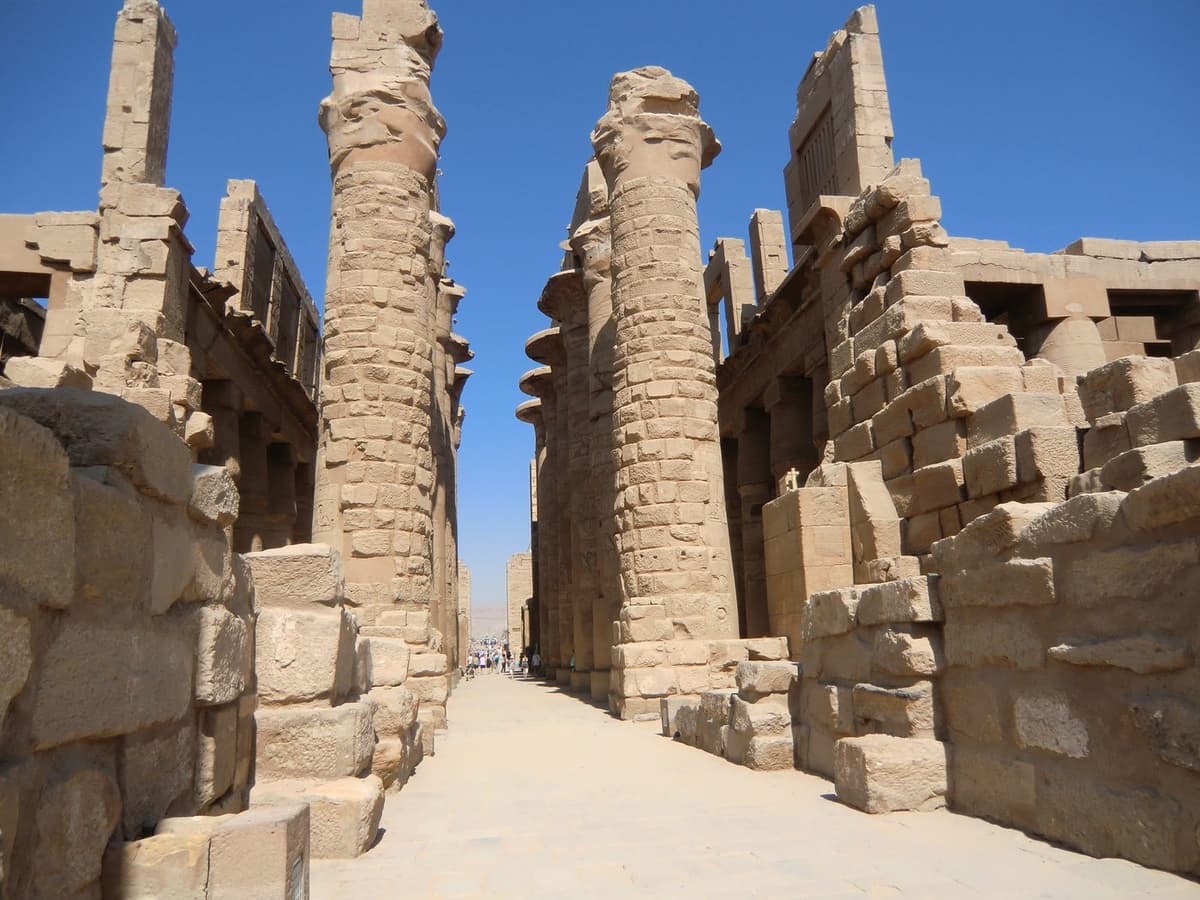
The most iconic structure is the Hypostyle Hall, a forest of 134 colossal columns arranged in 16 rows, covering an area of over 5,000 square meters. Begun by Amenhotep III and completed under Seti I and Ramesses II in the 13th century BCE, its central columns soar 21 meters high, supporting massive architraves that once blocked sunbeams except during carefully orchestrated illuminations. The hall's walls bear intricate reliefs depicting royal rituals and the sacred Opet festival. Other notable features include the twin obelisks of Hatshepsut (one still standing, at 29.6 meters and 320 tons), the Festival Temple of Thutmose III, and the ten monumental pylons that create a dramatic processional route stretching eastward from the Nile.
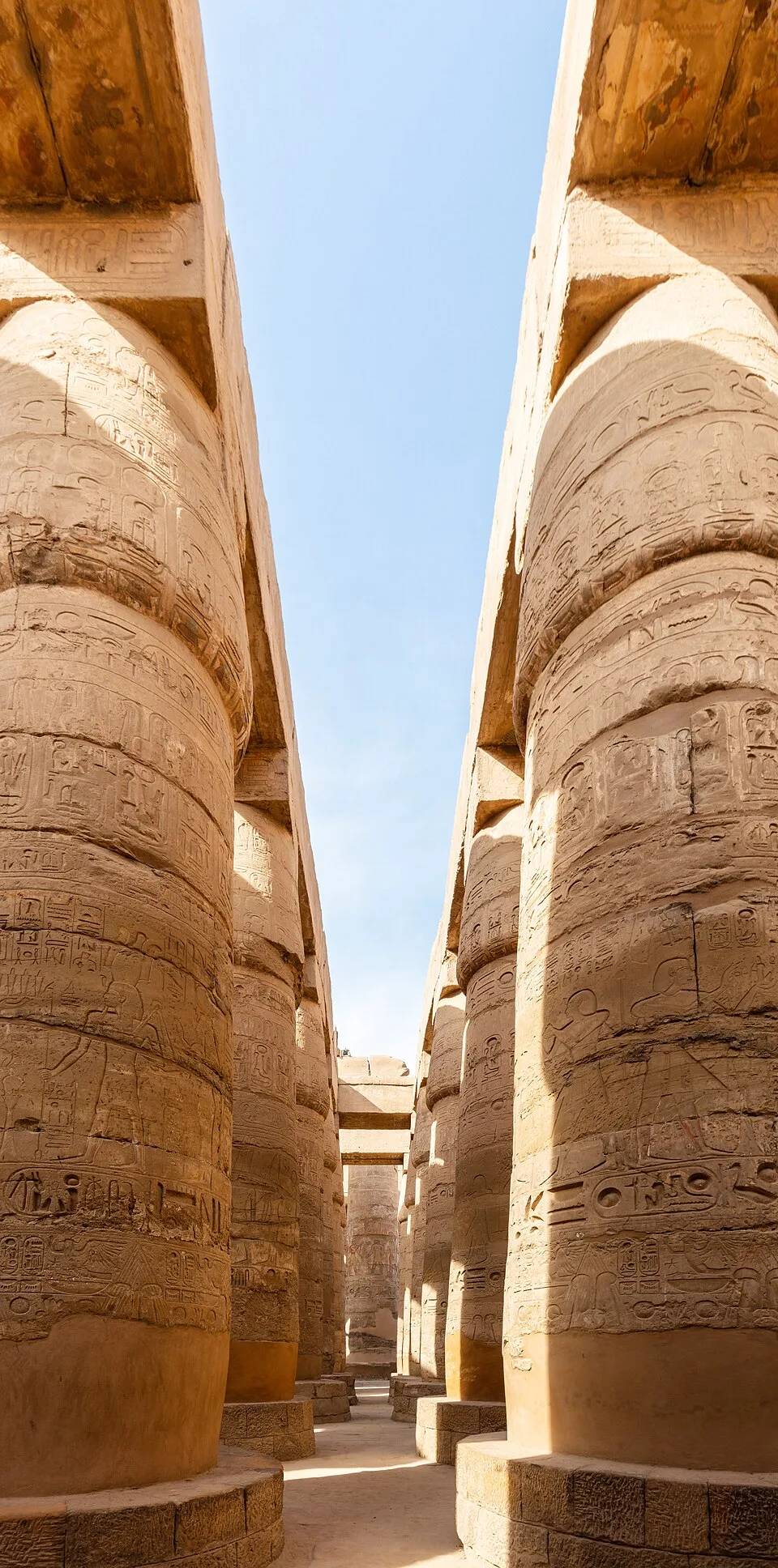
Templo de Karnak, Luxor, Egipto, 2022-04-03, DD 168
Templo de Karnak, Luxor, Egipto, 2022-04-03, DD 168 | Diego Delso (CC BY-SA 4.0)
"I have made this with a loving heart for my father Amun, having entered upon his mountain of pure limestone, that I might fashion for him a sacred place that should endure forever."
— Hatshepsut, Obelisk inscription at Karnak, c. 1473 BCE

Religious and Political Significance

Karnak was not merely a temple but the earthly residence of Amun-Ra, the divine patron of Thebes and later the dynastic god of the New Kingdom empire. Its priests wielded immense economic and political influence, controlling vast estates. The annual Opet festival, reenacting the marriage of Amun and the pharaoh's divine ka, reinforced royal legitimacy. During the Amarna period, Akhenaten briefly suppressed the Amun cult and built his own Aten temple at Karnak, only to have it dismantled and repurposed into later structures—a palpable act of damnatio memoriae. The complex thus encapsulates the fluctuating tides of Egyptian theology and statecraft.
Templo de Karnak, Luxor, Egipto, 2022-04-03, DD 147
Templo de Karnak, Luxor, Egipto, 2022-04-03, DD 147 | Diego Delso (CC BY-SA 4.0)

Archaeological Exploration and Conservation

Modern scientific engagement began with the Napoleonic expedition's documentation (1799–1801), followed by Auguste Mariette's extensive clearing in the 1850s. The legendary discovery of the Karnak Cachette by Georges Legrain in 1903–1907 uncovered over 800 stone statues and 17,000 bronzes, intentionally buried in antiquity, perhaps as a sacred deposit. Since 1967, the Franco-Egyptian Centre for the Study of the Temples of Karnak (CFEETK) has conducted meticulous excavations, epigraphic surveys, and digital recording, revealing the site's stratigraphic complexity. Despite centuries of study, only a fraction of Karnak has been fully explored, and conservation challenges persist due to groundwater, salt weathering, and tourism pressure.
Pourquoi c'est important

Karnak stands as the most ambitious sacred building project of the ancient world, a testament to centuries of royal piety and architectural innovation. Its vast array of inscriptions, reliefs, and statues provides a diachronic record of Egyptian political history, theology, and art. As the heart of the ancient city of Thebes, it illuminates the mechanisms of divine kingship and temple economy that sustained one of antiquity's greatest civilizations.

Preuves et interprétation

Distinguer ce qui est bien établi de ce qui reste débattu.

Faits bien établis

3
  • The earliest known structural phase at Karnak dates to the reign of Senusret I (c. 1971–1926 BCE), confirmed by foundation deposits and inscribed blocks.
  • The Karnak Hypostyle Hall was built primarily under Seti I and Ramesses II (13th century BCE), as demonstrated by cartouches, architectural sequence, and historical records.
  • The Cachette of Karnak, excavated by Georges Legrain in 1903–1907, yielded over 800 stone statues and 17,000 bronze objects, now housed in the Egyptian Museum in Cairo.

Inférences savantes

2
  • The progressive alignment of Karnak's east-west axis appears to target the winter solstice sunrise, suggesting a solar-chthonic fusion in the temple's ritual landscape.
  • The reuse of talatat blocks from Akhenaten's dismantled Aten temple in later pylons indicates a deliberate, state-sponsored effort to obliterate memory of the Amarna heresy.

Interprétations débattues

2
  • The precise theological motivation behind the burial of the Karnak Cachette remains contested: interpretations range from ritual deposition of outdated temple dedications to a protective hiding during periods of instability.
  • Scholars disagree on whether the First Intermediate Period (c. 2181–2055 BCE) at Thebes was marked by severe collapse or a more resilient local polity, affecting interpretations of Karnak's earliest development.

Découverte et fouilles

1799–1801

Napoleonic Expedition Documentation

Dirigé par Commission des Sciences et des Arts

The French expedition under Napoleon produced the first systematic maps and drawings of Karnak, recorded in the Description de l'Égypte.

1858–1861

Mariette's Clearance of Karnak

Dirigé par Auguste Mariette

Auguste Mariette undertook large-scale clearing of sand and debris, uncovering major structures and establishing the Egyptian Antiquities Service.

1903–1907

Discovery of the Karnak Cachette

Dirigé par Georges Legrain

Georges Legrain's excavation near the Seventh Pylon revealed a massive cache of statues and bronzes buried in antiquity, transforming understanding of Egyptian art and history.

1967

Franco-Egyptian Centre for the Study of the Temples of Karnak (CFEETK)

Dirigé par CFEETK / multiple directors

Established in 1967, CFEETK continues comprehensive archaeological excavation, epigraphic recording, architectural study, and conservation of the Karnak complex.

Photos de la communauté

Partagez votre expérience

Avez-vous visité ce site ? Téléchargez vos photos pour aider les autres à le découvrir.

Récits liés

Comment citer cette page

Atlas Anatolia. (2055). Karnak. Atlas Anatolia. https://atlasanatolia.com/fr/site/karnak

Contenu sous licence CC BY-SA 4.0 — attribution requise en cas de réutilisation.

Graphique

Connexions avec des sites et récits associés.

Sources

  • Arnold, Dieter (1999), Temples of Ancient Egypt — Dieter Arnold (1999)
  • Barguet, Paul (1962), Le Temple d'Amon-Rê à Karnak — Paul Barguet (1962)
  • Kemp, Barry (2006), Ancient Egypt: Anatomy of a Civilization — Barry Kemp (2006)
  • Gabolde, Luc (2005), L'origine du temple de Karnak: archéologie, architecture et épigraphie — Luc Gabolde (2005)
  • Sullivan, Elaine (2010), 'In the Presence of the Gods: The Karnak Cachette in Context' — Elaine Sullivan (2010)
  • UNESCO World Heritage Centre, Ancient Thebes with its NecropolisLien

Questions fréquentes

Où se trouve Karnak ?

Karnak est situé à/en Luxor Governorate, Upper Egypt, Egypt.

De quand date Karnak ?

Karnak remonte approximativement à 2055 av. J.-C. – 100 av. J.-C..

Quelles civilisations sont associées à Karnak ?

Karnak est associé à la civilisation Ancient Egyptian.

Pourquoi Karnak est-il important ?

Karnak stands as the most ambitious sacred building project of the ancient world, a testament to centuries of royal piety and architectural innovation.

Karnak est-il inscrit au patrimoine mondial de l'UNESCO ?

Oui — Karnak est inscrit sur la liste du patrimoine mondial de l'UNESCO.