

Saltar al contenido
Atlas Anatolia
NoticiasIce Age teeth in Sulawesi push betel-nut use back as far as 25,000 yearsRoman mosaic and Eros head uncovered in the basilica at Pompeiopolis, Kastamonu
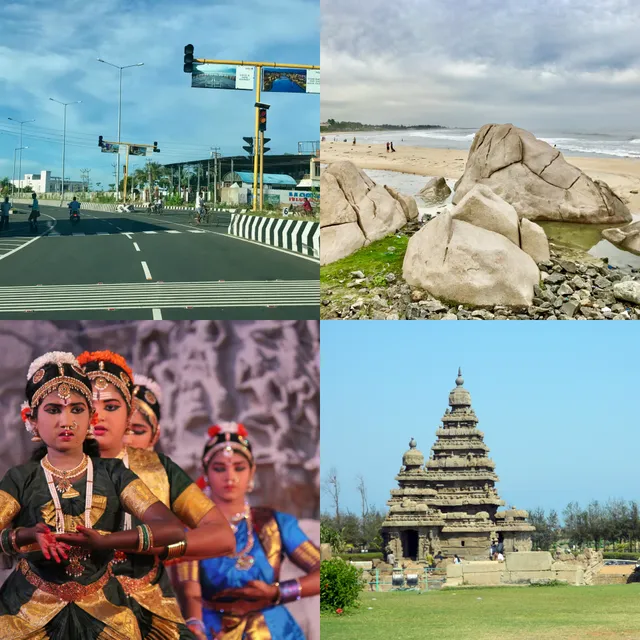
The Shore Temple at Mahabalipuram against the Bay of Bengal

Wikimedia Commons

ComplejoUNESCO

Mahabalipuram

Seyfi Cem Baskin

மாமல்லபுரம்600 d. C. – 800 d. C.

The Pallava port city on Tamil Nadu's Coromandel Coast — famous for 7th–8th-century rock-cut rathas, cave temples, the Shore Temple, and the giant open-air relief of the Descent of the Ganges — one of India's most visited UNESCO sites and a cornerstone of early Dravidian sculpture.

21
Interés 66

Ubicación

India

12.62°N · 80.19°E · Asia

Dynasty

Pallava kings Mahendravarman I and Narasimhavarman I (7th century CE)

Shore Temple

Structural granite temple facing the sea, c. 8th century CE

Relief

Descent of the Ganges — among the largest open-air rock reliefs

UNESCO

Group of Monuments at Mahabalipuram (1984)

Graphite pencil sketch banner of Mahabalipuram

Mahabalipuram documents the birth of monumental Dravidian temple form — from experimental monolithic rathas to the Shore Temple that influenced centuries of South Indian architecture.”

Ubicación

Resumen

Mahabalipuram (Mamallapuram) lies on the Bay of Bengal coast about 60 kilometres south of Chennai, Tamil Nadu. Under the Pallava kings Mahendravarman I (r. c. 600–630) and Narasimhavarman I (r. c. 630–668) — titled Mamalla ("great wrestler") — the site became a royal centre for rock-cut and structural temple architecture. The monuments are carved from local granite outcrops and include monolithic rathas (chariot-shaped shrines), mandapa cave temples, and the Shore Temple (c. 8th century) facing the sea.

The Descent of the Ganges (Arjuna's Penance) is one of the largest open-air bas-reliefs in the world, depicting Shiva, ascetics, elephants, and nagas on two huge boulders. Excavations after the 2004 tsunami revealed submerged structural remains offshore, suggesting a larger ancient port. The Archaeological Survey of India maintains the site; UNESCO inscribed the Group of Monuments in 1984.

Mahabalipuram remains an active stone-carving village and a mandatory stop on South India heritage circuits alongside Chennai, Kanchipuram, and Pondicherry.

Por qué es importante

Mahabalipuram documents the birth of monumental Dravidian temple form — from experimental monolithic rathas to the Shore Temple that influenced centuries of South Indian architecture. Its coastal reliefs and Pallava inscriptions are primary sources for early medieval trade, royal titles, and sculptural workshops in the Tamil country.

Evidencia e interpretación

Distinguir lo bien establecido de lo que sigue en debate.

Hechos bien establecidos

2
  • Pallava inscriptions and stylistic analysis date the rathas, mandapas, and Shore Temple to the 7th–8th centuries CE.
  • Submerged structural discoveries after 2004 confirm an extensive historic port zone beyond the visible shore temples.

Interpretaciones debatidas

1
  • The legend of "Seven Pagodas" swallowed by the sea is partially supported by offshore remains but the original count and destruction mechanism remain uncertain.

Fotos de la comunidad

Comparte tu experiencia

¿Has visitado este sitio? Sube tus fotos para ayudar a otros a descubrirlo.

Cómo citar esta página

Atlas Anatolia. (600). Mahabalipuram. Atlas Anatolia. https://atlasanatolia.com/es/site/mahabalipuram

Contenido bajo licencia CC BY-SA 4.0 — se requiere atribución al reutilizar.

Fuentes

  • Indian Temple Architecture: Form and TransformationHardy, Adam (1995)
  • UNESCO — MahabalipuramEnlace

Preguntas frecuentes

¿Dónde se encuentra Mahabalipuram?

Mahabalipuram se encuentra en India.

¿Qué antigüedad tiene Mahabalipuram?

Mahabalipuram se fecha aproximadamente en 600 d. C. – 800 d. C..

¿Qué civilizaciones se relacionan con Mahabalipuram?

Mahabalipuram se relaciona con Pallava.

¿Por qué es importante Mahabalipuram?

Mahabalipuram documents the birth of monumental Dravidian temple form — from experimental monolithic rathas to the Shore Temple that influenced centuries of South Indian architecture.

¿Mahabalipuram es Patrimonio Mundial de la UNESCO?

Sí. Mahabalipuram está inscrito en la Lista del Patrimonio Mundial de la UNESCO.