
Saltar al contenido
Atlas Anatolia
NoticiasIce Age teeth in Sulawesi push betel-nut use back as far as 25,000 yearsRoman mosaic and Eros head uncovered in the basilica at Pompeiopolis, Kastamonu
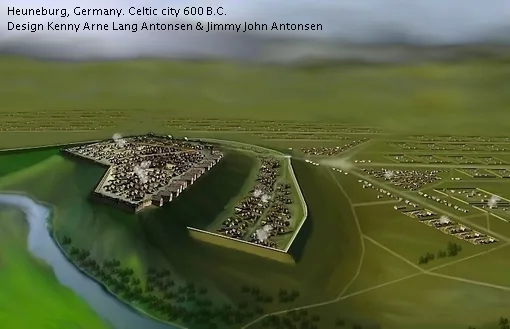
Reconstruction of the early Celtic Heuneburg with its mudbrick wall above the Danube, Germany

Wikimedia Commons

Récord nacional

Oldest City in Germany

Ciudad

Heuneburg

Seyfi Cem Baskin

620 a. C. – 450 a. C.

A fortified early Celtic hilltop town above the upper Danube in southwestern Germany, often called the oldest city north of the Alps. Around 600 BCE its rulers raised a Mediterranean-style mudbrick wall found nowhere else north of the Alps, traded for Greek wine and pottery, and buried their dead with gold — and it may be the "Pyrene" named by the Greek historian Herodotus.

311
Interés 46

Ubicación

Alemania

48.09°N · 9.41°E · Europa

Peak period

c. 620–450 BCE (late Hallstatt / early La Tène)

Mudbrick wall

c. 600 BCE — Mediterranean-style, unique north of the Alps

Scale

Citadel + lower town, ~100 ha; possibly the oldest city north of the Alps

Possibly

"Pyrene," named by Herodotus (5th c. BCE)

Burials

Hohmichele mound; the "Bettelbühl princess" (c. 583 BCE), gold-furnished

Trade

Greek pottery and wine amphorae — links to Massalia (Marseille)

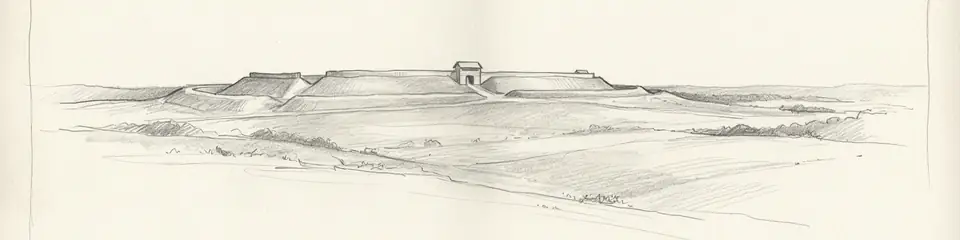
Graphite pencil sketch banner of Heuneburg

The Heuneburg is one of the most important prehistoric sites in central Europe and a key to understanding the emergence of urban life and social hierarchy north of the Alps.”

Ubicación

Resumen

The Heuneburg occupies a commanding spur above the upper Danube near Herbertingen in Baden-Württemberg, in the early Celtic heartland of southwestern Germany. Occupied at intervals from the Bronze Age, it reached its height in the early Iron Age, during the late Hallstatt and early La Tène periods, roughly between 620 and 450 BCE, when it became one of the most important power centres of early Celtic Europe.

Its most extraordinary feature dates to around 600 BCE. In place of the usual timber-and-earth ramparts of the period, the rulers of the Heuneburg built a fortification wall of sun-dried mudbrick set on a stone foundation, with projecting bastions, in a technique borrowed directly from the Mediterranean world. Nothing else like it is known anywhere north of the Alps. The white plastered wall would have been visible for miles and was a deliberate display of contact with, and emulation of, the civilizations of Greece and the Etruscans.

Excavation has shown that the fortified citadel was only the core of a much larger settlement. Beyond the walls lay an extensive lower town of planned streets and houses, together covering perhaps 100 hectares and home to an estimated several thousand people. This scale has led archaeologists to describe the Heuneburg as the earliest city, or proto-city, north of the Alps. Some scholars identify it with Pyrene, a place the Greek historian Herodotus, writing in the fifth century BCE, located near the source of the Danube — which would make it the earliest named settlement in central Europe recorded in history.

The power and wealth of its elite are vividly shown in the surrounding burial mounds. The Hohmichele was one of the largest burial mounds in Europe, and in 2010 the nearby Bettelbühl necropolis yielded the richly furnished grave of an early Celtic woman, the "Bettelbühl princess," buried around 583 BCE with gold and amber ornaments, datable with rare precision thanks to preserved timber. Imported Greek black-figure pottery, Mediterranean wine amphorae, and other luxury goods found at the site document long-distance trade networks reaching the Greek colony of Massalia (Marseille) and beyond. Today an open-air museum reconstructs part of the mudbrick wall and gateway on the original site.
Por qué es importante

The Heuneburg is one of the most important prehistoric sites in central Europe and a key to understanding the emergence of urban life and social hierarchy north of the Alps. Its Mediterranean-style mudbrick wall is unique in temperate Europe and provides dramatic evidence that early Celtic elites were in direct cultural and commercial contact with the Greek and Etruscan worlds centuries before the Roman conquest. The discovery that the citadel was the core of a far larger planned settlement has reshaped the debate about when and where the first cities appeared in Europe, with many archaeologists now regarding the Heuneburg as the earliest city north of the Alps. Its possible identification with Herodotus's Pyrene would make it the first place in central Europe to be named in written history. Together with its spectacular princely burials, the site offers an unmatched window into the wealthy, outward-looking Celtic society of the early Iron Age.

Evidencia e interpretación

Distinguir lo bien establecido de lo que sigue en debate.

Hechos bien establecidos

3
  • Excavations uncovered the foundations of a sun-dried mudbrick fortification wall on a stone footing with projecting bastions, dated to around 600 BCE — a Mediterranean building technique with no other parallel north of the Alps.
  • Imported Greek black-figure pottery and Mediterranean transport amphorae found at the site confirm long-distance trade between the early Celtic elite and the Greek world, including the colony of Massalia (Marseille).
  • The Bettelbühl necropolis, excavated from 2010, produced the intact, richly furnished grave of an elite woman with gold and amber ornaments; preserved oak timbers dated her burial by dendrochronology to around 583 BCE.

Inferencias académicas

1
  • Survey and excavation of the extensive lower town beyond the citadel indicate a settlement of perhaps 100 hectares and several thousand inhabitants, leading many archaeologists to interpret the Heuneburg as the earliest city, or proto-city, north of the Alps.

Interpretaciones debatidas

1
  • The identification of the Heuneburg with the "Pyrene" mentioned by Herodotus near the source of the Danube is plausible and widely cited, but cannot be proven; it remains a scholarly hypothesis rather than established fact.

Fotos de la comunidad

Comparte tu experiencia

¿Has visitado este sitio? Sube tus fotos para ayudar a otros a descubrirlo.

Historias relacionadas

Cómo citar esta página

Atlas Anatolia. (620). Heuneburg. Atlas Anatolia. https://atlasanatolia.com/es/site/heuneburg

Contenido bajo licencia CC BY-SA 4.0 — se requiere atribución al reutilizar.

Gráfico

Conexiones con sitios e historias relacionados.

Fuentes

  • The Ancient CeltsCunliffe, Barry (2018)
  • The Heuneburg: a Celtic early-urban centreKrausse, Dirk et al. (2016)

Preguntas frecuentes

¿Dónde se encuentra Heuneburg?

Heuneburg se encuentra en Germany.

¿Qué antigüedad tiene Heuneburg?

Heuneburg se fecha aproximadamente en 620 a. C. – 450 a. C..

¿Qué civilizaciones se relacionan con Heuneburg?

Heuneburg se relaciona con Celtic.

¿Por qué es importante Heuneburg?

The Heuneburg is one of the most important prehistoric sites in central Europe and a key to understanding the emergence of urban life and social hierarchy north of the Alps.

¿Heuneburg es Patrimonio Mundial de la UNESCO?

Heuneburg no está inscrito actualmente en la Lista del Patrimonio Mundial de la UNESCO.