
Saltar al contenido
Atlas Anatolia
NoticiasIce Age teeth in Sulawesi push betel-nut use back as far as 25,000 yearsRoman mosaic and Eros head uncovered in the basilica at Pompeiopolis, Kastamonu
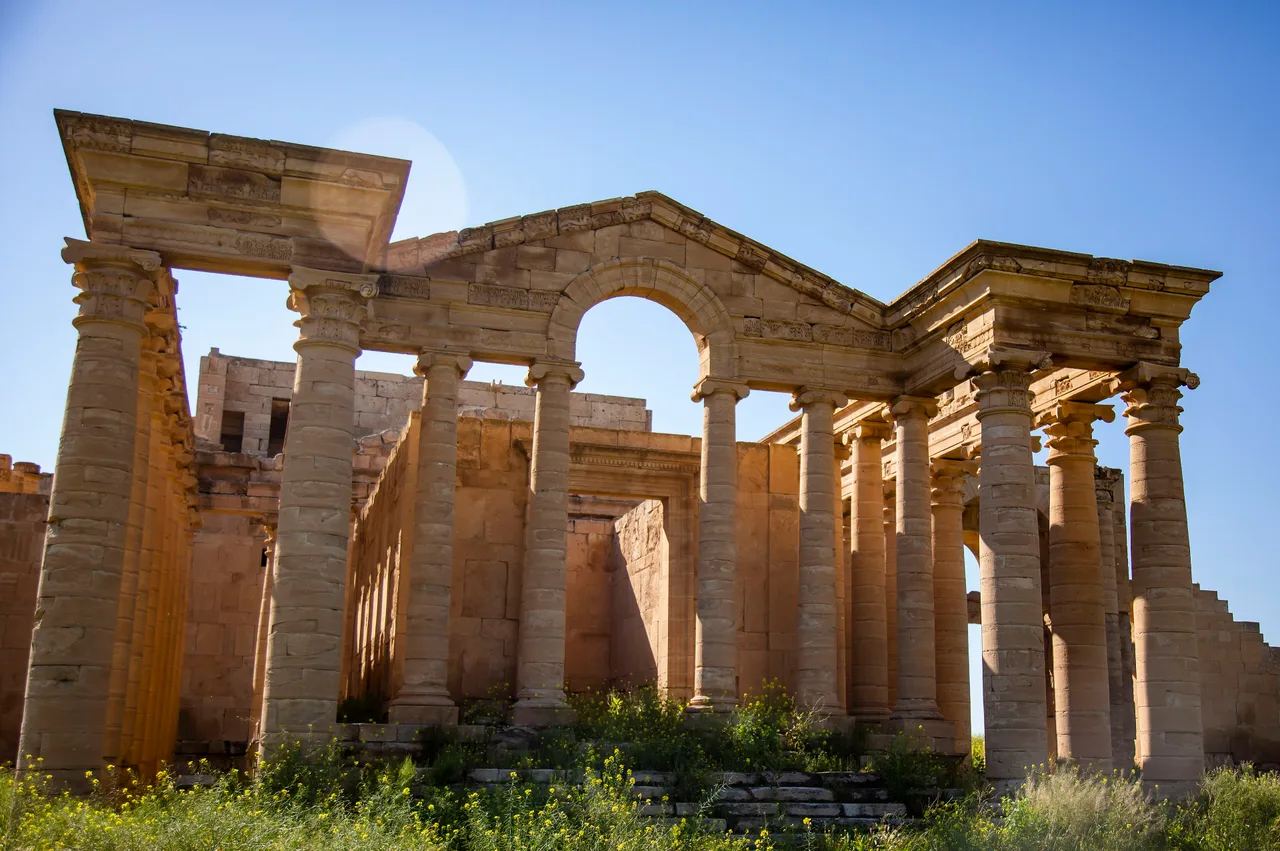
The Great Iwans of the sacred precinct at Hatra, Iraq

Wikimedia Commons

CiudadUNESCO

Hatra

Seyfi Cem Baskin

الحضر100 a. C. – 241 d. C.

A Parthian caravan city in the northern Iraqi desert that withstood sieges by both Trajan and Septimius Severus — its massive circular defensive walls and hybrid Greco-Roman-Mesopotamian temples stood intact for 1,800 years until partial destruction by ISIS in 2015.

31
Interés 64

Ubicación

Irak

35.59°N · 42.72°E · Asia

Outer wall circumference

7 km; walls up to 10 m high, 160+ towers

Roman sieges repelled

Trajan (116 CE) and Septimius Severus (197, 199 CE)

Destroyed by

Sasanian Shapur I, 241 CE; ISIS, 2015 CE

Architectural origin of iwans

Hatra's iwan halls became the prototype of Islamic architecture

UNESCO

World Heritage Site since 1985; listed as In Danger 2014–present

Location

110 km southwest of Mosul in the Iraqi Jazirah desert

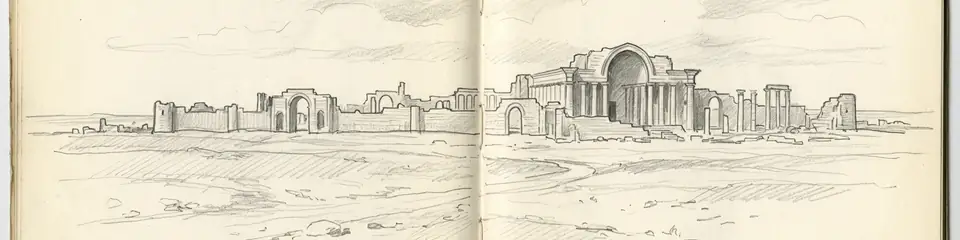
Graphite pencil sketch banner of Hatra

Hatra was a living proof that the Parthian Empire was not merely a corridor between Rome and India but a creative civilization producing its own architectural language, sculptural tradition, and political theology.”

Ubicación

Resumen

Hatra stands in the middle of the Iraqi desert, 110 km southwest of Mosul in the Jazirah plateau, surrounded by semi-arid steppe. It was the capital of a short-lived Parthian vassal state known as Araba (or Arba), which flourished from roughly the 1st century BCE to 241 CE, when it was destroyed by the Sasanian emperor Shapur I.

The city's circular plan — defined by two concentric rings of massive defensive walls encompassing an area of roughly 3.5 km in diameter — is its most immediately striking feature, visible from satellite as a perfect double circle in the desert. The outer ring is 7 km in circumference; the walls stand up to 10 m high and are reinforced by more than 160 towers. This fortification system repelled two major Roman assaults: Trajan besieged the city in 116 CE and withdrew after summer heat and harassment by archers; Septimius Severus besieged it twice (197 and 199 CE) and was driven off both times, the second siege lasting 20 days.

At the center of the city stood a large sacred precinct (the temenos) surrounded by its own high walls, containing a series of temples dedicated to a syncretic pantheon that combined Mesopotamian, Iranian, and Greek deities. The main temple complex — the Grand Temple or Great Iwans — consisted of a series of large iwan halls (open-vaulted porticoes of Iranian origin) facing a central courtyard, flanked by smaller temples dedicated to Maran ('Our Lord'), Martan ('Our Lady'), and a sun god, Shamash. The architectural vocabulary of Hatra was itself a cultural hybrid: the iwan halls are Iranian in origin, the column capitals and architectural ornament are Hellenistic, and the iconographic program of the carvings blends Parthian, Mesopotamian, and Greco-Roman conventions. Sculptures of gods, priests, and Araban kings found at Hatra — now divided between the Iraq Museum in Baghdad and formerly the Mosul Museum — were among the finest examples of Parthian art known.

In February and March 2015 ISIS systematically destroyed much of the standing sculpture at Hatra with sledgehammers and bulldozers, demolishing statues documented and photographed over the preceding century. A substantial portion of the architecture survives.

Por qué es importante

Hatra was a living proof that the Parthian Empire was not merely a corridor between Rome and India but a creative civilization producing its own architectural language, sculptural tradition, and political theology. The iwan — a vaulted portico open on one side — invented or refined at Hatra became the defining element of later Islamic architecture: from the mosques of Iraq and Iran to the Safavid monuments of Isfahan, every great iwan traces its lineage through Hatra. The city's successful resistance to Rome — twice — also illustrates the limits of Roman power in the east and the sophistication of Parthian defensive military engineering. The 2015 ISIS destruction converted the site from an archaeological resource into a test case for cultural heritage protection under conflict, accelerating the global shift toward 3D documentation and digital preservation of threatened monuments.

Evidencia e interpretación

Distinguir lo bien establecido de lo que sigue en debate.

Hechos bien establecidos

3
  • The Historia Augusta records both of Septimius Severus's failed sieges of Hatra (197 and 199 CE) with specific details of military operations and the reason for withdrawal; the account is consistent with the archaeological evidence of the wall system's defensive strength.
  • Trilingual inscriptions in Aramaic, Arabic, and Greek found at Hatra identify the city's rulers as kings of Araba and record temple dedications, confirming the political structure and the syncretic religious program.
  • The Great Iwan complex — documented by detailed archaeological surveys between 1951 and 1975 — consists of five iwans of different sizes arranged around a central court, a plan type that directly antecedes the standard mosque courtyard design of early Islamic architecture.

Interpretaciones debatidas

1
  • Whether Hatra was destroyed by Sasanian military force alone (as classical sources record) or succumbed to a combination of military pressure, internal revolt, and trade route disruption following the Silk Road's realignment is debated among Parthian specialists.

Fotos de la comunidad

Comparte tu experiencia

¿Has visitado este sitio? Sube tus fotos para ayudar a otros a descubrirlo.

Cómo citar esta página

Atlas Anatolia. (100). Hatra. Atlas Anatolia. https://atlasanatolia.com/es/site/hatra

Contenido bajo licencia CC BY-SA 4.0 — se requiere atribución al reutilizar.

Fuentes

  • Hatra: A Parthian City in the Western Mesopotamian DesertFuad Safar and Mohammed Ali Mustafa (1974)
  • The Parthian Empire and its ReligionsMarkus Sievers (2010)
  • UNESCO — Hatra (In Danger)Enlace

Preguntas frecuentes

¿Dónde se encuentra Hatra?

Hatra se encuentra en Iraq.

¿Qué antigüedad tiene Hatra?

Hatra se fecha aproximadamente en 100 a. C. – 241 d. C..

¿Qué civilizaciones se relacionan con Hatra?

Hatra se relaciona con Assyrian, Parthian.

¿Por qué es importante Hatra?

Hatra was a living proof that the Parthian Empire was not merely a corridor between Rome and India but a creative civilization producing its own architectural language, sculptural tradition, and political theology.

¿Hatra es Patrimonio Mundial de la UNESCO?

Sí. Hatra está inscrito en la Lista del Patrimonio Mundial de la UNESCO.