
Overview
Sanxingdui ("Three Stars Mound") lies near Guanghan in Sichuan province, southwestern China, on the floodplain of the Yazi River. It is the type-site of the Sanxingdui culture, part of the broader Bronze Age Shu civilization that flourished in the Sichuan Basin from roughly 2800 to 800 BCE — largely contemporary with the Shang and early Zhou dynasties of the Yellow River valley, over a thousand kilometres to the north, but archaeologically and artistically almost entirely distinct from them.
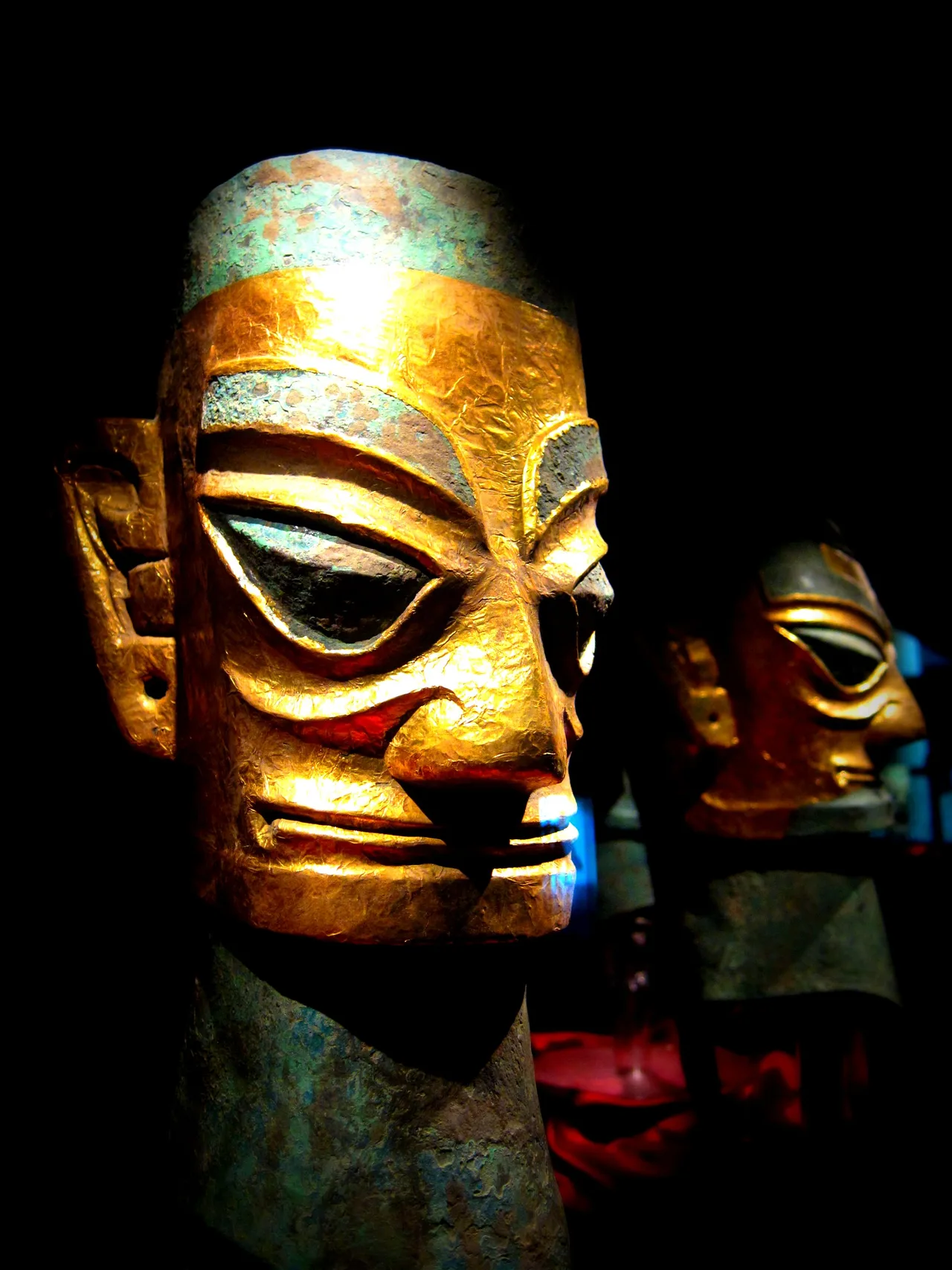
The site was first noticed in 1929 when a farmer clearing an irrigation ditch uncovered a cache of jade artefacts, but its true scale only became apparent in 1986, when construction workers accidentally exposed two large sacrificial pits. Pits 1 and 2 contained an extraordinary hoard of bronze, gold, jade, ivory, and bone objects — many of them deliberately broken, burned, and buried, apparently in a ritual act — including dozens of bronze masks and heads with sharply angular features, some with eyes protruding on cylindrical stalks up to 16 centimetres from the face. A bronze standing figure 2.62 metres tall (including its base), the largest bronze human figure known from the ancient world, was found alongside a bronze "sacred tree" originally standing nearly 4 metres, its branches hung with birds, fruit, and dragons.
Between 2019 and 2022, Chinese archaeologists excavated six additional sacrificial pits (Pits 3–8) using climate-controlled excavation tents and advanced conservation techniques unavailable in 1986, recovering thousands of further objects, including a gilded bronze mask, a bronze box with a tortoise-shaped lid, silk residue — the earliest confirmed evidence of silk in the region — and additional fragments that, remarkably, in some cases fit together with pieces excavated more than three decades earlier from the original 1986 pits, confirming that objects had been broken up and dispersed across multiple pits during the same ritual events.
No confirmed writing system has been identified at Sanxingdui, which leaves the identity, language, religious beliefs, and even the name of the civilization that built it almost entirely reconstructed from material culture alone. The exaggerated, otherworldly features of the bronze masks — some interpreted as representing Cancong, a legendary founding king of Shu described in much later Chinese texts as having protruding, vertical eyes — have no close parallel anywhere else in the Bronze Age world, fuelling both serious scholarly debate and popular speculation about the culture's origins and beliefs.
Sanxingdui's bronze-casting technology, using piece-mould methods broadly comparable to Shang metallurgy, indicates sustained contact and technological exchange with the Yellow River civilizations, even as its artistic and religious vocabulary developed along an entirely independent path. The site is associated with the ancient Kingdom of Shu, later referenced in Chinese historical texts, and is linked to the nearby, later Bronze Age site of Jinsha, which may represent a successor settlement after Sanxingdui's decline around 1000–800 BCE. A dedicated on-site museum displays the excavated bronzes, and the site remains under active excavation.