
Overview
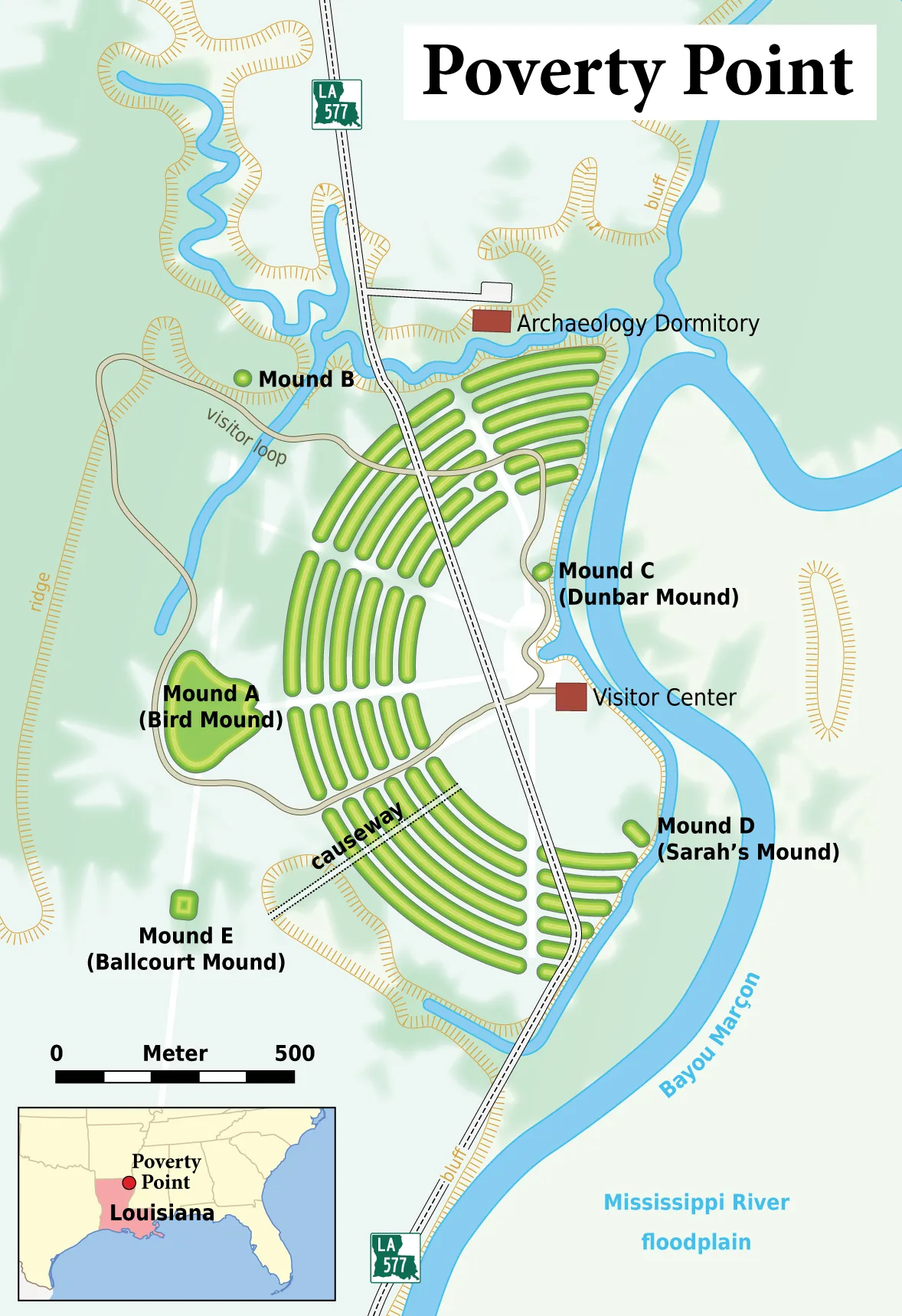
Poverty Point sits on a bluff above the Mississippi River floodplain in what is now West Carroll Parish, Louisiana. Between roughly 1700 and 1100 BCE, during the Late Archaic period — long before the introduction of agriculture, pottery, or metal tools to the region — the people who built and used this site constructed one of the largest and most sophisticated earthwork complexes anywhere in the pre-Columbian Americas.
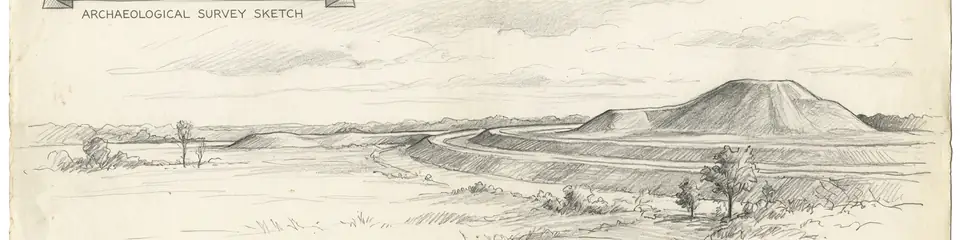
The site's central feature is a set of six concentric, C-shaped earthen ridges arranged around a flat plaza, together spanning roughly three-quarters of a mile in diameter. The ridges, originally standing up to two metres high and several metres wide, are thought to have supported residential structures, arranged in a pattern that suggests deliberate social and possibly astronomical organisation. Rising above the ridges is Mound A, a massive earthen mound roughly 22 metres tall and containing an estimated 238,000 cubic metres of soil — one of the largest earthen constructions in North America — apparently built in a single, rapid episode of intensive labour lasting perhaps only weeks or months, based on the absence of weathering layers within its fill.
What makes Poverty Point extraordinary is that its builders were not farmers. Unlike the later Mississippian mound-building cultures who supported large-scale construction with maize agriculture, the Poverty Point culture subsisted on hunting, fishing, and gathering along the resource-rich Mississippi floodplain. The scale of construction — an estimated 750,000 cubic metres of earth moved by hand, basket by basket, without draft animals or wheeled transport — implies a level of labour coordination, surplus food storage, and social organisation not previously believed possible among non-agricultural societies.
Archaeologists have also recovered evidence of an extensive long-distance trade network extending across much of North America: stone tools and raw materials from the site have been sourced to the Great Lakes region, the Appalachian Mountains, and the Ozark Plateau, suggesting Poverty Point functioned as a major hub in a continent-spanning exchange system nearly 3,700 years ago. Small fired clay objects known as Poverty Point Objects, used for cooking in the absence of suitable local stone for heating, are found by the thousands and serve as a diagnostic marker of the culture across the wider region. Poverty Point was inscribed as a UNESCO World Heritage Site in 2014.