


Overview
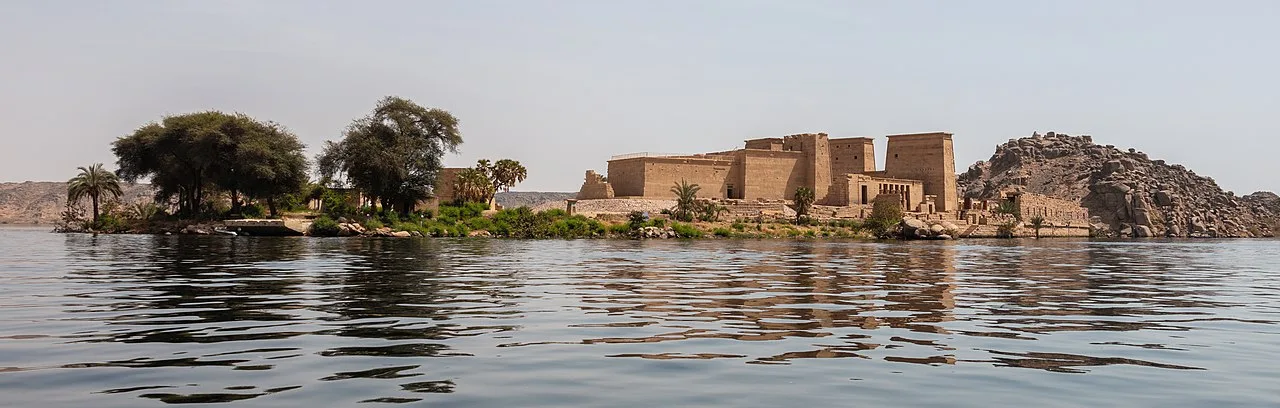
Philae lies just south of Aswan at the First Cataract of the Nile, the traditional southern frontier of ancient Egypt and the gateway to Nubia. The island was sacred to Isis, the great mother goddess of Egyptian religion, and was associated with the myth of Osiris, her husband, whom she was believed to have mourned and revived; a nearby island, Biga, was held to be one of the burial places of Osiris. The temple complex that grew up here became the principal cult centre of Isis in the late period of Egyptian history.
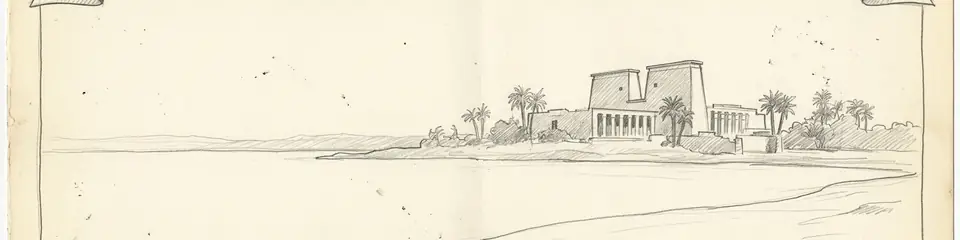
Although the cult on the island was ancient, the surviving buildings are relatively late. The oldest standing elements date to the 30th Dynasty pharaoh Nectanebo I (4th century BCE), but the great Temple of Isis and most of the other structures were built and decorated under the Ptolemaic dynasty (305–30 BCE) and added to by Roman emperors. The complex includes the main temple with its two great pylons and colonnaded forecourt, the elegant Kiosk of Trajan (an unfinished Roman pavilion that became one of the most admired and frequently painted monuments in Egypt), a temple of Hathor, and various gateways and chapels. The reliefs show Ptolemaic kings and Roman emperors performing rituals before the Egyptian gods, in the traditional pharaonic manner.
Philae has a special place in history as one of the last strongholds of ancient Egyptian religion. While most temples ceased to function after the Roman empire adopted Christianity, the cult of Isis at Philae continued, partly because the Nubian peoples to the south remained devoted to the goddess. The latest known inscription written in Egyptian hieroglyphs — the final dated use of the script that had been written for more than three thousand years — was carved here in 394 CE. The temple was eventually closed by order of the Christian emperor Justinian around 537 CE, and parts were converted into churches.
In the 20th century the temple faced destruction. The first Aswan Dam, built in 1902, left Philae submerged under the reservoir for much of each year, so that visitors viewed the temples by boat, peering down at the columns through the water. When the much larger Aswan High Dam was constructed in the 1960s, Philae would have been permanently flooded. In a UNESCO-coordinated rescue operation between 1972 and 1980, the entire complex was enclosed by a coffer dam, drained, dismantled into some 40,000 blocks, and reassembled on the higher nearby island of Agilkia, which was even reshaped to resemble the original Philae. The relocated temples opened to visitors in 1980.