
Skip to content
Atlas AnatoliaAtlas Anatolia
The Ashoka Pillar at Lumbini, Nepal, erected in 249 BCE marking the traditional birthplace of the Buddha

Lumbini

लुम्बिनी600 BCE – 630 CE
73

Interest

Iron AgeClassicalHellenisticLate AntiqueVedic IndianMauryanRupandehi District

Significance

Traditional birthplace of Siddhartha Gautama, the Buddha

Ashoka Pillar

Erected 249 BCE, Brahmi inscription confirms the birthplace tradition

Timber shrine

Radiocarbon dated to c. 6th century BCE — oldest known Buddhist structure in the world

Pilgrim accounts

Documented by Chinese monks Faxian (c. 403 CE) and Xuanzang (c. 636 CE)

UNESCO

World Heritage Site 1997

Lumbini offers a rare convergence of textual tradition, royal inscription, and modern archaeological science all pointing toward the same conclusion about a event from the 6th century BCE — an unusually strong evidentiary basis for a figure whose historical existence, for much of the 19th and 20th centuries, some Western scholars treated with considerable skepticism.”

Overview

Lumbini lies in the Rupandehi District of the Nepalese Terai, close to the border with India. Buddhist tradition holds that Queen Maya Devi, travelling from Kapilavastu to her parental home for childbirth as was customary, stopped in the gardens of Lumbini and gave birth to Siddhartha Gautama — the future Buddha — while grasping the branch of a sal tree, in a scene that has become one of the most frequently depicted moments in Buddhist art across Asia.

The site's historical authenticity as the Buddha's birthplace rests on unusually strong physical evidence for an event of such antiquity. In 249 BCE, the Mauryan emperor Ashoka, having converted to Buddhism and undertaken a pilgrimage to the major sites of the Buddha's life, erected a sandstone pillar at Lumbini bearing an inscription in Brahmi script. The inscription explicitly states that Ashoka visited the site because it was where the Buddha was born, and records that he exempted the village from certain taxes in recognition of its sanctity. Rediscovered in 1896 by Nepalese archaeologist Khadga Shumsher Rana and German indologist Alois Anton Führer, the Ashoka Pillar remains one of the most important primary inscriptional sources for anchoring the historical chronology of the Buddha's life, since it was erected only a few centuries after the events it commemorates and long before Buddhist textual traditions were formally written down.

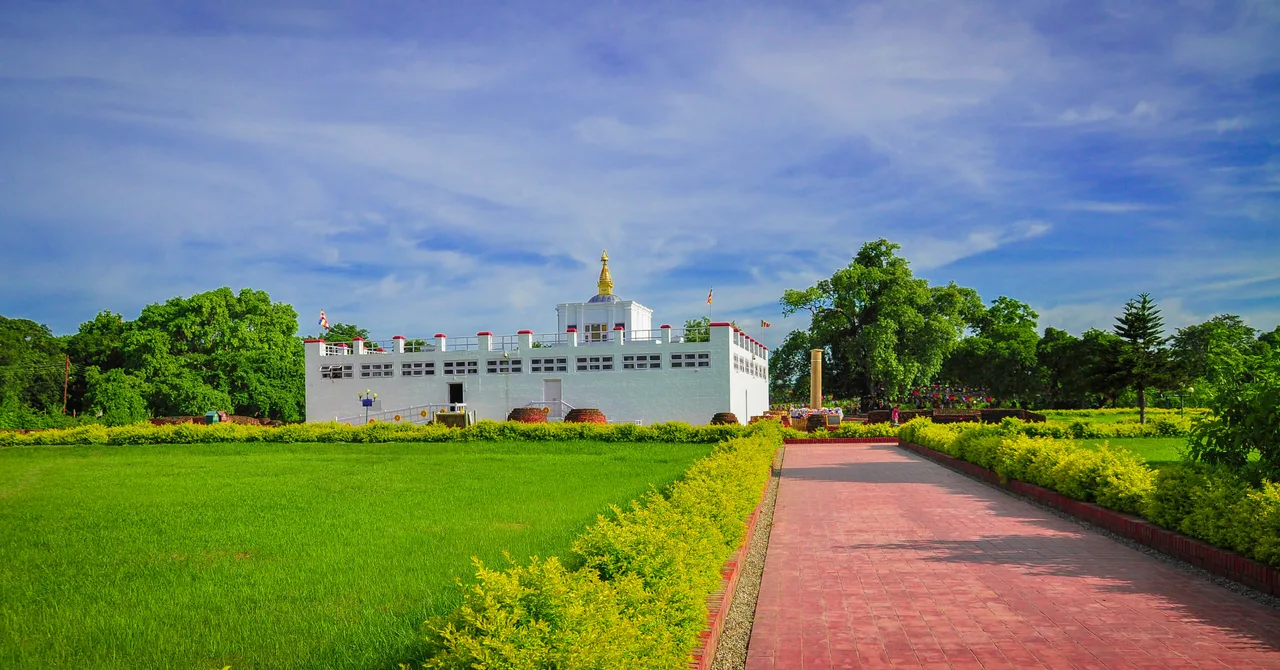
At the centre of the sacred garden stands the Maya Devi Temple, marking the precise traditional birth spot; within it, a marker stone identifies the exact location associated with the birth. A pivotal archaeological breakthrough came in 2011–2013, when a team led by Robin Coningham of Durham University, excavating beneath the temple's existing brick foundations with the permission of Nepal's Department of Archaeology, uncovered the remains of a previously unknown timber structure — an open-roofed shrine with a central void interpreted as having held a tree, consistent with the sal-tree birth narrative. Radiocarbon and optically stimulated luminescence dating placed this timber shrine at approximately the 6th century BCE, making it the oldest known Buddhist structure anywhere in the world and offering the first archaeological evidence broadly consistent with the traditional dating of the Buddha's life, a question long debated among historians on textual grounds alone.

Chinese Buddhist pilgrim monks Faxian (visiting around 403 CE) and Xuanzang (visiting around 636 CE) both recorded detailed descriptions of Lumbini in their travel accounts, providing valuable historical documentation of the site's continued status as an active pilgrimage destination across the centuries, along with descriptions of monuments — including the Ashoka Pillar itself, which Xuanzang recorded as having been struck by lightning and broken, matching its condition when rediscovered in 1896. After centuries of decline and jungle overgrowth following Xuanzang's era, the site was systematically identified, excavated, and progressively restored from the late 19th century onward, and was inscribed as a UNESCO World Heritage Site in 1997. A master plan by Japanese architect Kenzō Tange, adopted in 1978, established the modern Lumbini Development Zone surrounding the sacred garden, including a Monastic Zone where Buddhist nations have built temples reflecting their own national architectural traditions.

Why It Matters

Lumbini offers a rare convergence of textual tradition, royal inscription, and modern archaeological science all pointing toward the same conclusion about a event from the 6th century BCE — an unusually strong evidentiary basis for a figure whose historical existence, for much of the 19th and 20th centuries, some Western scholars treated with considerable skepticism. The Ashoka Pillar inscription in particular is among the earliest surviving pieces of physical evidence for any specific episode in the Buddha's life, predating by many centuries the earliest surviving written Buddhist texts. The 2011–2013 Durham University excavation demonstrated a rigorous method for investigating a living, actively venerated religious site without disturbing its ongoing sacred function — excavating carefully beneath and around, rather than through, the active temple, a model increasingly referenced in archaeology at other continuously used sacred sites worldwide. As the place of birth in a religious tradition followed by hundreds of millions of people across Asia and worldwide, Lumbini's continuous documented pilgrimage history — from Ashoka in the 3rd century BCE through Chinese monks in late antiquity to the international Buddhist monastic community building temples there today — offers an unusually long, continuously recorded thread connecting ancient archaeology directly to a living global religious practice.

Stay curious

New stories and sites, once a month. No spam.

Evidence & Interpretation

Distinguishing what is well-established from what remains debated.

Well-Established Facts

3
  • The Brahmi-script inscription on the Ashoka Pillar, rediscovered in 1896, explicitly identifies Lumbini as the Buddha's birthplace and records Ashoka's 249 BCE pilgrimage visit and tax exemption for the village.
  • Radiocarbon and optically stimulated luminescence dating of a timber shrine structure excavated beneath the Maya Devi Temple in 2011–2013 place it at approximately the 6th century BCE, the earliest known Buddhist structure identified anywhere.
  • The travel accounts of Chinese Buddhist pilgrims Faxian and Xuanzang, from the 5th and 7th centuries CE respectively, independently document Lumbini's monuments, including a physical description of the Ashoka Pillar that matches its condition upon rediscovery in 1896.

Scholarly Inferences

1
  • The precise identification of the marker stone within the Maya Devi Temple as the exact spot of birth is a matter of continuous religious tradition rather than independent archaeological confirmation of that specific point.

Debated Interpretations

1
  • The exact calendar date of the Buddha's birth remains debated among historians, with estimates varying by roughly a century depending on which textual and astronomical chronological traditions are followed; the 6th-century BCE timber shrine date is consistent with, but does not by itself resolve, this wider debate.

Discovery & Excavation

1896

Rediscovery of the Ashoka Pillar

Khadga Shumsher Rana and Alois Anton Führer rediscover and identify the inscribed Ashoka Pillar, confirming the site's identity as Lumbini.

1978

Kenzō Tange master plan

Adoption of the Japanese architect's master plan establishing the modern Lumbini Development Zone and international Monastic Zone.

2011–2013

Durham University excavation

Robin Coningham-led excavation beneath the Maya Devi Temple uncovers a 6th-century BCE timber shrine, the earliest known Buddhist structure.

More Photos

Museum Artifacts

Community Photos

Share your experience

Have you visited this site? Upload your photos to help others discover it.

Location

Sources

  • The Earliest Buddhist Shrine: Excavating the Birthplace of the Buddha, Lumbini, NepalConingham, Robin et al. (2013)
  • Si-Yu-Ki: Buddhist Records of the Western World (Xuanzang)Beal, Samuel (trans.) (1884)
  • UNESCO — Lumbini, the Birthplace of the Lord BuddhaLink

Research Papers

Frequently Asked Questions

Where is Lumbini located?

Lumbini is located in Rupandehi District, Lumbini Province, Nepal.

How old is Lumbini?

Lumbini dates to approximately 600 BCE – 630 CE.

Which civilizations are associated with Lumbini?

Lumbini is associated with the Vedic Indian, Mauryan.

Why is Lumbini important?

Lumbini offers a rare convergence of textual tradition, royal inscription, and modern archaeological science all pointing toward the same conclusion about a event from the 6th century BCE — an unusually strong evidentiary basis for a figure whose historical existence, for much of the 19th and 20th centuries, some Western scholars treated with considerable skepticism.

Is Lumbini a UNESCO World Heritage Site?

Yes — Lumbini is inscribed as a UNESCO World Heritage Site.